Zoning types in NSW investment properties are defined by Local Environmental Plans (LEPs), which are the primary statutory instruments under the Environmental Planning and Assessment Act 1979 (EP&A Act 1979) that determine what you can legally build or operate on any given parcel of land. The LEP divides land into zones and specifies permitted, prohibited, and consent-required development for each. For property investors and developers in NSW, understanding zoning classifications is not optional. It is the foundation of every feasibility assessment, development application, and acquisition decision you will make. Recent reforms including the Low and Mid-Rise Housing Policy and the Housing Delivery Authority (HDA) approval pathway have materially changed what is possible across R2, R3, and R4 residential zones.
Get a council-ready Statement of Environmental Effects for your DA in 5 minutes — no town planner, no waiting.
Get your SEE report →1. what are the main zoning types NSW investment properties rely on?
NSW councils must use a standard set of 35 government-approved zone types. They cannot create new zones outside this framework. For property investors, the residential zones R1 through R5 are the most relevant classifications, with R2, R3, and R4 carrying the greatest development potential and investment activity.
Here is a summary of the core residential zones you will encounter:
- R1 General Residential: A broad zone permitting a wide mix of housing types. Less common in established suburbs but used in growth areas.
- R2 Low Density Residential: The most common suburban zone in NSW. Traditionally limited to detached dwellings, but now permits dual occupancies statewide following 2024 reforms.
- R3 Medium Density Residential: Supports townhouses, duplexes, and residential flat buildings. Favoured by developers for its balance of yield and approval complexity.
- R4 High Density Residential: Permits apartment towers, shop-top housing, and mixed-use buildings. Concentrated near major transport nodes and town centres.
- R5 Large Lot Residential: Rural-residential land with significant restrictions on subdivision and secondary dwellings.
Each zone carries its own development standards, including height limits, floor space ratios, and setback requirements, all of which are set by the applicable LEP and Development Control Plan (DCP).
2. r2 low density residential: more flexible than it looks

R2 is the most common residential classification in suburban NSW. For years, it was synonymous with a single detached dwelling on a standard lot. That perception is now outdated.
Post-2024 reforms under the Low and Mid-Rise Housing Policy mean dual occupancies are permitted in all R2 zones statewide. Within 800 metres of nominated town centres and transport hubs, terraces, townhouses, and low-rise apartments are also now permissible. This change applies across metropolitan Sydney, the Central Coast, Illawarra-Shoalhaven, and the Lower Hunter regions.
For investors, R2 land near transport corridors has shifted from a single-dwelling holding to a genuine development opportunity. The key is confirming your specific site falls within the designated 800-metre catchment, which requires checking the NSW Planning Portal (planningportal.nsw.gov.au) and the applicable LEP map.
3. r3 medium density residential: the developer's sweet spot
Spend 5 minutes, not 3 weeks
instantSEE generates a complete, DA-ready Statement of Environmental Effects online. No town planner. No waiting.
Get your SEE report in 5 minutes →R3 supports townhouses, duplexes, and residential flat buildings, making it the preferred zone for small-to-medium developers seeking yield without the complexity of high-rise approvals. R3 land is typically located near established commercial precincts and public transport, which supports both rental demand and resale value.
The development economics of R3 are attractive. A standard R3 lot can often support three to six townhouses depending on site area, setbacks, and the applicable floor space ratio. That multiplier effect on a single land purchase is what draws experienced developers to this zone above all others.
R3 zoning also tends to attract less community opposition than R4 proposals, which can reduce approval timeframes. That said, you still need to comply with the LEP's development standards and prepare a compliant Statement of Environmental Effects (SEE) as part of your Development Application (DA).
4. r4 high density residential: proximity to transport is everything
R4 zoning permits the highest residential densities in NSW, including apartment buildings, mixed-use towers, and shop-top housing. R4 zones support higher density apartment buildings close to major transport nodes, which directly drives land values and development feasibility.
The financial upside of R4 is significant, but so is the complexity. Development applications in R4 zones typically require detailed traffic, acoustic, and shadow impact assessments. Height limits and floor space ratios vary considerably between councils, so you cannot assume what was approved in one R4 zone will be replicated in another.
R4 land commands a premium at acquisition. That premium is only justified if your development yield and sale or rental returns support the numbers. Always model your feasibility against the specific development standards of the applicable LEP before committing to purchase.
5. how recent NSW policy reforms change the opportunity set
The NSW Government's Low and Mid-Rise Housing Policy is the most significant shift in residential zoning flexibility in over a decade. The policy permits dual occupancies in all R2 zones statewide and allows terraces, townhouses, and low-rise apartments within 800 metres of nominated town centres and transport hubs.
Key changes investors need to understand:
- Dual occupancies are now permitted by right in all R2 zones across NSW, removing the previous council-by-council inconsistency.
- Terraces and townhouses are permissible within the 800-metre catchment zones without requiring rezoning.
- Low-rise apartment buildings (up to three storeys) are now permitted in designated areas, opening up R2 land that previously had no multi-dwelling pathway.
- The Housing Delivery Authority (HDA) provides a state-led approval pathway for large residential developments valued at $60 million or above in Greater Sydney, or $30 million or above in regional NSW, bypassing local council delays.
The HDA pathway is particularly relevant for developers working on large-scale projects where council approval timelines create financing risk. State-led approvals aim to deliver greater speed and consistency across the board.
Pro Tip: If your site sits within 800 metres of a train station or nominated town centre, check the Low and Mid-Rise Housing Policy mapping tool on the NSW Planning Portal before assuming your R2 land is limited to a single dwelling. The uplift in development potential can be substantial.
6. commercial, industrial, and environmental zones: what investors need to know
Not all investment property in NSW is residential. Commercial zones (B1 through B8 under older LEPs, now transitioning to E and MU designations under the Standard Instrument) permit retail, office, and mixed-use development. Industrial zones (IN1 and IN2) support warehousing, manufacturing, and light industry. Environmental zones (E1 through E4) impose strict restrictions and often prohibit most forms of development.
The table below summarises the key non-residential zones relevant to investors:
| Zone | Primary Use | Investment Consideration |
|---|---|---|
| B2 / E1 Local Centre | Retail, commercial, mixed-use | Shop-top housing permitted in many LEPs |
| B4 / MU1 Mixed Use | Residential and commercial combined | High flexibility, strong rental demand |
| IN1 General Industrial | Warehousing, manufacturing | Strong yields, limited development upside |
| IN2 Light Industrial | Light manufacturing, storage | Rezoning to mixed-use possible in some areas |
| E1 National Parks | Conservation | Development generally prohibited |
Planning overlays add another layer of complexity. Flood, bushfire, and heritage constraints can override base zoning to restrict or prohibit development even when the zone appears favourable. These overlays are not always visible on standard zoning maps. You must cross-reference multiple layers using the NSW Planning Spatial Viewer to identify constraints before committing capital.
Pro Tip: Relying solely on online zoning maps without consulting local council planning departments risks missing conflicting controls such as heritage or flood overlays. Always obtain a Section 10.7 planning certificate from the relevant council before exchange of contracts.
7. the legal weight of section 10.7 certificates
A Section 10.7 planning certificate is the only legally binding document from a council confirming the permissible use and development standards applicable to a specific property. Online zoning maps and the NSW Planning Spatial Viewer are advisory tools only. They do not carry legal weight.
Experienced developers obtain Section 10.7 certificates before purchase or before lodging a DA. The certificate discloses the zone, any applicable overlays, and any known planning proposals that may affect the site. It is the starting point for every serious feasibility assessment.
The certificate comes in two forms: a Section 10.7(2) certificate covering basic zoning information, and a Section 10.7(5) certificate that includes additional information about planning proposals and other matters affecting the land. For investment decisions, the Section 10.7(5) version gives you the most complete picture.
Rezoning is one of the most misunderstood concepts in NSW property investment. Rezoning land is a complex, costly, and lengthy process involving formal Planning Proposals, community consultation, and approvals from multiple levels of government. It should not be treated as a reliable short-term strategy.
Key points to understand before pursuing rezoning:
- A formal Planning Proposal must be submitted to the relevant council or the Department of Planning, Housing and Infrastructure.
- Community consultation is mandatory and can generate opposition that delays or defeats the proposal.
- Rezoning from R2 to R3 often generates significant land value uplift and attracts developer premiums, but the process can take years.
- Zoning is not static; councils review and amend zones regularly in response to population growth and housing supply targets, which creates both opportunity and risk for long-term holders.
- State-led rezonings under the HDA or strategic planning programmes can accelerate the process for large-scale projects, but individual site rezonings remain slow.
The practical advice is straightforward. Do not acquire land on the assumption that rezoning is achievable within your investment timeframe unless you have received formal pre-lodgement advice from the council or the Department of Planning, Housing and Infrastructure.
Key takeaways
Understanding NSW zoning classifications under the EP&A Act 1979 is the single most important step in assessing the legal and financial viability of any investment property in the state.
| Point | Details |
|---|---|
| R2 zones now permit dual occupancies | Post-2024 reforms allow dual occupancies statewide and multi-dwellings within 800m of transport hubs. |
| R3 and R4 offer the strongest development yields | R3 suits townhouse and duplex projects; R4 suits apartment development near major transport nodes. |
| Overlays can override favourable zoning | Always cross-check flood, heritage, and bushfire overlays via the NSW Planning Spatial Viewer before purchase. |
| Section 10.7 certificates are legally binding | Online maps are advisory only; obtain a Section 10.7 certificate from council before exchange of contracts. |
| Rezoning is a long-term strategy, not a quick win | Formal Planning Proposals require community consultation and multi-level government approval; plan accordingly. |
Why zoning knowledge is non-negotiable for NSW investors
The most common and costly mistake in NSW property investment is treating zoning as a background detail rather than a primary driver of value and risk. Zoning determines not just what you can build today, but what the land is worth to the next buyer and what your financing options look like at every stage of a project.
Investors often misunderstand that Development Control Plans (DCPs) serve as guides, but the LEP is the legally binding document determining land use and zoning compliance. That distinction matters enormously when a council refuses a DA on LEP grounds that a DCP review would not have flagged.
The 2026 policy environment in NSW is more dynamic than it has been in years. The Low and Mid-Rise Housing Policy, the HDA pathway, and ongoing LEP reviews mean that zoning classifications and their permitted uses are shifting. Investors who stay current with these changes will identify opportunities before the market prices them in. Those who rely on outdated assumptions will pay premiums for land that no longer delivers the development potential they expected.
Due diligence in NSW property investment means more than checking a zoning map. It means obtaining a Section 10.7 certificate, reviewing all applicable overlays, understanding the LEP development standards, and confirming your proposed development is permissible before you sign a contract.
Prepare your DA documentation with Instantsee
Once you have confirmed your zoning and development pathway, the next step is preparing a compliant Development Application. A Statement of Environmental Effects (SEE) is a mandatory document for most residential DAs in NSW under the EP&A Regulation 2021.
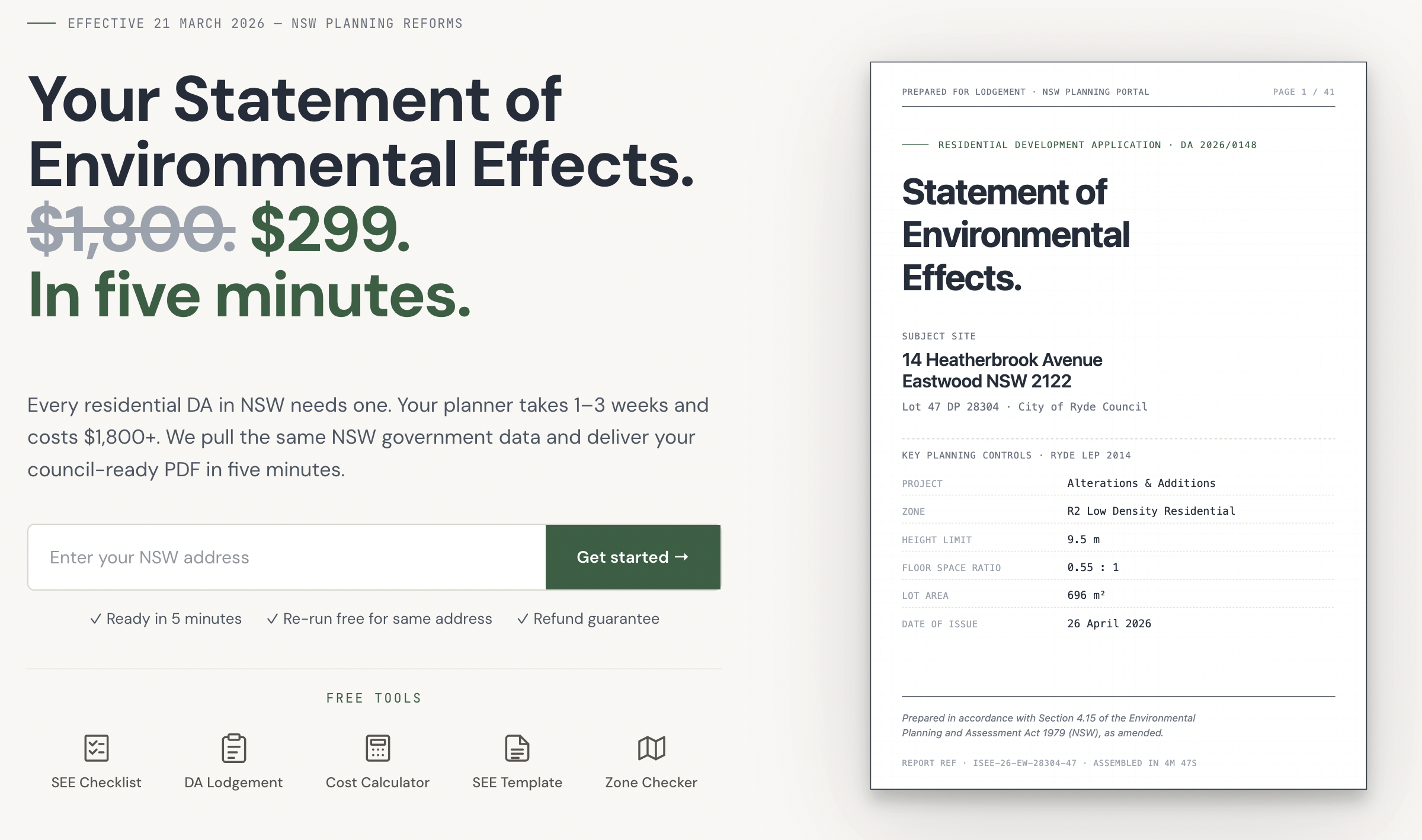
Traditional town planners charge $800–$2,500 for an SEE and take 1–3 weeks to deliver it. instantSEE generates a council-ready SEE for residential DAs in NSW in 5 minutes. The service draws data directly from NSW government sources to address the zoning and planning controls applicable to your specific site. If you want to understand exactly what your SEE must cover, the SEE requirements checklist on the instantSEE website sets out every mandatory element. For a full list of DA documents required at lodgement on the NSW Planning Portal (planningportal.nsw.gov.au), the DA lodgement checklist is a practical starting point.
Recommended
Frequently asked questions
What is the difference between r2, r3, and r4 zoning in NSW?
Does the low and mid-rise housing policy apply everywhere in NSW?
What is a section 10.7 certificate and why do i need one?
How long does rezoning take in NSW?
What is the HDA approval pathway?
Ready to get your SEE report?
Skip the writing. Get a DA-ready Statement of Environmental Effects in 5 minutes.
Get your SEE report