A secondary dwelling in New South Wales is defined as a self-contained, ancillary residence on the same lot as a principal dwelling, regulated under the State Environmental Planning Policy (Housing) 2021 (Housing SEPP). Understanding what is secondary dwelling NSW rules means knowing the precise size limits, zoning permissions, and approval pathways that determine whether your project proceeds quickly or stalls at council. The rules are prescriptive by design. Get them right from the start and you avoid costly redesigns, approval delays, and compliance failures that affect both homeowners and property developers across NSW.
Get a council-ready Statement of Environmental Effects for your DA in 5 minutes — no town planner, no waiting.
Get your SEE report →What are the main regulatory requirements for secondary dwellings in NSW?
Secondary dwelling guidelines NSW set hard limits on size, height, setbacks, and lot dimensions. These are not negotiable under the Complying Development Certificate (CDC) pathway. Every standard must be met in full.
The core development standards under the Housing SEPP are:
- Maximum floor area: 60m² or 25% of the principal dwelling's floor area, whichever is the lesser. This cap applies regardless of how large your block is.
- Minimum lot size: 450m² to qualify for the CDC fast-track pathway. Lots below this threshold must proceed via a Development Application (DA).
- Maximum height: 8.5m to the topmost point of the structure.
- Rear setback: Minimum 3m from the rear boundary.
- Side setbacks: 0.9m for single-storey structures and 1.5m for two-storey structures.
- Front setback: The secondary dwelling must sit behind the main building line of the principal dwelling.
- One per lot: Only one secondary dwelling is permitted per lot, and it cannot be subdivided or sold separately.
Beyond these measurements, your design must also satisfy BASIX (Building Sustainability Index) requirements for energy and water efficiency. Landscaped area minimums and private open space provisions may apply depending on your council's Development Control Plan (DCP). Car parking is typically required at one space per secondary dwelling.
Pro Tip: Check your council's DCP before finalising your design. Some councils impose additional controls on secondary dwellings beyond the Housing SEPP minimums, particularly around landscaping ratios and private open space dimensions.
CDC vs DA: which approval pathway applies to your project?
The two approval pathways for secondary dwellings in NSW are the Complying Development Certificate (CDC) and the Development Application (DA). They differ significantly in cost, timeframe, and flexibility.
| Feature | CDC | DA |
|---|---|---|
| Timeframe | 10–20 business days | 40–90 business days |
| Typical cost | $800–$2,500 | $5,000–$10,000 |
| Assessed by | Private certifier | Local council |
| Flexibility | None. All standards must be met exactly. | Greater flexibility for constrained sites |
| Neighbour notification | Not required | Required in most cases |
| Site constraints allowed | No flood, heritage, or bushfire-prone areas | Available for constrained sites |
The CDC pathway is the preferred route for most standard residential lots. Most standard builds on unconstrained residential lots qualify for CDC, making it the fastest and most cost-effective option. A private certifier assesses compliance against the prescriptive standards and issues the certificate without council involvement.
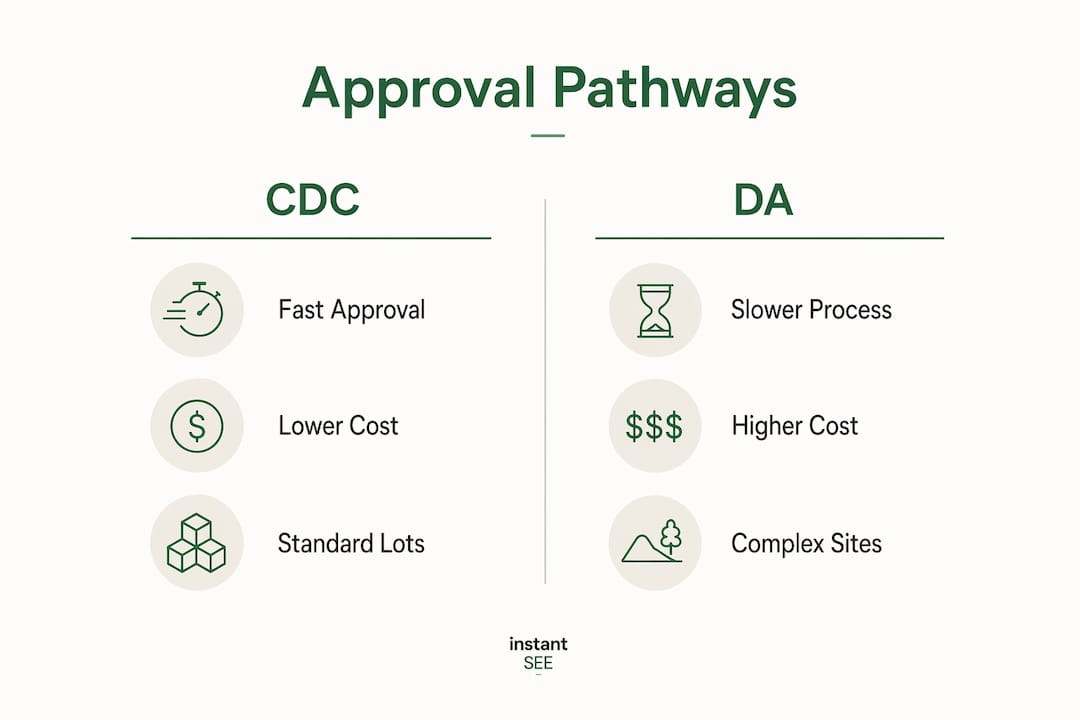
The DA pathway is slower and more expensive, but it is the only option when your site or design falls outside CDC eligibility. This includes properties in flood zones, heritage conservation areas, or bushfire-prone land with a Bushfire Attack Level (BAL) rating of BAL-40 or above. It also applies when your lot is under 450m², your design exceeds any prescribed measurement, or your council's LEP imposes additional controls.
One critical point: failing any single CDC standard forces the entire application onto the DA pathway. A rear setback that is 10 centimetres short, or a lot that measures 448m² instead of 450m², is enough to disqualify CDC approval entirely. The DA pathway then adds months and significantly higher costs to your project.
Pro Tip: Commission a registered surveyor to confirm your lot dimensions and boundary setbacks before lodging any application. Relying on title documents alone has caught many applicants out.
Which zones in NSW permit secondary dwellings?
Spend 5 minutes, not 3 weeks
instantSEE generates a complete, DA-ready Statement of Environmental Effects online. No town planner. No waiting.
Get your SEE report in 5 minutes →NSW secondary dwelling laws specify which residential zones permit secondary dwellings as either exempt or complying development. The permitted zones under the Housing SEPP are:
- R1 General Residential
- R2 Low Density Residential
- R3 Medium Density Residential
- RU5 Village
Secondary dwellings are generally not permitted in R5 Large Lot Residential zones under the standard Housing SEPP provisions. Parts of R4 High Density Residential may also exclude them depending on the applicable LEP. Always confirm zone permissions with your council or through the NSW Planning Portal (planningportal.nsw.gov.au).
Secondary dwellings cannot be subdivided or issued a separate Torrens title. This means you cannot sell the secondary dwelling independently from the principal dwelling. The two structures must remain on the same lot under the same ownership. This restriction also applies to strata and community title schemes, where the rules of the scheme may impose further limitations on construction and use.
Local Environmental Plans (LEPs) can modify or supplement the Housing SEPP provisions. Some councils have adopted DCPs that restrict secondary dwelling height, bulk, or character to align with neighbourhood design objectives. Checking both the LEP and the DCP for your specific council area is a mandatory step before committing to a design.
How to build a secondary dwelling in NSW: practical steps
Following a clear process reduces the risk of delays, redesigns, and unexpected costs. The steps below apply whether you are pursuing a CDC or DA pathway.
-
Confirm site eligibility. Check your zoning, lot size, and any site constraints including flood, bushfire, and heritage overlays. Use the NSW Planning Portal (planningportal.nsw.gov.au) to access zoning maps and overlay information.
-
Review your council's DCP. Download the relevant DCP from your council's website and identify any controls that apply to secondary dwellings beyond the Housing SEPP minimums.
-
Engage a designer or architect. Prepare concept plans that comply with all applicable development standards. Confirm BASIX requirements early, as they affect window placement, insulation, and hot water systems.
-
Assess the approval pathway. Determine whether your project qualifies for CDC or requires a DA. Site constraints like bushfire BAL-40+ or heritage listings are common hidden issues that disqualify CDC approval and require thorough early assessment.
-
Engage a private certifier (CDC) or prepare a DA. For CDC, a registered private certifier assesses your plans against the prescriptive standards. For a DA, you will need to prepare a full application including a Statement of Environmental Effects (SEE), site analysis, and supporting reports.
-
Lodge your application. All DAs in NSW are lodged through the NSW Planning Portal (planningportal.nsw.gov.au) under the Environmental Planning and Assessment Act 1979 (EP&A Act) and the Environmental Planning and Assessment Regulation 2021 (EP&A Regulation 2021).
-
Respond to any requests for information. Councils may issue requests for additional information during DA assessment. Respond promptly with accurate documentation to avoid further delays.
Pro Tip: Prepare your Statement of Environmental Effects before lodging a DA. This document explains how your proposal addresses the relevant planning controls and is a mandatory part of the DA package under the EP&A Regulation 2021.
Key takeaways
Secondary dwellings in NSW are governed by the Housing SEPP 2021, with the CDC pathway offering the fastest approval for compliant, unconstrained residential lots.
| Point | Details |
|---|---|
| Core size limit | Secondary dwellings are capped at 60m² or 25% of the principal dwelling's floor area. |
| CDC eligibility | Lots must be at least 450m² and free of flood, heritage, or bushfire constraints to qualify. |
| Zoning permissions | Secondary dwellings are permitted in R1, R2, R3, and RU5 zones under the Housing SEPP. |
| No separate title | Secondary dwellings cannot be subdivided or sold separately from the principal dwelling. |
| Approval timeframes | CDC takes 10–20 business days; DA takes 40–90 business days and costs significantly more. |
The case for early assessment over late corrections
The most common and costly mistake in secondary dwelling projects is treating the site assessment as a formality rather than the foundation of the entire approval strategy. Many applicants invest in detailed architectural plans before confirming whether their lot qualifies for CDC. When a constraint is discovered after design is complete, the redesign cost and timeline impact can exceed the original savings from choosing CDC over DA.
NSW is unusual among Australian states in that there is no owner-occupier requirement for secondary dwellings. You do not need to live on the property to build one, and you can rent the secondary dwelling separately from the main house. This makes secondary dwellings a genuine investment vehicle, not just a family accommodation option. That distinction changes how developers should approach site selection and financial modelling.
The CDC pathway is fast and cost-effective, but it offers zero flexibility. Any deviation from the prescribed standards, no matter how minor, removes CDC eligibility entirely. Developers who treat the CDC standards as approximate targets rather than hard limits consistently end up on the DA pathway with a more expensive and time-consuming process ahead of them.
The practical advice is straightforward: commission a full site constraint check before engaging a designer, confirm your lot dimensions with a registered surveyor, and review both the Housing SEPP and your council's DCP before finalising any plans. The time spent on early due diligence is always less than the time lost correcting a non-compliant design.
Prepare your DA documentation with Instantsee
If your secondary dwelling project requires a Development Application, the Statement of Environmental Effects is one of the most time-consuming documents to prepare correctly.
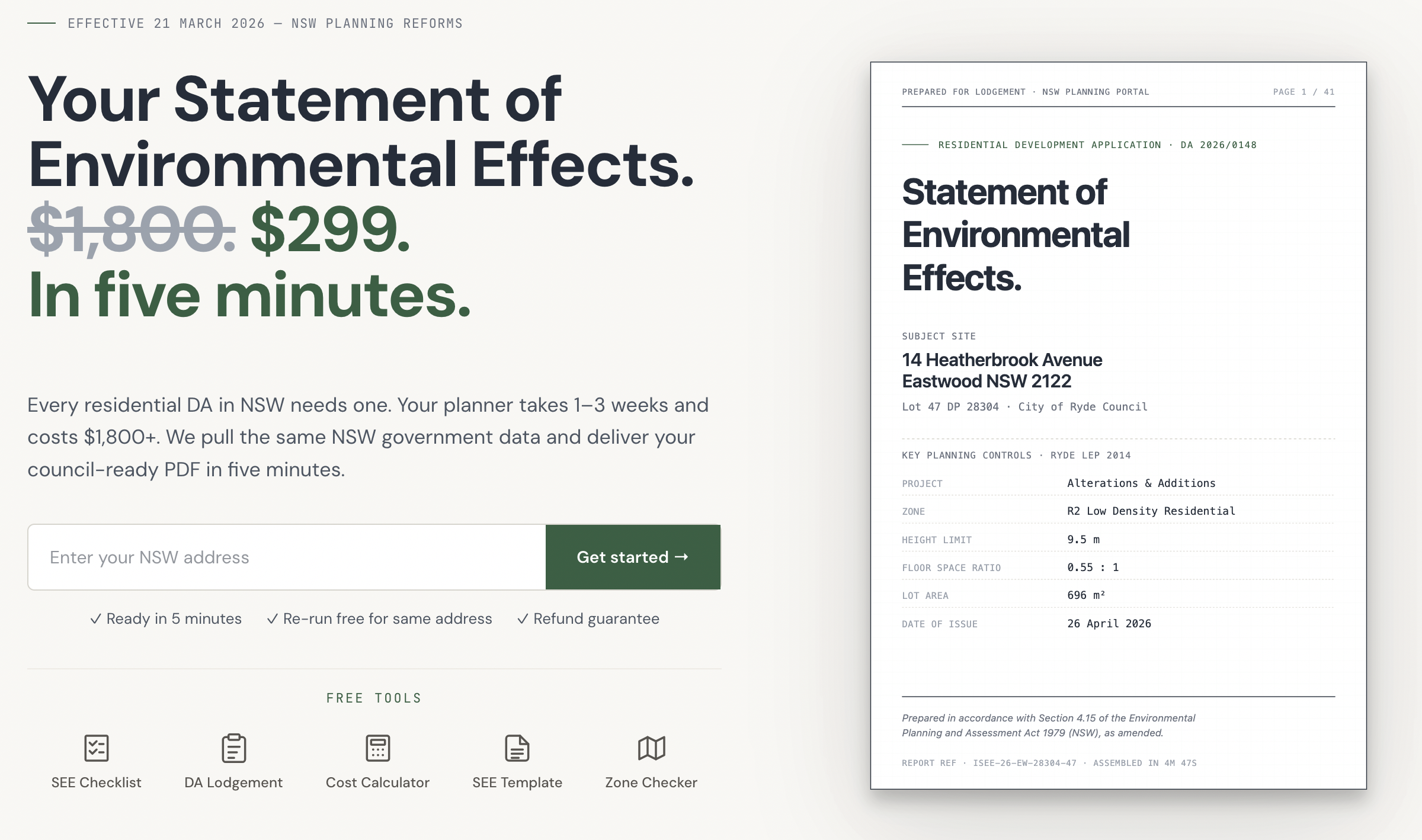
instantSEE generates a council-ready SEE for residential DAs in NSW in 5 minutes. Traditional town planners charge $800–$2,500 and take 1–3 weeks for the same document. instantSEE automates data collection from NSW government sources and produces a PDF report that addresses the relevant planning controls under the EP&A Act 1979 and the Housing SEPP 2021. For homeowners and small developers lodging a DA for a secondary dwelling, it removes one of the most significant bottlenecks in the approval process. You can also review the SEE requirements checklist to confirm your documentation is complete before lodging through the NSW Planning Portal.
Recommended
Frequently asked questions
What is a secondary dwelling under NSW planning law?
What is the maximum size for a secondary dwelling in NSW?
Can i rent out a secondary dwelling in NSW?
What happens if my site does not qualify for CDC approval?
Do i need a statement of environmental effects for a secondary dwelling DA?
Ready to get your SEE report?
Skip the writing. Get a DA-ready Statement of Environmental Effects in 5 minutes.
Get your SEE report