A development application (DA) in NSW is a formal request for development consent under the Environmental Planning and Assessment Act 1979 (EP&A Act 1979), submitted to your local council when your proposed development does not qualify as exempt or complying development. The DA is the primary planning approval mechanism in New South Wales, and without it, certain building and land use projects cannot legally proceed. Understanding what a DA requires, which documents to prepare, and how the NSW Planning Portal (planningportal.nsw.gov.au) fits into the process is the foundation of any successful development project.
Get a council-ready Statement of Environmental Effects for your DA in 5 minutes — no town planner, no waiting.
Get your SEE report →What is a development application in NSW?
A development application in NSW is a statutory application lodged with a local council seeking consent to carry out development that requires council approval under the EP&A Act 1979. Not every building project needs one. NSW planning law creates three distinct pathways: exempt development, complying development, and development requiring a DA.
Exempt development covers minor works, such as small garden sheds or internal renovations, that meet prescribed standards and need no approval at all. Complying development covers a broader range of works, such as single-storey additions, that meet specific development standards and can be approved quickly through a private certifier or council via a Complying Development Certificate (CDC). A DA is required for everything else: any proposal that does not fit neatly into those two categories.

The EP&A Act 1979 and the EP&A Regulation 2021 set the legal framework for DAs. Your local council's Local Environmental Plan (LEP) and Development Control Plan (DCP) then apply site-specific rules around zoning, height, setbacks, and land use. These documents determine whether your project needs a DA and what conditions it must satisfy.
What developments require a DA in NSW?
Development consent is mandatory for any proposal that is not exempt or complying development under the applicable planning controls. The following types of development commonly require a DA:
- New dwellings on land where complying development standards are not met
- Dual occupancies and secondary dwellings that exceed CDC thresholds
- Demolition of heritage-listed or significant structures
- Change of use for commercial or industrial premises
- Subdivisions that create new lots
- Developments in sensitive zones, such as flood-prone land, bushfire-prone land, or heritage conservation areas
- Larger residential additions that exceed complying development height or floor area limits
Your council's LEP is the starting point for determining which pathway applies to your site. Zoning is the critical variable. A project that qualifies as complying development in one zone may require a full DA in another.
Pro Tip: Before preparing any documents, contact your local council's duty planner for a pre-application discussion. Many councils offer this service at no cost, and it can identify potential issues before you invest in detailed plans or reports.
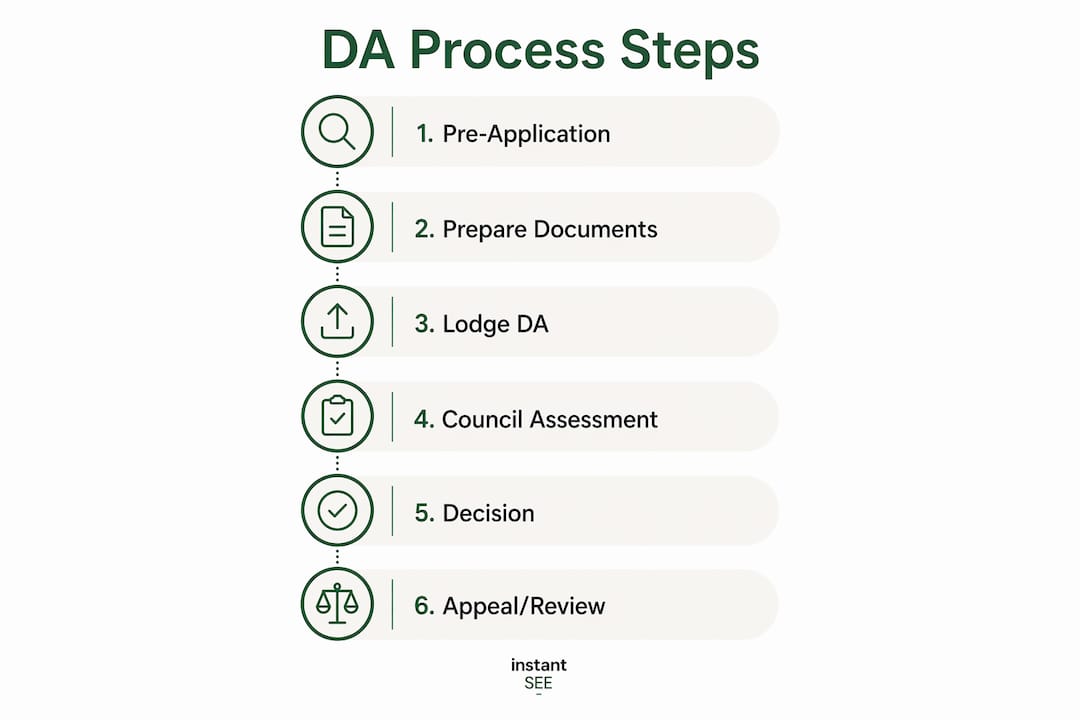
How to lodge a development application via the NSW planning portal
Spend 5 minutes, not 3 weeks
instantSEE generates a complete, DA-ready Statement of Environmental Effects online. No town planner. No waiting.
Get your SEE report in 5 minutes →All DAs in NSW must be lodged online through the NSW Planning Portal (planningportal.nsw.gov.au). Service NSW confirms that applicants upload key documents and pay fees during submission. The portal then triggers the formal assessment workflow and allows you to track your DA status and respond to council requests throughout the process.
Follow these steps to prepare and lodge your DA:
- Confirm your development pathway. Verify with your council or a town planner that a DA is the correct pathway for your project, not a CDC.
- Engage a designer or architect. Prepare architectural plans that comply with your council's DCP, including site plans, floor plans, and elevations.
- Prepare a Statement of Environmental Effects (SEE). The SEE is a mandatory planning document that addresses the environmental and social impacts of your proposal. It is the written argument that explains why your development should be approved.
- Gather supporting reports. Depending on your site, you may need a BASIX Certificate, a Bushfire Assessment Report, a Flood Study, a Heritage Impact Statement, or a Traffic Impact Assessment.
- Obtain owner's consent. If you are not the registered owner of the land, you must include a signed owner's consent form.
- Prepare a cost estimate report. This is used to calculate your council's application fee.
- Create an account on the NSW Planning Portal. Log in at planningportal.nsw.gov.au and start a new DA application.
- Upload all documents and pay the lodgement fee. Fees are calculated based on the estimated cost of works and vary by council.
- Track your application. Once lodged, the portal manages the full DA lifecycle, including council requests for additional information.
Pro Tip: A complete application at lodgement is the single most effective way to avoid delays. Councils perform an initial completeness check, and missing documents can stall your assessment before it even begins. Use a DA lodgement checklist to verify every document before you submit.
What happens after you lodge a DA?
After lodgement, your council follows a structured assessment process under the EP&A Act 1979. The timeline varies by council and project complexity, but the core steps are consistent across NSW.
Inner West Council's DA process illustrates the standard workflow:
- Completeness check. Council reviews the application to confirm all required documents are present. If anything is missing, you will receive a formal request for additional information.
- Public notification. For developments that may affect neighbours, council places the DA on public exhibition. Adjoining owners and the broader community can lodge written submissions during this period.
- Assessment. A council planner assesses the DA against the EP&A Act 1979, the LEP, the DCP, and any relevant State Environmental Planning Policies (SEPPs). Submissions received during notification are considered as part of this assessment.
- Peer review. Council peer review of DA recommendations promotes transparency and consistency in decision-making.
- Determination. Council issues a Notice of Determination with one of three outcomes.
| Determination Outcome | Meaning | Next Step |
|---|---|---|
| Approved (Consent Granted) | Development may proceed subject to conditions | Apply for a Construction Certificate before building |
| Deferred Commencement Consent | Consent is granted but cannot operate until specific conditions are satisfied | Satisfy pre-conditions, then activate consent |
| Refused | Council has declined the application | Review reasons, amend proposal, and re-lodge or appeal to the Land and Environment Court |
Once you receive a Notice of Determination granting consent, you hold development consent under the EP&A Act 1979. This is a legal authorisation to carry out the development, but it does not permit construction to begin. That requires a separate approval.
DA approval vs construction certificate: what is the difference?
DA approval and a Construction Certificate (CC) are two distinct approvals that serve different purposes under NSW planning law. Confusing them is one of the most common and costly mistakes applicants make.
The DA establishes that your proposed development is acceptable in planning terms. It addresses land use, visual impact, neighbourhood character, and compliance with planning controls. Municipal assessment focuses on planning law compliance, not building standards. The DA does not assess whether your building is structurally sound or compliant with the National Construction Code (NCC).
The Construction Certificate fills that gap. It is issued by a council or a private certifier and confirms that your construction plans comply with the NCC and any conditions of your DA consent. Construction cannot commence until the CC is granted, even if your DA has been approved.
Key points to understand about the relationship between a DA and a CC:
- A DA can be approved before a CC is applied for, or both can be prepared in parallel to save time.
- Your CC application must be consistent with the approved DA plans. Changes made after DA approval may require a modification application under Section 4.55 of the EP&A Act 1979.
- A Principal Certifier must be appointed before construction begins. This person oversees compliance inspections during the build.
- Occupation of a completed building requires a further approval: an Occupation Certificate (OC).
Pro Tip: Engage your certifier early, ideally during the DA preparation stage. Aligning your construction drawings with DA plans from the outset avoids costly redesigns after consent is granted.
The planning pathway in NSW is therefore sequential: DA consent, then CC, then construction, then OC. Each stage has its own documentation requirements and approval body.
Key takeaways
A development application in NSW is the formal planning consent mechanism under the EP&A Act 1979, and lodging one correctly through the NSW Planning Portal with complete documentation is the most direct path to approval.
| Point | Details |
|---|---|
| DA defined by law | A DA is a formal request for development consent under the EP&A Act 1979, required when exempt or complying development pathways do not apply. |
| Documents determine outcomes | A complete application including a Statement of Environmental Effects, owner's consent, and supporting reports avoids assessment delays. |
| Portal is mandatory | All NSW DAs must be lodged via the NSW Planning Portal (planningportal.nsw.gov.au), which manages the full assessment lifecycle. |
| DA and CC are separate approvals | DA consent authorises the development in planning terms; a Construction Certificate is required separately before any building work begins. |
| Determination has three outcomes | Council may approve, defer, or refuse a DA. Refusal can be appealed to the NSW Land and Environment Court. |
The document that decides most das
The Statement of Environmental Effects is the most underestimated document in the DA process. Most applicants focus on architectural plans and assume the SEE is a formality. It is not. The SEE is the written case for your development. It explains how your proposal addresses the relevant planning controls, manages environmental impacts, and responds to the objectives of the zone. A weak or incomplete SEE is one of the most common reasons councils request additional information, which stalls assessment and adds weeks to the timeline.
Councils are not required to approve a DA simply because the plans look good. The assessment officer must be satisfied that the proposal is consistent with the EP&A Act 1979, the LEP, and the DCP. The SEE is the document that makes that argument. If it does not address the right criteria, the assessment cannot proceed. Applicants who treat the SEE as a box-ticking exercise often find themselves responding to council requests for information that a well-prepared SEE would have addressed upfront.
The practical implication is clear. Investing time and care in the SEE at the preparation stage is more efficient than addressing council queries after lodgement. A compliant SEE that directly addresses the relevant planning controls gives your DA the strongest possible foundation from day one.
How Instantsee simplifies your NSW DA
Preparing a Statement of Environmental Effects has traditionally required engaging a town planner, at a cost of $800–$2,500 and a wait of 1–3 weeks. instantSEE changes that equation for NSW residential DA applicants.
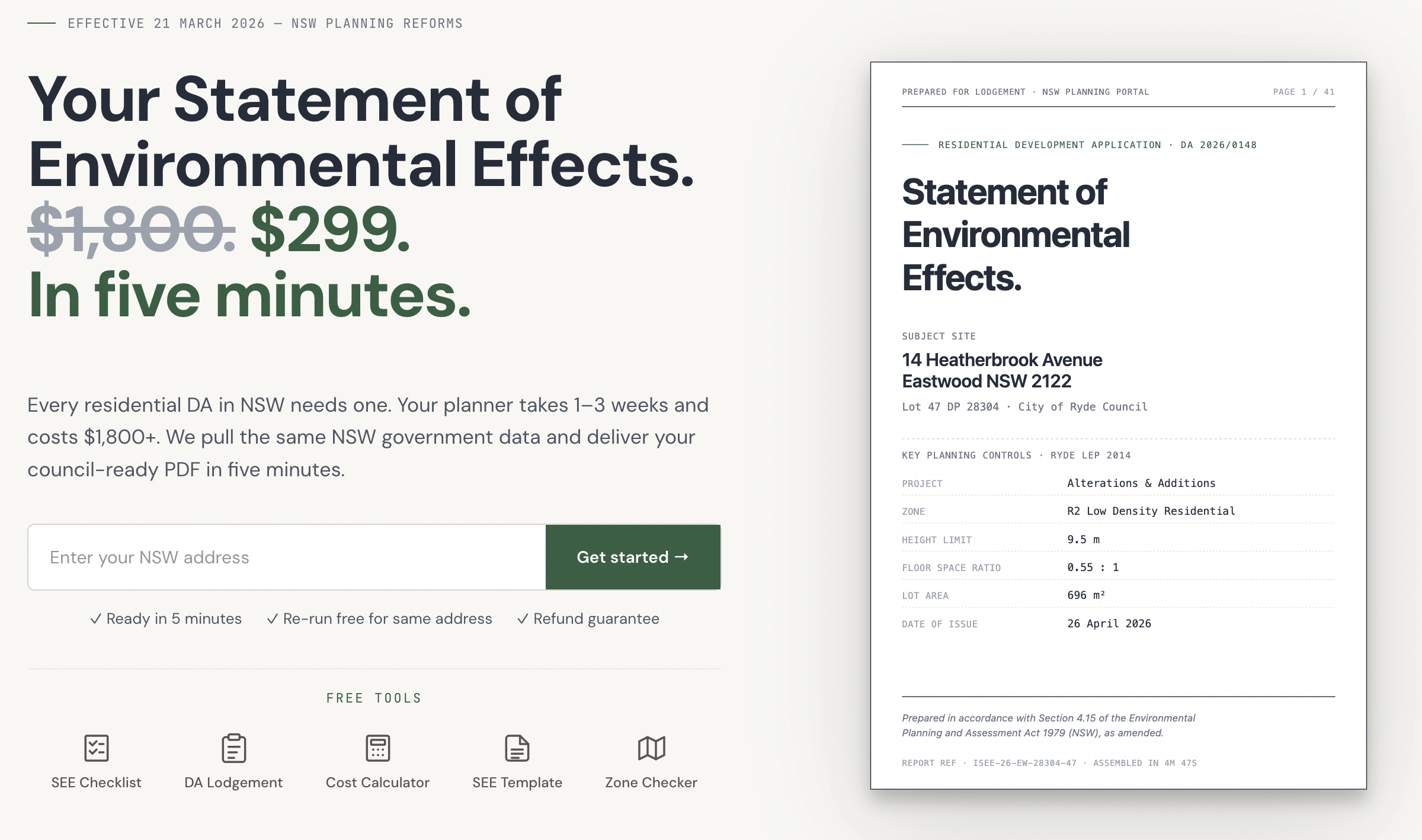
instantSEE generates a council-ready SEE for residential DAs in NSW in 5 minutes. The service draws on NSW government data sources to perform compliance checks and produce a PDF report formatted to meet council requirements. For homeowners and small developers lodging a DA through the NSW Planning Portal (planningportal.nsw.gov.au), it removes one of the most time-consuming and expensive steps in the process. Review the SEE requirements checklist to understand exactly what your statement must cover, or go directly to instantSEE to generate your document today.
Recommended
Frequently asked questions
What is a DA in NSW?
What documents are needed for a NSW development application?
How long does a development application take in NSW?
Can i lodge a development application without a town planner?
What is the difference between a DA and a construction certificate?
Ready to get your SEE report?
Skip the writing. Get a DA-ready Statement of Environmental Effects in 5 minutes.
Get your SEE report