The NSW development standards list is defined as the collection of planning instruments, codes, and regulatory provisions that prescribe the criteria a development must meet to receive approval in New South Wales. The core instruments include the State Environmental Planning Policy (Exempt and Complying Development Codes) 2008 (Codes SEPP), the Pattern Book Development Code 2025, and Clause 4.6 of the Standard Instrument Local Environmental Plan (LEP), which governs permissible variations. Recent reforms under the Building (Approvals and Practitioners) Bill 2026 and the mandatory variations register on the NSW Planning Portal (planningportal.nsw.gov.au) have added new layers of accountability and transparency that every developer, architect, and planning consultant must understand before lodging a development application (DA).
Get a council-ready Statement of Environmental Effects for your DA in 5 minutes — no town planner, no waiting.
Get your SEE report →1. What are NSW development standards?
NSW development standards are the measurable, prescriptive requirements set by planning instruments under the Environmental Planning and Assessment Act 1979 (EP&A Act 1979). They cover matters such as floor space ratio, building height, setbacks, lot size, and landscaped area. Each standard is tied to a specific zone or land use category defined in a Local Environmental Plan or State Environmental Planning Policy (SEPP).
The term "development standards" has a precise legal meaning under the EP&A Act 1979. A standard is only a development standard if the relevant instrument expressly states that it is one. This distinction matters because only formally designated standards can be varied under Clause 4.6. Generic design guidelines or council policies do not carry the same legal weight.

For practical purposes, the NSW development standards list that most developers encounter falls into three tiers: exempt development (no approval needed), complying development (fast-track certificate), and merit-assessed development (full DA). Understanding which tier applies to your project is the single most consequential decision in the approvals process.
2. Codes SEPP 2008: the foundation of fast-track approvals
The State Environmental Planning Policy (Exempt and Complying Development Codes) 2008 is the primary instrument governing fast-track approvals across New South Wales. It sets out the development standards guidelines that determine whether a project qualifies as exempt or complying development, removing the need for a full council DA in many residential and commercial scenarios.
Complying development under the Codes SEPP covers a broad range of project types, including:
- Single dwellings and alterations on standard residential lots
- Secondary dwellings (granny flats) on lots meeting minimum size requirements
- Demolition of structures below prescribed thresholds
- Commercial fit-outs and changes of use in business zones
- Subdivision of land meeting minimum lot size standards
Standard complying development approvals must be determined within 20 days. This is a statutory obligation, not a target. If your project meets every prescribed standard, the certifier has no discretion to refuse or delay beyond that window.
Pro Tip: Check the Codes SEPP eligibility criteria before engaging a certifier. If your site has a heritage overlay, flood planning level constraint, or is within a foreshore area, the Codes SEPP pathway may be excluded entirely, regardless of how well the design meets the numerical standards.
The all-or-nothing nature of complying development is its most significant limitation. Minor variations to complying development currently trigger a full DA process, adding over 60 days on average to approval timelines. This is a major cost and schedule risk for developers who discover a non-compliance late in the design phase.
3. Pattern Book Development Code 2025: faster approvals for standardised designs
Spend 5 minutes, not 3 weeks
instantSEE generates a complete, DA-ready Statement of Environmental Effects online. No town planner. No waiting.
Get your SEE report in 5 minutes →The Pattern Book Development Code 2025 is the most significant addition to the NSW development standards list in recent years. It enables 10-day approvals for projects using pre-approved architectural designs from the NSW Government's pattern book catalogue, compared to the standard 20-day complying development timeline.
The speed advantage is real, but it comes with a specific procedural requirement. Neighbour notification must be completed 7 days before the certificate is issued. This notification period runs concurrently with the assessment, so the 10-day clock does not restart after neighbours are notified. Coordinating this step early is critical to achieving the faster timeline.
Pattern book designs are pre-assessed against NSW building regulations and zoning requirements, which removes much of the technical risk from the certifier's assessment. For developers building multiple dwellings across different sites, the pattern book approach offers a repeatable, low-risk approval pathway that reduces both professional fees and programme uncertainty.
The Pattern Book Development Code applies to residential flat buildings and dual occupancies on eligible lots. Not every zone or lot configuration qualifies. Checking eligibility against New South Wales zoning laws at the outset avoids wasted design investment.
4. Clause 4.6 variations: flexibility within the standards framework
Clause 4.6 of the Standard Instrument LEP is the formal mechanism that allows a consent authority to approve a development that does not strictly comply with a development standard. It is not a loophole. It is a structured, evidence-based process requiring the applicant to demonstrate that compliance is unreasonable or unnecessary in the circumstances.
The process for a Clause 4.6 variation involves four key steps:
- Identify the specific development standard that cannot be met and confirm it is formally designated as such under the relevant LEP.
- Prepare a written request demonstrating that compliance is unreasonable or unnecessary, supported by planning merit arguments.
- Obtain the concurrence of the Secretary of the Department of Planning, Housing and Infrastructure (or rely on a standing concurrence direction where applicable).
- Submit the variation request as part of the DA, with the consent authority recording the decision on the public register.
Since November 2023, all variations to development standards must be recorded in a mandatory public register on the NSW Planning Portal. This requirement applies to all consent authorities, including councils and the Sydney Planning Panels. The register records the standard varied, the extent of variation, and the reasons given by the consent authority.
The variations register gives communities and practitioners public access to all variation requests and council reasons, improving transparency across the planning system. For consultants, it is also a practical research tool. Reviewing past variations for a specific standard or council area reveals what arguments have succeeded and what extent of departure has been accepted.
| Feature | Detail |
|---|---|
| Instrument | Clause 4.6, Standard Instrument LEP |
| Trigger | Development standard cannot be strictly met |
| Key test | Compliance is unreasonable or unnecessary |
| Register mandatory since | 1 November 2023 |
| Register location | NSW Planning Portal (planningportal.nsw.gov.au) |
5. Building certifier reforms under the 2026 bill
The Building (Approvals and Practitioners) Bill 2026 introduces the most significant changes to certifier accountability in NSW planning requirements since the introduction of private certification. The reforms directly affect how development standards compliance is verified and enforced at the certificate stage.
The headline change is the increase in maximum court-imposed penalties for certifier breaches. Maximum penalties rise from $33,000 to $1.1 million. This is not a marginal adjustment. It signals that the NSW Government treats certifier non-compliance as a serious regulatory matter, not an administrative oversight.
Key obligations introduced or clarified by the 2026 reforms include:
- Certifiers are formally recognised as public officials, separating their duty to the public from any commercial relationship with the developer or builder
- Mandatory compliance declarations are required for regulated buildings, particularly Class 2, 3, and 9c structures under the National Construction Code
- Certifiers must register and declare compliance explicitly, with no certificate issued without proper regulated design compliance declarations
- Building Commission NSW is expanding proactive compliance audits across the sector
"Certifiers' professional accountability is increasingly emphasised to prevent conflicts of interest and maintain public trust in the planning and building system."
Pro Tip: For Class 2, 3, and 9c buildings, coordinate with your designer and certifier before design development is complete. Certifiers cannot issue certificates without regulated design compliance declarations, and resolving gaps at documentation stage is far less costly than at construction.
6. Comparing the major NSW development standards frameworks
Understanding which framework applies to your project is not always straightforward. The Codes SEPP, Pattern Book Development Code, and Clause 4.6 variation pathway each serve different scenarios and carry different risk profiles.
| Framework | Approval timeline | Flexibility | Best suited for |
|---|---|---|---|
| Codes SEPP 2008 | 20 days | Low (all-or-nothing) | Standard residential and commercial projects meeting all prescribed standards |
| Pattern Book Development Code 2025 | 10 days | Low (pre-approved designs only) | Developers using pre-approved designs seeking fastest possible approval |
| Clause 4.6 variation (via full DA) | 60+ days | High (merit-based) | Projects with genuine site constraints preventing strict compliance |
| Full DA (no variation) | 40 to 120+ days | High | Complex or non-standard developments requiring merit assessment |
The Codes SEPP pathway carries the lowest risk when your project genuinely meets all standards. The Pattern Book Development Code offers the fastest timeline but restricts design freedom. Clause 4.6 provides flexibility but adds time, cost, and uncertainty. Choosing the wrong pathway at the outset is one of the most common and costly mistakes in NSW development assessment.
7. Practical tips for complying with NSW planning requirements
Compliance with NSW development standards is most efficiently achieved when it is built into the design process from day one, not checked at the end. The following practices reduce approval risk and protect programme.
- Confirm zone and land use category first. New South Wales zoning laws determine which standards apply before any design work begins. Use the NSW Planning Portal to confirm the zone, applicable LEP, and any overlays.
- Use the NATSPEC NSW Class 2 Reference Specification. Developers using the NATSPEC specification can identify compliant products early and reduce the risk of rectification orders from Building Commission NSW.
- Engage your certifier at concept stage. Certifiers can identify Codes SEPP eligibility issues before design fees accumulate. Early engagement is particularly important for sites with heritage, flood, or bushfire constraints.
- Monitor the variations register. Reviewing the NSW Planning Portal variations register for your council area reveals how consent authorities are interpreting specific standards and what variation arguments are succeeding.
- Prepare your Statement of Environmental Effects (SEE) in parallel. For projects requiring a full DA under the EP&A Act 1979 and EP&A Regulation 2021, the SEE must demonstrate how the development addresses all relevant standards and planning controls. Preparing it early identifies compliance gaps before they become approval risks.
Pro Tip: If your project is borderline for complying development eligibility, commission a pre-lodgement meeting with the certifier before finalising the design. The cost of a single meeting is trivial compared to the cost of redesigning to meet a standard you missed.
Key takeaways
Complying with the NSW development standards list requires selecting the right approval pathway at the outset, understanding the flexibility mechanisms available, and staying current with 2026 certifier reforms.
| Point | Details |
|---|---|
| Codes SEPP is all-or-nothing | Any non-compliance with prescribed standards triggers a full DA, adding 60+ days to your timeline. |
| Pattern Book halves approval time | Pre-approved designs under the 2025 code achieve 10-day certificates, the fastest pathway available. |
| Clause 4.6 requires a public record | All variations since November 2023 are recorded on the NSW Planning Portal variations register. |
| Certifier penalties have risen sharply | Maximum court penalties increased from $33,000 to $1.1 million under the 2026 reforms. |
| Early coordination prevents delays | Engaging certifiers and preparing the SEE at concept stage removes the most common approval bottlenecks. |
The NSW planning system is moving in the right direction, but slowly
The reforms introduced through 2025 and 2026 reflect a genuine shift in how NSW approaches development compliance. The Pattern Book Development Code, the mandatory variations register, and the strengthened certifier accountability framework are all outcomes-focused changes. They reduce ambiguity, improve transparency, and reward developers who invest in proper compliance upfront.
The challenge is that the system still punishes minor non-compliance harshly. A project that misses a single Codes SEPP standard by a small margin faces the same 60-plus day delay as a project with fundamental design issues. The NSW Government's consultation on variations to complying development signals awareness of this problem, but reform in this area has been slow. Until a flexible minor variation pathway exists, developers and consultants must treat complying development eligibility as binary and verify it rigorously before committing to a design.
The variations register is genuinely useful for practitioners who know how to read it. Searching by council and standard reveals patterns in how consent authorities exercise discretion, which is information that was previously only available through informal networks. Using it as a research tool before preparing a Clause 4.6 request is now standard practice for experienced planning consultants.
The 2026 certifier reforms will take time to bed down. The increase in maximum penalties is significant, but the more consequential change is the formal recognition of certifiers as public officials. This reframes the certifier's duty in a way that affects how they approach borderline compliance decisions. Developers who previously relied on certifier flexibility to resolve minor non-compliances will need to adjust their expectations.
Prepare your development application documentation with instantSEE
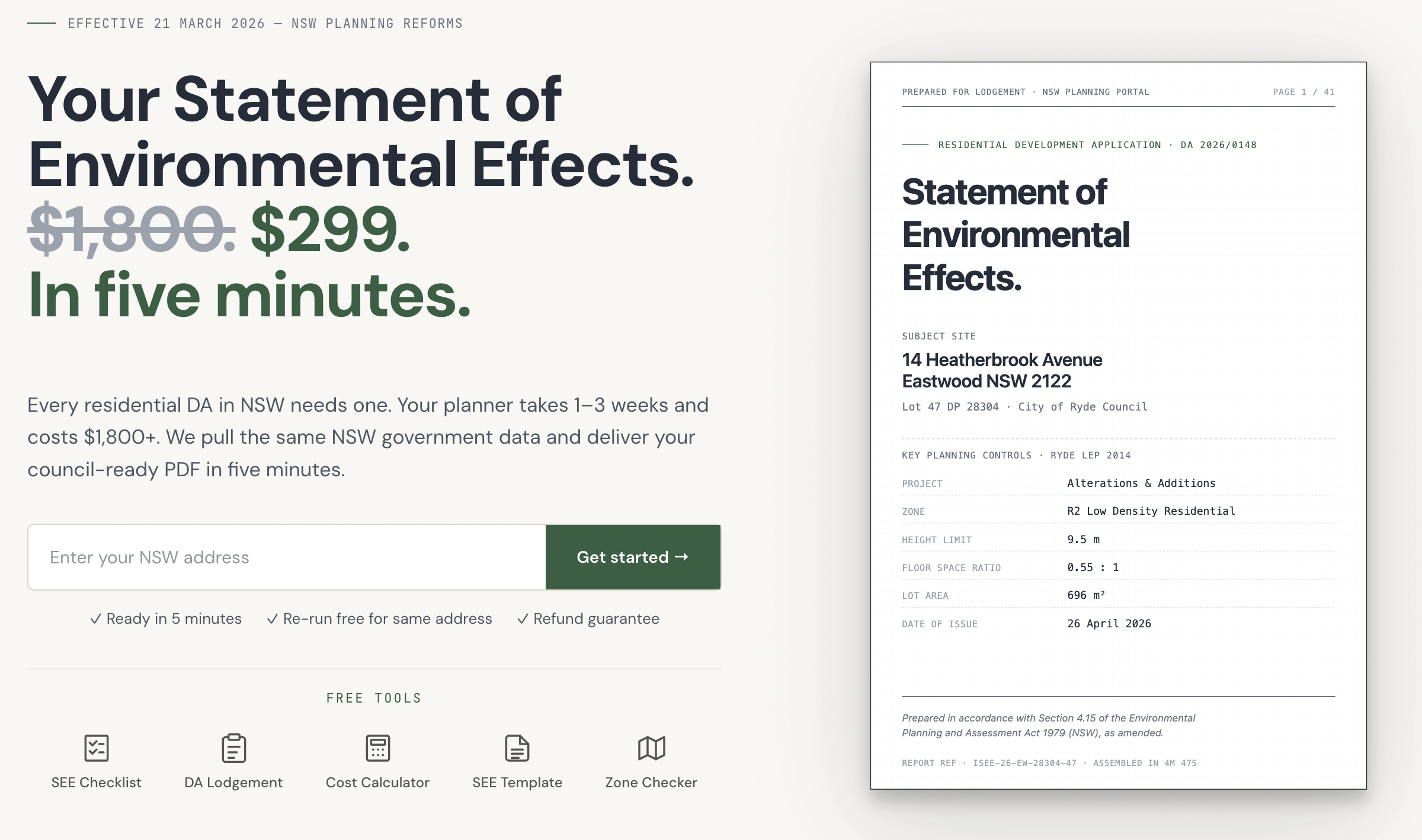
For residential development applications in NSW, the Statement of Environmental Effects is a mandatory document under the EP&A Regulation 2021. It must address how your proposal meets the relevant development standards, planning controls, and any applicable SEPPs. Preparing it accurately and efficiently is where many applications lose time.
instantSEE generates a council-ready SEE for residential DAs in NSW in 5 minutes AUD. The service draws directly from NSW government planning data to produce a compliant report aligned with current NSW planning requirements. Compared to engaging a town planner at $600 to $3,000 and waiting one to three weeks, instantSEE gives you a council-ready SEE at a fraction of the cost and time. For developers and consultants managing multiple applications, that efficiency compounds quickly.
Frequently asked questions
What is the NSW development standards list?
How long does complying development approval take in NSW?
What is Clause 4.6 and when does it apply?
Where can I find the NSW variations register?
What changed for building certifiers under the 2026 reforms?
Ready to get your SEE report?
Skip the writing. Get a DA-ready Statement of Environmental Effects in 5 minutes.
Get your SEE report