Developer contributions are mandatory charges or works required from NSW developers to fund the infrastructure demand their projects create. Formally known as infrastructure contributions, these levies are imposed under the Environmental Planning and Assessment Act 1979 (EP&A Act) and apply to most residential, commercial, and mixed-use developments across the state. The two primary local mechanisms are Section 7.11 and Section 7.12 contributions, alongside the state-level Housing and Productivity Contribution. Understanding how these charges work, and why they exist, is critical for any developer, homeowner, or investor planning a project in NSW.
Get a council-ready Statement of Environmental Effects for your DA in 5 minutes — no town planner, no waiting.
Get your SEE report →Why developer contributions are required in NSW
Developer contributions exist because new development creates measurable demand on public infrastructure. Roads become more congested, stormwater systems carry greater loads, and parks serve larger populations. Without a mechanism to recover these costs from the developments that cause them, the financial burden falls on existing ratepayers and state taxpayers. That outcome is neither equitable nor sustainable.
NSW councils impose local contributions under Sections 7.11 and 7.12 of the EP&A Act to fund infrastructure triggered by additional demand from new developments. The policy rests on three principles: nexus (the contribution must be linked to the demand the development creates), equity (those who cause the demand should pay for it), and cost-reflectivity (the amount charged should reflect the actual cost of the infrastructure required).

Developer contributions provide equity and cost-reflectivity so that developments pay for the infrastructure demand they create, rather than burdening existing residents. This principle is what gives the system its legal and moral legitimacy. A 200-lot subdivision that generates hundreds of new vehicle trips per day should fund the road upgrades those trips require, not the residents already living nearby.
What legal frameworks govern developer contributions in NSW?
The EP&A Act provides the statutory foundation for all developer contributions in NSW. Three distinct mechanisms operate under or alongside this framework, each with different triggers, calculation methods, and application areas.
| Mechanism | Governing provision | Basis for calculation | Applies to |
|---|---|---|---|
| Section 7.11 contribution | EP&A Act s 7.11 | Demonstrated nexus to infrastructure demand | Most residential and commercial development |
| Section 7.12 contribution | EP&A Act s 7.12 | Fixed percentage levy on construction cost | Development above cost thresholds |
| Housing and Productivity Contribution | EP&A Amendment Act 2023 | State-set rate per dwelling or lot | High-growth and designated areas |
Section 7.11 is the most common local mechanism. It requires councils to demonstrate a direct connection between the development and the infrastructure it will fund. This nexus requirement means councils must publish a contributions plan that maps specific infrastructure items to specific development catchments. If a council cannot show the link, it cannot charge the levy.
Section 7.12 operates differently. It applies a fixed percentage levy to the cost of development works, without requiring a nexus to specific infrastructure. A quantity surveyor cost report is commonly required to certify the cost of works for s 7.12 contributions, providing an independent verification of the contribution base. This mechanism is simpler to administer but offers less transparency about where the money goes.
The Housing and Productivity Contribution is a NSW state-level charge that replaced the former Special Infrastructure Contribution, applying to high-growth areas to fund state and regional infrastructure. It was legislated via the Environmental Planning and Assessment Amendment (Housing and Productivity Contribution) Bill 2023 and reflects the state government’s recognition that regional infrastructure in growth corridors requires a dedicated funding stream beyond what local councils can collect.
Pro Tip: Check whether your development site falls within a Housing and Productivity Contribution area before finalising your feasibility model. The additional state-level charge can materially affect project viability, particularly for medium-density residential developments in Sydney’s growth corridors.
What infrastructure do developer contributions fund?
Spend 5 minutes, not 3 weeks
instantSEE generates a complete, DA-ready Statement of Environmental Effects online. No town planner. No waiting.
Get your SEE report in 5 minutes →The funds collected through developer contributions do not disappear into consolidated revenue. They are quarantined and spent on specific infrastructure items identified in council contributions plans or state infrastructure programmes.
Contributions fund crucial infrastructure such as roads, drainage, parks, community facilities, and water and sewer systems necessary for sustainable development. Each of these categories addresses a direct consequence of population growth driven by new development. The list below reflects the most common infrastructure types funded through local contributions plans:
-
Roads and traffic facilities: intersection upgrades, new local roads, traffic management devices
-
Stormwater and drainage: detention basins, gross pollutant traps, drainage channel upgrades
-
Open space and parks: new parks, sportsgrounds, playground equipment, embellishment of existing reserves
-
Community facilities: libraries, childcare centres, multipurpose community halls
-
Water and sewer: reticulation extensions, pump station upgrades, treatment plant capacity
The importance of this funding cannot be overstated. Without contributions, councils in high-growth areas like the Sydney Basin, Hunter Valley, and Illawarra would face an impossible choice: either delay infrastructure delivery and degrade liveability, or fund it from general rates and borrowings, effectively charging existing residents for growth they did not cause.
Developer contributions are not a single universal fee but a combination of local and state mechanisms that vary by development type and location. A duplex in an established suburb may attract only a modest s 7.12 levy, while a greenfield subdivision in a growth area could be subject to both a substantial s 7.11 contribution and the Housing and Productivity Contribution simultaneously.
How do councils assess and collect developer contributions?
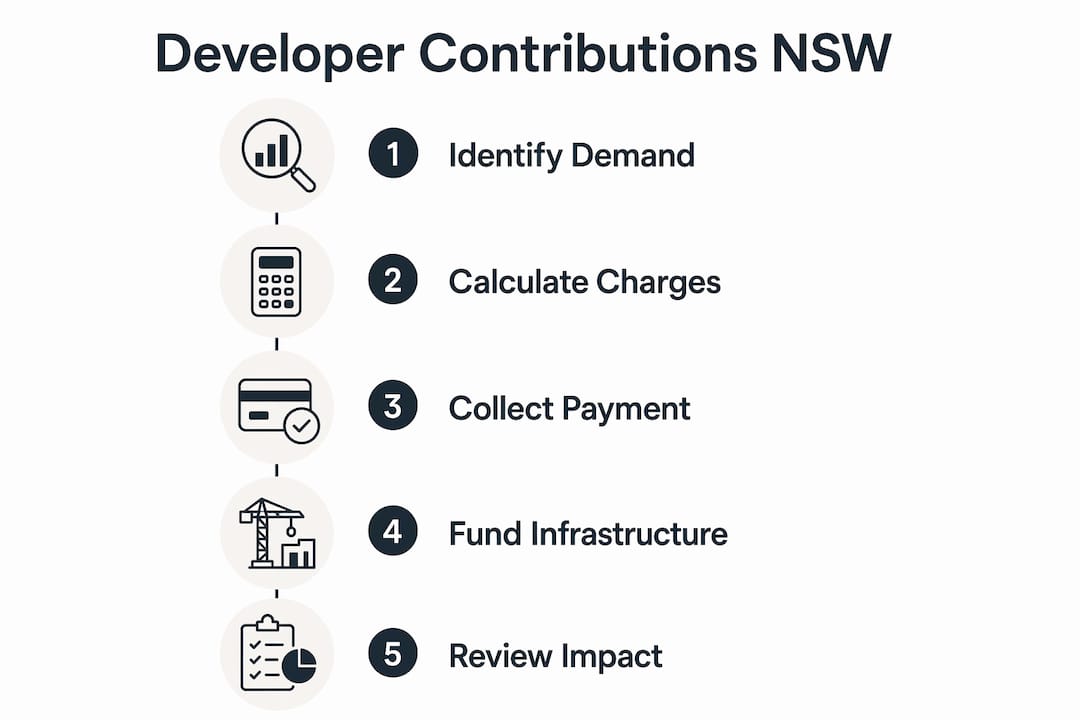
The practical process for calculating and collecting contributions follows a defined sequence. Understanding each step helps you anticipate costs and avoid compliance surprises.
-
Identify the applicable contributions plan. Each council publishes one or more contributions plans on its website. These plans identify the infrastructure schedule, the catchment areas, and the contribution rates per dwelling, per lot, or per square metre of floor space.
-
Calculate the contribution amount. For s 7.11, the rate is drawn directly from the contributions plan and multiplied by the number of lots, dwellings, or the relevant demand measure. For s 7.12, the rate is applied to the certified construction cost, which is why an independent quantity surveyor report is required.
-
Receive the condition of consent. Councils impose contributions as conditions on development consent, satisfied by monetary payment, land dedication, works in kind, or planning agreements. The condition will specify the amount, the payment trigger, and the acceptable payment methods.
-
Satisfy the contribution before works commence. Payment is typically required before the construction certificate or building works commence. This timing is set in the development consent or complying development certificate and is strictly enforced by councils and certifiers.
-
Obtain confirmation of payment. Once the contribution is paid or the works in kind are accepted, the council or certifier issues confirmation. This document forms part of your compliance record and may be required by financiers.
The flexibility in payment methods is worth noting. A developer who can offer land dedication or construct a specific piece of infrastructure directly may negotiate a works-in-kind arrangement with the council, which can reduce cash outflow at a critical stage of the project.
What are the practical implications for developers and investors?
Developer contributions directly affect project feasibility. They are a fixed cost that must be modelled accurately from the earliest stages of a project. Underestimating contributions is one of the most common causes of feasibility shortfalls in NSW residential development.
The NSW Productivity Commission’s review recommends improving transparency and consistency in contributions, with 29 recommendations aimed at equity, transparency, and certainty. This means the system is actively being reformed, and developers who engage with updated contributions plans and digital tools will have a clearer picture of their obligations than those relying on outdated information.
Key practical considerations for developers, homeowners, and investors include:
-
Budget early and accurately. Obtain a copy of the relevant contributions plan before signing a contract or lodging a development application. Contribution rates are indexed regularly and can change between the time you run your feasibility and the time consent is issued.
-
Understand your negotiation options. Developer contributions can be negotiated to include works in kind or land dedication, which can improve project feasibility. Larger projects in particular may benefit from a planning agreement, which allows for a bespoke arrangement with the council.
-
Engage the council pre-lodgement. A pre-lodgement meeting with the council’s development assessment team will clarify which contributions plans apply, whether any exemptions exist, and whether a works-in-kind proposal is likely to be accepted.
-
Account for state-level charges separately. The Housing and Productivity Contribution is collected by the state, not the council, and operates on a different payment schedule. It must be modelled as a separate line item.
Pro Tip: Negotiating for works in kind or land dedication instead of cash payments can improve feasibility in larger projects and is encouraged under the Housing and Productivity Contribution reforms. Approach the council early with a clear proposal and cost evidence prepared by a registered quantity surveyor.
Improving transparency and predictability through published contribution plans and standardised digital tools benefits developers and councils alike. The direction of reform in NSW is towards greater certainty, which is good news for anyone planning a project in the next few years.
Key takeaways
Developer contributions in NSW are statutory, cost-reflective charges imposed under the EP&A Act to fund the infrastructure demand that new development creates, and understanding the three-mechanism framework of s 7.11, s 7.12, and the Housing and Productivity Contribution is the foundation of sound project planning.
| Point | Details |
|---|---|
| Legal basis is the EP&A Act | Sections 7.11 and 7.12 govern local contributions; the Housing and Productivity Contribution operates at state level. |
| Nexus principle drives s 7.11 | Councils must demonstrate a direct link between the development and the infrastructure being funded. |
| Payment timing is fixed | Contributions are typically due before the construction certificate is issued, not at project completion. |
| Negotiation is possible | Works in kind, land dedication, and planning agreements are all recognised payment mechanisms under NSW law. |
| Reforms are improving certainty | The NSW Productivity Commission’s 29 recommendations are driving greater transparency and consistency across contribution plans. |
My view on developer contributions after years in NSW planning
The most common mistake I see developers make is treating contributions as an afterthought. They run their feasibility, get excited about the margin, sign the contract, and then discover a contributions liability that was sitting in the council’s plan the entire time. That is not a planning system failure. It is a due diligence failure.
What the system actually rewards is preparation. Councils are generally willing to discuss contributions early, and the works-in-kind pathway is genuinely underused. I have seen projects where a developer constructed a local park or upgraded a footpath network, had that work credited against their monetary contribution, and came out ahead on both cost and community goodwill. That outcome is available to anyone who engages early and comes with a credible proposal.
The Housing and Productivity Contribution is the piece that catches people most off guard right now. It is newer, it applies in areas where developers are most active, and it sits on top of local contributions rather than replacing them. If your project is in a designated growth area, you need to model both layers from day one.
The broader point is that developer contributions are not an obstacle to development. They are the mechanism that makes development acceptable to existing communities. Infrastructure-poor growth destroys liveability and generates political resistance that ultimately slows approvals for everyone. Contributions, when designed and applied well, are what allow growth to proceed with community support.
— Alex
Get your Statement of Environmental Effects sorted before lodgement
A development application in NSW requires more than just plans and a contributions calculation. You also need a Statement of Environmental Effects (SEE) that addresses your project’s compliance with planning controls, including any contributions obligations.
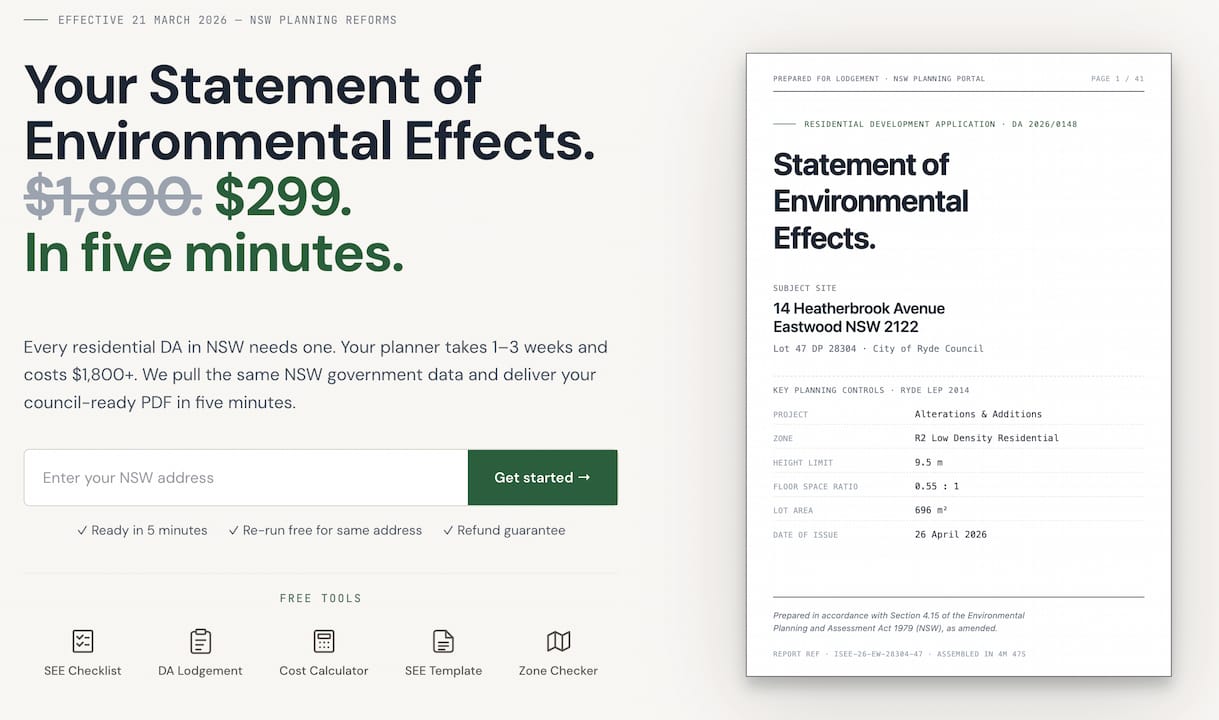
Instantsee delivers a council-ready SEE report in five minutes , drawing directly from NSW government planning data. Traditional planners charge $800 to $2,500 and take weeks. Instantsee automates the data collection and compliance checks so you can lodge with confidence. Free re-runs are included, and a refund guarantee applies if the SEE causes a return of your development application. If you are preparing a development application in NSW, Instantsee is the practical first step.
Frequently asked questions
What are developer contributions in NSW?
What is the difference between s 7.11 and s 7.12 contributions?
When do you pay developer contributions in NSW?
Can developer contributions be negotiated?
What is the Housing and Productivity Contribution?
Ready to get your SEE report?
Skip the writing. Get a DA-ready Statement of Environmental Effects in 5 minutes.
Get your SEE report