A town planner in NSW is a qualified professional who assesses land use proposals and development applications against planning schemes, policies, and legislation to ensure compliant, sustainable outcomes for communities. In New South Wales, this role is governed primarily by the Environmental Planning and Assessment Act 1979 (EP&A Act 1979) and the EP&A Regulation 2021, with applications lodged through the NSW Planning Portal (planningportal.nsw.gov.au). Town planners, formally known as urban planners, work across local councils, state government agencies, and private consultancies. Whether you are a homeowner seeking approval for a renovation, a developer pursuing a major project, or a student considering a career in NSW urban planning, understanding what a town planner does is the starting point for navigating the system confidently.
Get a council-ready Statement of Environmental Effects for your DA in 5 minutes — no town planner, no waiting.
Get your SEE report →What is a town planner NSW and what do they do?
A town planner in NSW assesses developments based on local planning schemes and advises on compliance, risk, and required changes during the approvals process. Their work sits at the intersection of law, community interest, and built environment design. Every development application (DA) lodged in NSW must be evaluated against a Local Environmental Plan (LEP) and, where applicable, a Development Control Plan (DCP). Town planners are the professionals who perform that evaluation or prepare the documentation to support it.
The role extends well beyond paperwork. Town planners liaise closely with architects, builders, engineers, council staff, and community groups to produce outcomes that are both legally compliant and practically workable. They interpret complex legislation, translate it into plain advice, and communicate that advice to clients, councils, and the public. This combination of technical knowledge and communication skill is what makes a qualified town planner indispensable in the NSW planning system.

What qualifications and skills do town planners in NSW need?
Town planners in NSW are required to hold a tertiary degree in Town Planning, Urban Planning, or a closely related discipline such as Environmental Science or Geography. Many practitioners also hold postgraduate qualifications or professional membership with the Planning Institute of Australia (PIA), which sets ethical and competency standards for the profession. While NSW does not currently mandate statutory registration for planners in the way it does for architects or engineers, PIA membership signals recognised professional standing to councils and clients alike.
The skills demanded of a town planner go beyond academic knowledge. Practitioners must demonstrate:
- Legislative literacy: Deep working knowledge of the EP&A Act 1979, EP&A Regulation 2021, State Environmental Planning Policies (SEPPs), and council LEPs.
- Report writing: The ability to prepare clear, evidence-based planning reports, Statements of Environmental Effects (SEEs), and heritage impact statements.
- Negotiation: Skill in managing competing interests between applicants, councils, and community objectors.
- Communication: Translating technical planning language into plain terms for clients and the public.
- Analytical judgement: Assessing whether a proposal meets development standards and identifying where variations may be justified.
In terms of remuneration, NSW council salaries for town planners range between $94,500 and $132,292 per year depending on experience and seniority. This range reflects the depth of expertise required and the significant responsibility planners carry in shaping community outcomes. Private sector roles often attract higher remuneration, particularly for senior consultants managing complex or high-value projects.
Public vs private town planners: what is the difference?
Spend 5 minutes, not 3 weeks
instantSEE generates a complete, DA-ready Statement of Environmental Effects online. No town planner. No waiting.
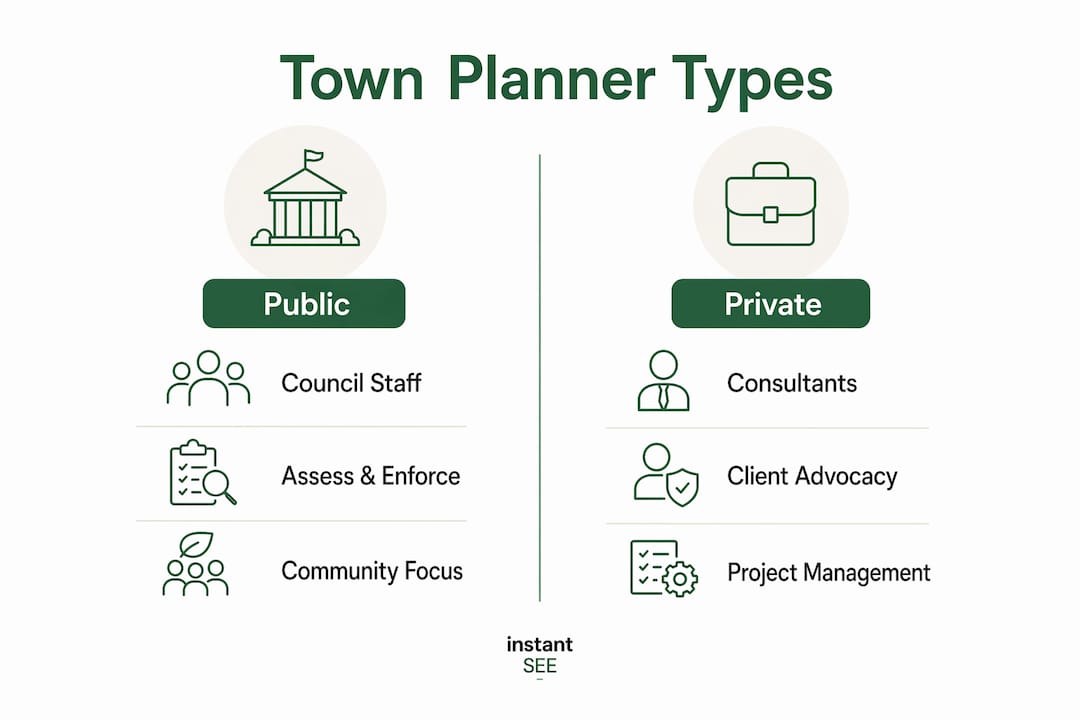
Get your SEE report in 5 minutes →Public town planners employed by councils focus on assessment and policy enforcement for community benefit, whereas private planners focus on securing approval for their clients' projects. This distinction matters enormously if you are a homeowner or developer, because the two types of planner have different objectives and different relationships with you.
| Feature | Public town planner | Private town planner |
|---|---|---|
| Employer | Local council or state agency | Private consultancy or self-employed |
| Primary objective | Community benefit and regulatory compliance | Client advocacy and application approval |
| Key tasks | Assessing DAs, enforcing LEPs, policy development | Preparing DAs, writing SEEs, negotiating with councils |
| Who they serve | The public interest | The applicant (homeowner or developer) |
| Interaction with applicants | Formal, arms-length assessment | Direct, collaborative, advisory |
A council planner reviewing your DA is not your advocate. Their obligation is to the public interest and the relevant planning instruments. A private planner, by contrast, acts as your advocate, managing council communications, responding to Requests for Further Information (RFIs), and coordinating specialists such as heritage consultants or traffic engineers to reduce delays and improve your chances of approval.
Pro Tip: When engaging a private town planner, ask specifically about their experience with your local council's LEP and DCP. A planner familiar with your council's assessment culture will anticipate objections before they arise.
What are the key responsibilities of a town planner in NSW?
The day-to-day responsibilities of a town planner in NSW vary depending on whether they work in the public or private sector, but several core tasks are common across both settings.
- Assessing land and development proposals: Evaluating whether a proposed development complies with zoning, height limits, floor space ratios, setbacks, and other development standards prescribed in the relevant LEP and DCP.
- Preparing planning reports: Town planners prepare full reports on how developments comply with local codes and the benefits to the zone, community, and region for council consideration. These reports form the evidentiary basis of a DA.
- Lodging development applications: Private planners prepare and lodge DAs through the NSW Planning Portal (planningportal.nsw.gov.au), attaching all required documents including the SEE, site plans, and specialist reports.
- Managing RFIs and council correspondence: When a council requests further information, the planner coordinates the response, often engaging additional consultants to address specific concerns.
- Community notification and objection management: Planners manage the notification process, respond to public submissions, and advise clients on how objections may affect the outcome.
- Appeals and reviews: Where a DA is refused or conditions are disputed, planners prepare submissions for the Land and Environment Court of NSW or the Local Planning Panel.
Beyond these formal tasks, town planners also provide strategic pre-lodgement advice. Developers and homeowners benefit from planners who anticipate issues such as easements, overlays, and environmental constraints before application submission. Identifying a problem before lodgement is far less costly than addressing it after a council has issued a refusal.
How do town planners add value to homeowners and developers?
Hiring a private town planner helps avoid delays caused by council feedback on non-compliant applications, particularly in complex regulatory environments. For homeowners, the value is clearest when a project involves heritage overlays, flood constraints, or non-standard design. For developers, the stakes are higher: a delayed or refused DA can cost significantly more than the planner's fee.
The practical benefits of engaging a private town planner include:
- Reduced application delays: Planners who know the relevant LEP and DCP submit applications that are complete and compliant from the outset, reducing the likelihood of RFIs.
- Higher approval rates: A well-prepared SEE and supporting documentation addresses council concerns proactively, improving the prospect of consent.
- Condition negotiation: When consent is granted with onerous conditions, an experienced planner can negotiate modifications that reduce cost or construction complexity.
- Risk identification: Pre-lodgement advice flags zoning conflicts, heritage issues, or environmental constraints before they become formal refusals.
- Specialist coordination: Private planners proactively manage RFIs and coordinate multidisciplinary consultants to produce unified reports that satisfy council codes, significantly reducing approval timelines.
On cost, private town planners in NSW typically charge $800–$2,500 for residential DA work, with more complex projects attracting higher fees and timelines of one to three weeks for documentation. For straightforward residential projects, this cost must be weighed against the risk of a delayed or refused application. You can use the town planner cost calculator to estimate fees and timelines for your specific project before committing to a consultant.
What steps should you take when working with a town planner in NSW?
Engaging a town planner effectively requires preparation. The more organised you are before your first meeting, the more efficiently a planner can assess your project and advise on the path forward.
- Gather your property information: Have your property's address, lot and deposited plan number, and any existing approvals or certificates ready. The planner will use these to identify the applicable LEP zone and development standards.
- Clarify your proposal: Prepare a clear description of what you want to build or change, including approximate dimensions, materials, and intended use. Sketch plans or architect drawings at this stage are helpful but not always required.
- Check the NSW Planning Portal: The NSW Planning Portal (planningportal.nsw.gov.au) provides zoning maps, LEP information, and DA lodgement tools. Reviewing these before your consultation saves time and demonstrates preparedness.
- Understand the SEE requirement: Most DAs in NSW require a Statement of Environmental Effects. This document explains how your proposal addresses the relevant planning controls. Your planner will either prepare this or advise you on its contents. Reviewing the SEE checklist for NSW before your consultation helps you understand what will be required.
- Confirm your planner's credentials: Check for PIA membership or relevant tertiary qualifications. Ask for examples of similar projects they have managed in your local government area.
Pro Tip: Request a pre-lodgement meeting with your local council before submitting your DA. Many councils offer this service at no cost, and your planner can attend with you to address potential concerns directly with the assessing officer.
Before lodgement, also review the DA lodgement checklist to confirm every required document is in order. Missing a single mandatory attachment is one of the most common causes of delayed assessments.
Key takeaways
Town planners in NSW are the professionals who translate complex planning legislation into compliant, approvable development outcomes for both the public and private sectors.
| Point | Details |
|---|---|
| Core definition | A town planner assesses land use proposals against the EP&A Act 1979, LEPs, and DCPs to ensure compliance. |
| Qualifications required | A tertiary degree in Urban or Town Planning and PIA membership are the standard professional credentials in NSW. |
| Public vs private distinction | Council planners serve the public interest; private planners advocate for their client's approval. |
| Key responsibilities | Preparing SEEs, lodging DAs, managing RFIs, coordinating specialists, and negotiating conditions. |
| Value for homeowners | Private planners reduce delays, improve compliance, and identify constraints before lodgement. |
The evolving role of town planners in NSW
The private town planner's role is frequently misunderstood. Many homeowners and small developers assume that lodging a DA is primarily an administrative task, and that a planner's job is simply to fill in forms. This misreads the profession significantly. The most valuable work a private planner does happens before lodgement: identifying whether a proposal is achievable, advising on design modifications that improve compliance, and building a documentation package that anticipates council concerns rather than reacting to them.
NSW's planning system has grown considerably more complex over the past decade. The introduction of new SEPPs, the expansion of the Complying Development Certificate (CDC) pathway, and the ongoing reform of LEPs across metropolitan and regional councils have created a regulatory environment where specialist knowledge is not optional for anything beyond the simplest project. Homeowners who attempt to navigate this without professional guidance frequently encounter RFIs, delays, or refusals that could have been avoided.
Digital tools are changing parts of this process. Services that automate the preparation of standard planning documents reduce the time and cost burden for straightforward residential projects. However, these tools complement rather than replace the judgement of a qualified planner on complex or contentious matters. The distinction is worth understanding clearly before you decide how to proceed with your own project.
Prepare your Statement of Environmental Effects with instantSEE
For residential development applications in NSW, the Statement of Environmental Effects is one of the most time-consuming documents to prepare. instantSEE generates a council-ready SEE for residential DAs in NSW in 5 minutes. drawing directly from NSW government planning data to address the relevant LEP controls and development standards for your property.
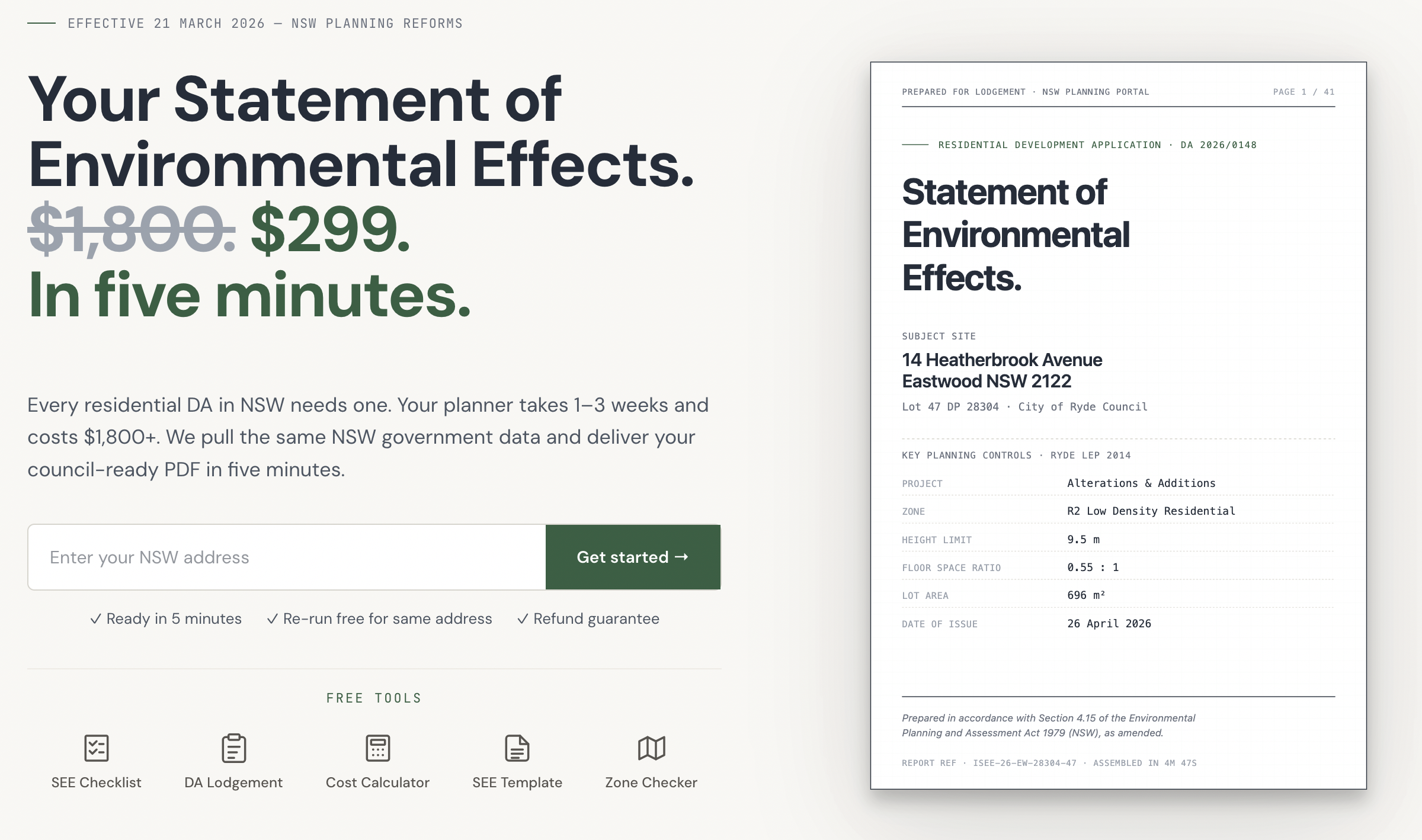
Where a private town planner charges $800–$2,500 and typically takes one to three weeks to deliver documentation, instantSEE suits homeowners and small developers with straightforward residential projects who need a compliant, professionally structured SEE without the wait. For more complex projects involving heritage, environmental constraints, or non-standard designs, a qualified private planner remains the appropriate choice. instantSEE works best as part of a well-prepared DA package. Review the full SEE requirements to confirm it suits your project before you begin.
Frequently asked questions
What does a town planner do in NSW?
What qualifications does a town planner need in NSW?
What is the difference between a public and private town planner?
How much does a town planner cost in NSW?
Do I need a town planner to lodge a DA in NSW?
Ready to get your SEE report?
Skip the writing. Get a DA-ready Statement of Environmental Effects in 5 minutes.
Get your SEE report