A development ready site in NSW is defined as land where all necessary technical, environmental, and statutory assessments have been completed and relevant approvals are in place to allow construction to commence with minimal delay. The term "development ready" is widely used in the property industry, though the recognised planning equivalent is "site readiness," a concept governed by the Environmental Planning and Assessment Act 1979 (EP&A Act 1979) and the EP&A Regulation 2021. For developers and investors in New South Wales, understanding what qualifies a site as development ready is the difference between a project that moves quickly and one that stalls for months in due diligence. This article explains the regulatory criteria, technical audit requirements, and practical steps for identifying and verifying development ready land in NSW.
Get a council-ready Statement of Environmental Effects for your DA in 5 minutes — no town planner, no waiting.
Get your SEE report →What is a development ready site in NSW?
A development ready site meets a defined set of planning, environmental, and infrastructure standards that allow a developer to proceed to construction without significant further investigation. This goes well beyond simply being zoned for residential or commercial use. True site readiness means the land has cleared the key hurdles that typically slow projects down, including contamination clearance, geotechnical suitability, infrastructure confirmation, and compliance with applicable development standards.
The statutory framework for site readiness in NSW rests on several instruments:
- Local Environmental Plans (LEPs): Each council in NSW administers an LEP that sets permitted land uses, minimum lot sizes, height limits, and floor space ratios. A development ready site must comply with the relevant LEP provisions before any approval pathway is viable.
- Development Control Plans (DCPs): DCPs sit beneath LEPs and prescribe detailed design and siting requirements. Overlays within DCPs, such as flood planning levels or bushfire attack level (BAL) ratings, directly affect whether a site can be developed and at what cost.
- State Environmental Planning Policy (Exempt and Complying Development Codes) 2008: This SEPP establishes the criteria for Complying Development Certificates (CDCs), which offer a faster approval pathway than a full Development Application (DA).
- Zoning compliance: The site must be within a zone that permits the intended use. For example, dual occupancy is now permitted in R1, R2, R3, and RU5 zones statewide, with a minimum lot size of 450 square metres and 12 metre frontage, following 2025 regulatory updates.
- Overlay constraints: Acid sulfate soils, heritage listings, biodiversity corridors, and riparian land constraints must all be identified and addressed before a site can be considered ready.
A CDC can be issued within 20 days if all code requirements are met, making the CDC pathway significantly faster than a DA for eligible sites. Pattern Book developments are faster still, with approval in 10 days and a 7-day neighbour notification period. This speed advantage is only available to sites that already satisfy the underlying development standards, which is precisely what development readiness delivers.
What technical assessments make a site development ready?
Technical assessments are the backbone of site readiness. They transfer the cost and risk of discovery from the buyer to the seller or certifying body, and they are what separates a genuinely certified development ready site from one that merely looks promising on a zoning map. Due diligence for raw land typically takes 6 to 12 months. Certified sites bypass much of this, accelerating the path to construction commencement.
The standard suite of technical assessments includes:
- Phase I Environmental Site Assessment (ESA): This audit reviews historical land use to identify potential contamination from industrial activity, underground storage tanks, or chemical use. A Phase I ESA is mandatory for many commercial and industrial sites and is increasingly expected for residential infill in older suburbs.
- Geotechnical investigation: A geotechnical report assesses soil bearing capacity, reactive clay classification, and foundation suitability. Without this, a builder cannot confirm footing design or cost, which makes financing and construction programming unreliable.
- Wetland and endangered ecological community studies: Under the Biodiversity Conservation Act 2016, sites near mapped biodiversity values require a Biodiversity Development Assessment Report (BDAR) or a concurrence from the NSW Department of Planning, Housing and Infrastructure.
- Archaeological survey: Sites in areas of known Aboriginal heritage or European historical significance require an Aboriginal Cultural Heritage Assessment or a historical heritage assessment, depending on the relevant overlay.
- Utility capacity confirmation: Infrastructure readiness requires a credible, funded plan to deliver water, sewer, electricity, and telecommunications to the site. Uncertainty about infrastructure delivery is more damaging to a project than the absence of physical connections.
- Stormwater and drainage assessment: Particularly relevant in flood-affected areas, this confirms whether the site can manage runoff within council and state requirements.
Pro Tip: Ask the vendor or agent for a copy of all completed technical reports before making an offer. If reports are unavailable or more than three years old, factor the cost and time of commissioning fresh assessments into your due diligence budget.
Completing these assessments upfront is what makes a site genuinely ready for development. It also significantly strengthens your position with lenders, as site readiness includes a clean title, current environmental reports, and a clearly defined infrastructure scope, all of which are critical for financing approvals.

Development ready vs. raw land vs. DA-approved: what is the difference?
Spend 5 minutes, not 3 weeks
instantSEE generates a complete, DA-ready Statement of Environmental Effects online. No town planner. No waiting.
Get your SEE report in 5 minutes →Understanding the distinctions between these three site categories prevents costly assumptions. The table below summarises the key differences.
| Site category | Planning status | Technical assessments | Typical due diligence period | Construction commencement |
|---|---|---|---|---|
| Raw land | Zoned but unapproved | None completed | 6 to 12 months | 12 to 24 months or longer |
| DA-approved site | Consent granted | Partial, as required by consent | 2 to 4 months | 3 to 6 months after DA |
| Development ready site | Approved or CDC-eligible | Full suite completed | Near zero | Weeks to months |
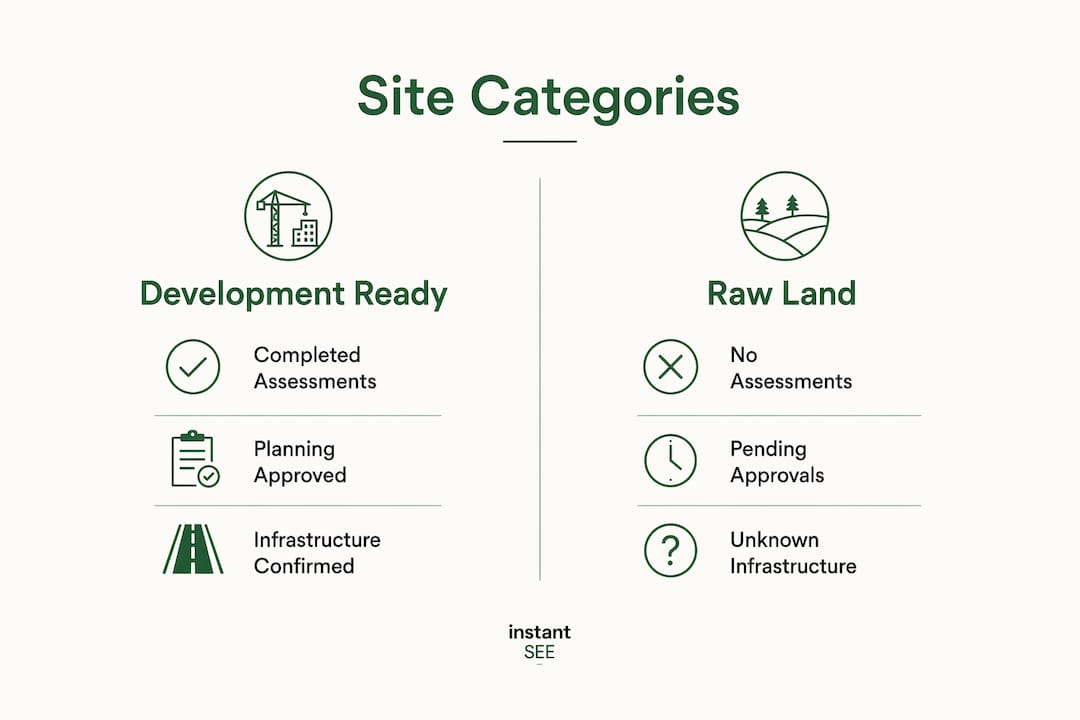
Raw land carries the highest risk and the longest timeline. A buyer must commission all technical assessments, navigate the full DA or CDC process, and manage any conditions of consent before a builder can be engaged. This is appropriate for experienced developers with capital reserves and long holding periods.
A DA-approved site is often misunderstood. DA approval does not guarantee shovel-ready status. Investors frequently assume that a DA consent means construction can begin immediately, but consent conditions often require further reports, engineering drawings, or infrastructure agreements before a Construction Certificate can be issued. DA approvals also carry expiry dates, typically five years under the EP&A Act 1979, and a lapsed consent returns the site to unapproved status.
The term "shovel-ready" is sometimes used interchangeably with "development ready," but they are not identical. A shovel-ready site has a Construction Certificate in hand and a builder contracted. A development ready site has completed the assessments and approvals that make reaching shovel-ready status fast and low-risk. Development readiness is the precondition; shovel-ready is the outcome.
How to find and verify development ready sites in NSW
Finding a development ready site requires more than a property search on a real estate portal. The following steps give you a structured approach to identifying and verifying genuine site readiness.
- Search specialist channels: Development ready land in NSW is listed through commercial real estate agents, specialist development site portals, and state government land release programmes. The NSW Department of Planning, Housing and Infrastructure publishes information on rezoned and released land through its housing programs.
- Check the NSW Planning Portal: The NSW Planning Portal (planningportal.nsw.gov.au) provides access to zoning maps, LEP provisions, and planning certificates (Section 10.7 certificates). A Section 10.7(2) certificate confirms the zoning and any overlays affecting the site. A Section 10.7(5) certificate provides additional detail on known constraints.
- Verify technical reports: Request copies of all third-party assessments. Confirm the date of each report, the qualifications of the author, and whether the findings have been accepted by the relevant authority. Environmental reports older than three years may require updating.
- Assess site attributes: Favourable development sites have adequate frontage, flat or gently sloping topography, consistent zoning, and alignment with local planning instruments. Check minimum lot size, frontage requirements, and any DCP controls on setbacks, landscaping, and car parking.
- Engage a town planner or development consultant: A qualified planner can review the LEP and DCP provisions, identify any constraints not visible on the planning portal, and advise on the most appropriate approval pathway. This is particularly important for sites with overlays or sites where the intended use is not a straightforward permitted use.
- Confirm infrastructure capacity: Contact the relevant utility providers (Sydney Water, Essential Energy, Ausgrid, or the local council) to confirm available capacity for water, sewer, and electricity at the proposed development scale.
- Review the DA lodgement checklist: Understanding what documents are required for a DA submission helps you identify gaps in the existing assessment package.
Pro Tip: Flood zones and bushfire overlays are two of the most commonly overlooked constraints. Always cross-reference the Section 10.7 certificate with the relevant council flood study and the NSW Rural Fire Service's Planning for Bushfire Protection guidelines before committing to a site.
Hidden site constraints such as flood risk, acid sulfate soils, or bushfire overlays frequently cause costly redesigns or failed projects when they are not identified early. A site that appears straightforward on a zoning map can carry significant cost implications once these overlays are factored into the design.
Key takeaways
A development ready site in NSW requires completed technical assessments, current planning approvals, and confirmed infrastructure capacity, not just favourable zoning.
| Point | Details |
|---|---|
| Readiness is multidimensional | Zoning alone does not make a site development ready; environmental, geotechnical, and infrastructure assessments are all required. |
| CDC pathway rewards readiness | Sites that meet the State Environmental Planning Policy (Exempt and Complying Development Codes) 2008 can receive CDC approval within 20 days. |
| DA approval is not enough | A DA consent does not confirm shovel-ready status; conditions of consent and expiry dates must be actively managed. |
| Technical audits reduce risk | Completed Phase I ESAs, geotechnical reports, and utility confirmations shorten due diligence from months to weeks. |
| Verification requires multiple sources | Use the NSW Planning Portal, Section 10.7 certificates, and third-party reports together to confirm genuine site readiness. |
The real cost of assuming a site is ready
Most developers who run into trouble with site readiness do so not because they ignored the concept, but because they conflated planning approval with genuine readiness. A site with an LEP-compliant zone and a fresh DA consent can still carry years of delay if the geotechnical report reveals reactive soils requiring expensive raft footings, or if the Section 10.7(5) certificate discloses a heritage conservation area that was not flagged in the initial search.
Site readiness is less a static label and more a risk-reducing process that transfers discovery costs from buyer to seller or community. When you pay a premium for a certified development ready site, you are not paying for the land alone. You are paying for the absence of unpleasant surprises. That premium is almost always justified when measured against the cost of a 12-month delay in a rising construction cost environment.
The NSW regulatory environment is also shifting. The 2025 dual occupancy reforms, the Pattern Book programme, and the state government's housing targets are all creating new categories of fast-tracked approvals. But these pathways are only accessible to sites that already meet the underlying standards. Developers who invest in thorough site assessment upfront are the ones positioned to use these faster pathways. Those who skip the assessment phase to save time often find themselves locked out of the very mechanisms designed to accelerate approvals.
Financial and commercial viability must be assessed alongside technical readiness. A site that sails through every technical audit but sits in a location with weak rental demand or poor comparable sales will not deliver a viable project. True development readiness is technical, regulatory, financial, and increasingly, community-aligned.
How instantSEE supports your development application
Once you have identified a development ready site and confirmed its compliance with NSW planning requirements, the next step is preparing your Development Application documentation for lodgement through the NSW Planning Portal (planningportal.nsw.gov.au).
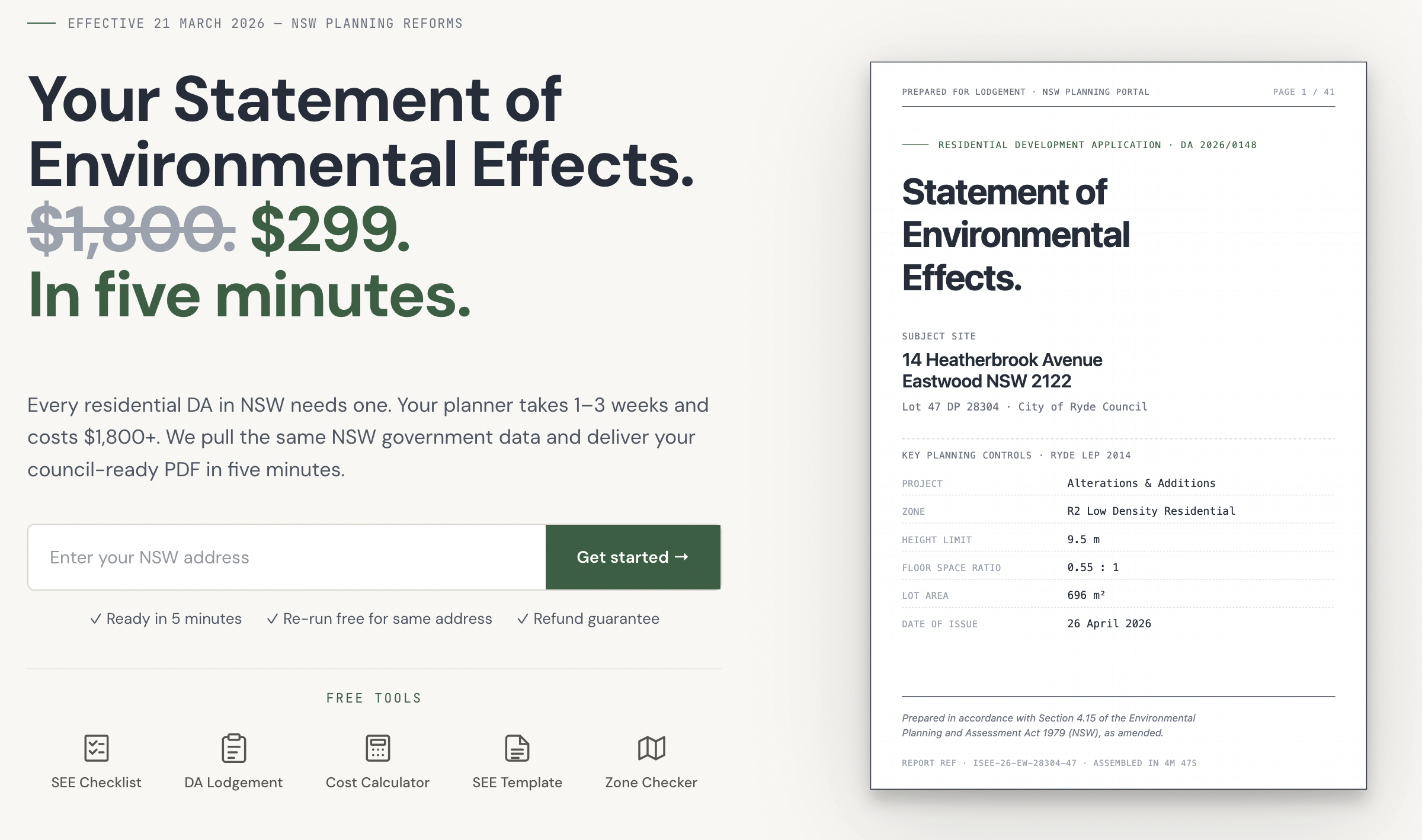
A Statement of Environmental Effects (SEE) is a mandatory document for most DAs under the EP&A Act 1979. Traditional town planners charge between $600 and $3,000 for an SEE and typically take one to three weeks to deliver it. instantSEE generates a council-ready SEE in 5 minutes AUD, drawing directly from NSW government data sources to confirm zoning, overlays, and development standards. For developers working with development ready sites, this means your DA documentation can be prepared and lodged quickly, without the delays that slow down even well-prepared projects. Review the SEE requirements checklist to confirm what your statement must address before lodgement.
Recommended
Frequently asked questions
What does "development ready" mean in NSW planning?
Is a DA-approved site the same as a development ready site?
What is a Section 10.7 certificate and why does it matter?
How long does a CDC take in NSW?
What are the most common mistakes when assessing a development ready site?
Ready to get your SEE report?
Skip the writing. Get a DA-ready Statement of Environmental Effects in 5 minutes.
Get your SEE report