In NSW, residential development applications fall into three legally distinct categories under the Environmental Planning and Assessment Act 1979 (EP&A Act): exempt development, complying development, and development requiring consent (a DA). Each category carries different approval requirements, processing times, and documentation obligations. Choosing the wrong pathway wastes time and money. This guide explains every type of residential development application in NSW, including how 2026 reforms and the NSW Planning Portal affect your options.
Get a council-ready Statement of Environmental Effects for your DA in 5 minutes — no town planner, no waiting.
Get your SEE report →1. What are the types of residential development applications NSW?
The three types of residential development applications in NSW are defined by the EP&A Act 1979 and administered through the EP&A Regulation 2021. Exempt development requires no approval at all. Complying development is approved by a private certifier or council within a prescribed timeframe. A development application (DA) goes through full council assessment and is the most complex pathway. Processing times range from zero days for exempt works to up to 90 days for DAs, which means selecting the right pathway from the outset directly determines your project timeline.

2. Exempt development: no approval required
Exempt development is low-impact residential work that meets preset standards under the State Environmental Planning Policy (Exempt and Complying Development Codes) 2008 (Codes SEPP) and proceeds without any council consent or certifier involvement.
Common residential projects that qualify as exempt development include:
- Small garden sheds under prescribed floor area and height limits
- Fences meeting height and setback standards for the zone
- Minor landscaping, garden beds, and retaining walls under 600mm
- Rainwater tanks, pergolas, and cubby houses within size limits
- Replacement of like-for-like windows and doors
No application form, no fee, and no waiting period apply. The trade-off is strict compliance with every standard in the Codes SEPP. If your project deviates from even one prescribed measurement, it is no longer exempt and you must seek another approval pathway.
Pro Tip: Before starting any work you believe is exempt, check the NSW Planning Portal's exempt development tool at planningportal.nsw.gov.au. It steps you through the relevant standards for your zone and property type, so you can confirm eligibility before picking up a shovel.
The benefit of exempt development is speed. There is no council involvement, no public notification, and no approval document to obtain. For straightforward, low-impact works on standard residential land, this pathway removes all administrative burden.
3. Complying development: the fast-track CDC pathway
Spend 5 minutes, not 3 weeks
instantSEE generates a complete, DA-ready Statement of Environmental Effects online. No town planner. No waiting.
Get your SEE report in 5 minutes →A Complying Development Certificate (CDC) is a combined planning and construction approval issued by a private accredited certifier or council. It is the fast-track pathway for residential projects that meet strict, non-discretionary standards set out in the Codes SEPP.
Residential projects commonly approved via CDC include:
- New single dwellings on standard lots
- Alterations and additions to existing homes
- Dual occupancies in eligible zones under the Low-Rise Housing Diversity Code
- Secondary dwellings (granny flats) meeting size and setback requirements
- Demolition of structures meeting prescribed criteria
CDC applications are processed in 10 to 20 business days, compared to the 40 to 90 days typical for a DA. That time saving is significant for developers and homeowners working to a construction schedule. A BASIX certificate is mandatory for residential projects above $50,000, covering energy and water efficiency compliance, and must be submitted with the CDC application.
The critical constraint of the CDC pathway is that failure to meet even one standard in the Codes SEPP disqualifies CDC eligibility and forces the application into the DA pathway. A minor setback shortfall or a breach of a tree protection zone can invalidate the entire CDC. This means thorough pre-application checking is not optional; it is the difference between a 10-day approval and a 90-day council process.
Pro Tip: Engage your accredited certifier before finalising your design. They can identify Codes SEPP compliance issues at the concept stage, saving you costly redesigns after documentation is complete.
A pattern book scheme introduced in 2025 allows CDC approval in as little as 10 days for low-rise homes built to pre-approved designs. This is faster than the standard CDC process and is worth considering for straightforward new dwellings on standard lots.
4. When a full development application (DA) is required
A development application is the formal consent pathway under the EP&A Act 1979 for residential projects that cannot proceed as exempt or complying development. Council assesses the DA against the relevant Local Environmental Plan (LEP), Development Control Plan (DCP), and any applicable state policies.
The following residential projects typically require a full DA:
- Multi-dwelling housing and residential flat buildings
- Torrens title and strata subdivisions
- Projects on heritage-listed land or within heritage conservation areas
- Development on flood-prone land or land with significant ecological constraints
- Dual occupancies or extensions that exceed CDC standards
- Projects in zones not covered by the Low-Rise Housing Diversity Code
- Any development where council discretion is needed to vary a standard
Site-specific factors like heritage status, flood-prone land, or significant trees automatically push applications to the DA pathway regardless of the project's apparent simplicity. This is one of the most common surprises for homeowners who assume a straightforward extension qualifies for CDC.
A DA is not simply a longer form of a CDC. It is a discretionary assessment process where council weighs the merits of your proposal against planning controls, neighbour impacts, and public interest. The outcome is never guaranteed.
The DA process involves public notification (typically 14 days), council officer assessment, and a determination by a delegate or the Local Planning Panel. The formal assessment clock only starts once council validates the application as complete, meaning incomplete documentation can add weeks before assessment even begins. A Statement of Environmental Effects (SEE), site plan, BASIX certificate (where applicable), and other supporting reports are mandatory documents for most residential DAs.
Councils cannot begin formal assessment until all documents including the SEE, site plan, and BASIX are uploaded and validated. Documents must be clearly labelled and complete. Submitting a poorly prepared SEE is the single most common cause of DA delays for residential applicants.
5. Comparing NSW residential development application types
Selecting the right approval pathway depends on your project type, site constraints, and timeline. The table below summarises the key differences.
| Approval type | Processing time | Typical cost range | Approval authority | Eligible projects |
|---|---|---|---|---|
| Exempt development | No approval needed | Nil | Not applicable | Minor works, fences, sheds |
| Complying development (CDC) | 10 to 20 business days | Certifier fees vary | Accredited certifier or council | New dwellings, extensions, dual occupancies |
| Development application (DA) | 40 to 90 days | Council fees plus consultant costs | Local council | Complex residential, heritage, flood-prone sites |
The risk of choosing the wrong pathway is real. Submitting a CDC for a project that does not meet Codes SEPP standards results in rejection and a restart via DA, adding months to your timeline. Conversely, lodging a DA for a project that qualifies for CDC means paying higher fees and waiting longer than necessary.
Pro Tip: Use the NSW Planning Portal's development type checker before engaging any consultant. It identifies whether your project falls under exempt, CDC, or DA requirements based on your address and proposed works, giving you a reliable starting point before spending money on design or reports.
6. How 2026 reforms and the NSW Planning Portal affect your application
The 2026 Low and Mid-Rise Housing (LMR) reforms have materially changed what qualifies for CDC approval in NSW. Dual occupancies on R2 zoned land now require a minimum lot size of 450sqm, reduced from the previous 600 to 700sqm threshold in LMR-mapped areas. This change opens the CDC pathway to a significantly larger number of residential lots across Sydney and regional NSW, making medium-density housing more accessible without requiring a full DA.
The NSW Planning Portal (planningportal.nsw.gov.au) is now the mandatory digital lodgement platform for all DAs and CDCs. Key impacts of the portal on your application include:
- Applications are validated on upload, with incomplete submissions rejected before formal assessment begins
- The formal assessment timeframe starts only after council confirms the application is complete, not on the date of upload
- All documents must be uploaded as clearly labelled PDFs in the prescribed format
- Pre-lodgement consultation requests can be submitted through the portal for complex sites
The digital portal shifts the evidence burden to applicants, making document quality the primary driver of approval speed. A well-prepared application with a thorough SEE, accurate site plan, and complete BASIX certificate moves through validation quickly. A poorly prepared one stalls before assessment even starts.
Pre-lodgement consultations with council remain best practice for heritage sites, flood-prone land, or any project with unusual site constraints. Relying solely on the portal's automated processes risks missing site-specific constraints that only a council planner would flag during a pre-lodgement meeting.
Key takeaways
Selecting the correct residential development application pathway in NSW requires matching your project type and site constraints to the exempt, CDC, or DA category before committing to any design or documentation.
| Point | Details |
|---|---|
| Three distinct pathways | Exempt, CDC, and DA each carry different approval requirements, timeframes, and costs under the EP&A Act 1979. |
| CDC is fast but unforgiving | One non-compliant detail in the Codes SEPP disqualifies CDC eligibility and forces the slower DA process. |
| DA documentation drives speed | The formal assessment clock starts only after council validates all documents, so a complete SEE and site plan are critical. |
| 2026 LMR reforms expand CDC access | Dual occupancy minimum lot sizes reduced to 450sqm in LMR areas, opening CDC to more residential properties. |
| Pre-lodgement consultation saves time | Complex or constrained sites benefit from council pre-lodgement meetings before any formal application is lodged. |
The practical reality of choosing your approval pathway
The most persistent misconception in NSW residential development is that a project's physical simplicity determines its approval pathway. It does not. Expert Nathan Battishall notes that many assume simple projects qualify for CDC when site-specific factors like heritage overlays or flood planning levels automatically require a DA. A single-storey extension on a heritage-listed property in an inner-Sydney suburb is not a CDC project, regardless of its size.
The practical advice is to treat pathway selection as a research task, not an assumption. Pull the property's planning certificate (Section 10.7 certificate) from the NSW Planning Portal before engaging any designer or certifier. That certificate tells you the zone, any overlays, and the applicable planning instruments. It is the starting point for every residential development decision.
The 2026 LMR reforms have added genuine opportunity for dual occupancy development on smaller lots, but the Codes SEPP compliance requirements remain strict. A 449sqm lot does not qualify under the new 450sqm threshold. These are not rounding errors; they are hard legal boundaries. Thorough site measurement and survey work before lodgement prevents costly rework.
For DA projects, the quality of your Statement of Environmental Effects is the single document most likely to determine how quickly your application moves through council. A vague or incomplete SEE triggers requests for additional information, which pauses the assessment clock and extends your timeline by weeks.
— Alex
Prepare your DA documents faster with instantSEE
Lodging a residential DA through the NSW Planning Portal (planningportal.nsw.gov.au) requires a council-ready Statement of Environmental Effects. Preparing one through a traditional town planner costs $600 to $3,000 and takes one to three weeks.
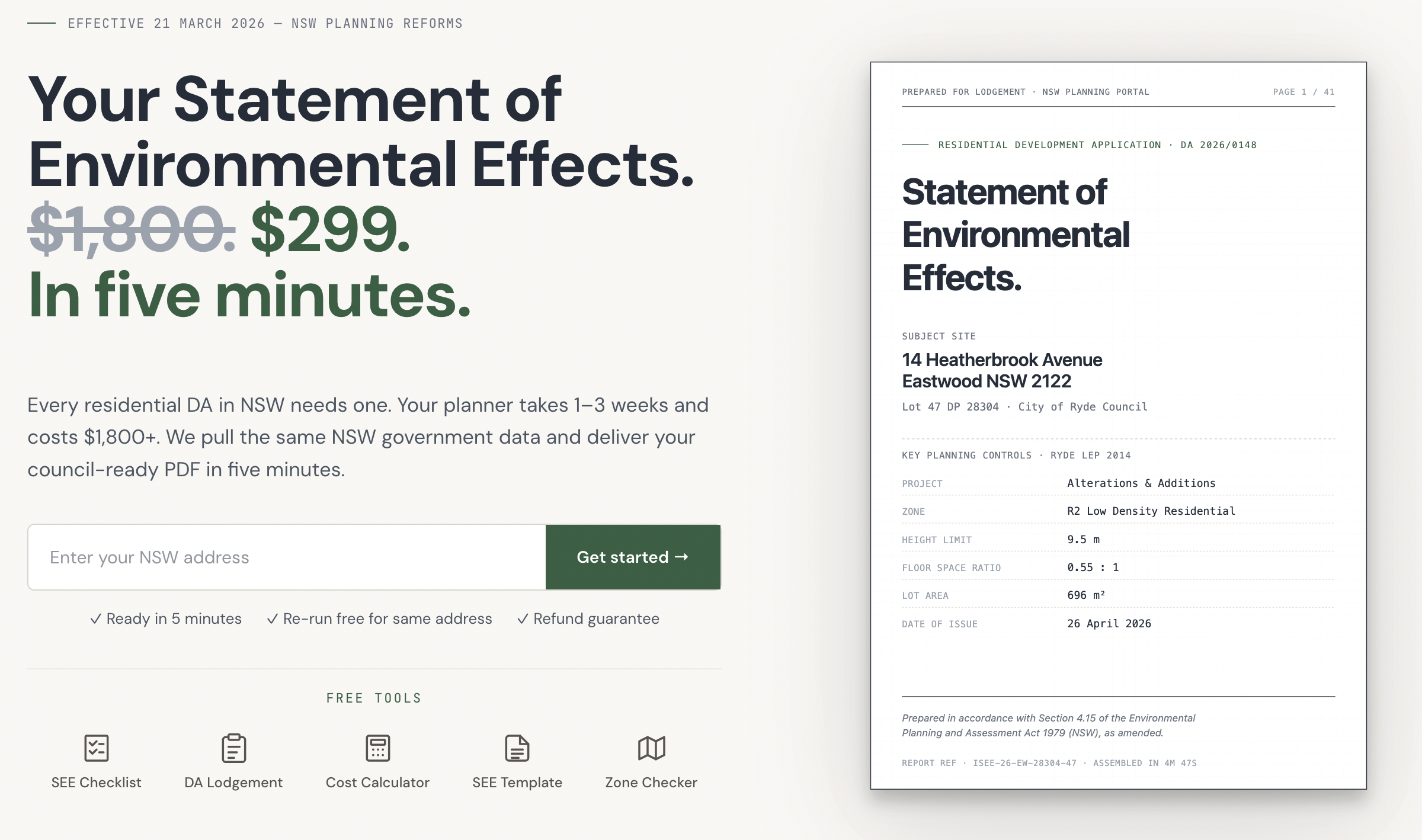
instantSEE generates a council-ready SEE for your NSW residential DA in 5 minutes AUD. The platform pulls data directly from NSW government sources and produces a compliant PDF report formatted to council requirements. For homeowners and small developers who need to lodge a DA without the delay and cost of traditional planning consultants, instantSEE is a practical, affordable solution built specifically for the NSW planning system.
Frequently asked questions
What are the three types of development applications in NSW?
Can I use CDC for a dual occupancy in NSW?
What documents are required for a residential DA in NSW?
Why does my DA take longer than the stated 40 to 90 days?
Do I need a Statement of Environmental Effects for a CDC?
Ready to get your SEE report?
Skip the writing. Get a DA-ready Statement of Environmental Effects in 5 minutes.
Get your SEE report