Environmental Impact Assessment (EIA) is a systematic, preventive process that evaluates the potential environmental consequences of a proposed development before any approvals are granted or construction begins. The role of environmental impact assessment is to serve as a decision-support tool, not a bureaucratic formality. It identifies, predicts, and mitigates environmental and social impacts before they become costly problems. For NSW homeowners and developers lodging development applications (DAs) under the Environmental Planning and Assessment Act 1979 (EP&A Act 1979), understanding how EIA works, and what documents it requires, is the difference between a smooth approval and a stalled project.
Get a council-ready Statement of Environmental Effects for your DA in 5 minutes — no town planner, no waiting.
Get your SEE report →What is the environmental impact assessment process?
The formal EIA process involves nine key cyclical stages, each building on the last. Skipping or rushing any stage creates data gaps that regulators will flag. Here is what the full process looks like in order:
- Screening — Determines whether a project requires a full EIA or a simpler assessment.
- Scoping — Defines the boundaries of the study, including which environmental factors to assess.
- Baseline data collection — Gathers existing environmental conditions as a reference point.
- Impact prediction — Forecasts how the project will alter those baseline conditions.
- Mitigation planning — Designs measures to avoid, reduce, or offset predicted impacts.
- Public consultation — Invites affected communities and stakeholders to review findings.
- Regulatory appraisal — The relevant authority reviews the submitted documentation.
- Decision-making — A formal approval or refusal, often within 90 days of complete data submission.
- Ongoing monitoring — Tracks actual impacts against predictions throughout construction and operation.
Baseline data collection is one of the most underestimated stages. Seasonal data collection can take between three months and a full year for environmentally sensitive sites. Failing to plan for this timeline is one of the most common causes of project delays.
Pro Tip: Start baseline data collection as early as possible, ideally before you finalise the project design. Waiting until after design lock-in means you may need expensive redesigns if the data reveals a constraint.

Public consultation is equally critical. Effective public participation can change project outcomes by surfacing environmental and social risks that the project team has overlooked. It also builds the community trust that regulators look for when assessing project legitimacy.
EA vs EIS: which assessment does your project need?
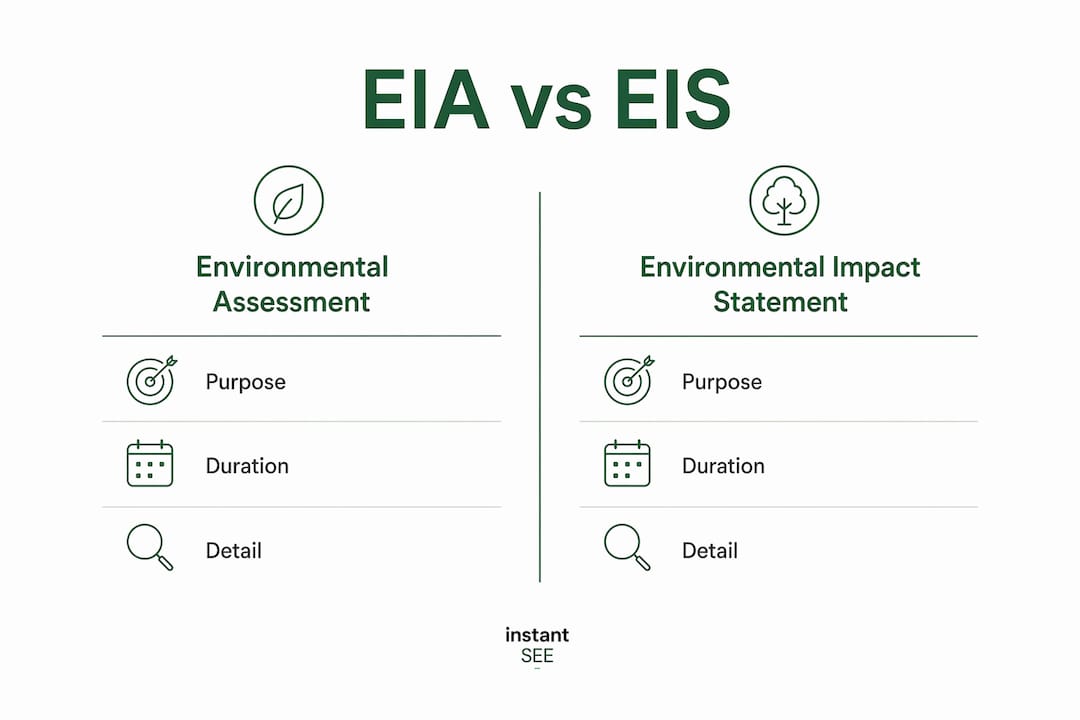
Not every project requires the same level of assessment. The two primary instruments are the Environmental Assessment (EA) and the Environmental Impact Statement (EIS), and choosing the wrong one creates compliance risk.
| Feature | Environmental Assessment (EA) | Environmental Impact Statement (EIS) |
|---|---|---|
| Purpose | Used when impact significance is uncertain | Required when significant impacts are likely |
| Typical timeline | 2–3 years | 3–4 years or more |
| Procedural depth | Moderate; may lead to a Finding of No Significant Impact | Extensive; full public review and regulatory scrutiny |
| Typical projects | Smaller infrastructure upgrades, residential subdivisions | Major industrial, transport, or energy projects |
| Outcome | Finding of No Significant Impact (FONSI) or triggers EIS | Formal approval with binding conditions |
An EA is the starting point when you are unsure whether your project will cause significant environmental harm. If the EA concludes that significant impacts are likely, it triggers the requirement for a full EIS. In NSW, the EP&A Act 1979 and the EP&A Regulation 2021 prescribe which projects require which level of assessment, and the thresholds are project-specific.
For residential DA applicants in NSW, the most common document required is a Statement of Environmental Effects (SEE), which sits within the broader environmental impact evaluation role as a project-level assessment tool. The SEE is not the same as a full EIS, but it must address the same core questions: what are the impacts, and how will they be managed?
Pro Tip: Check your local council's development control plan (DCP) and the relevant Local Environmental Plan (LEP) before commissioning any assessment. These documents specify exactly which environmental factors your SEE or EIA must address for your zone and project type.
What is the four-level mitigation hierarchy in EIA?
Spend 5 minutes, not 3 weeks
instantSEE generates a complete, DA-ready Statement of Environmental Effects online. No town planner. No waiting.
Get your SEE report in 5 minutes →Mitigation planning is where EIA moves from analysis to action. The four-level mitigation hierarchy ranks impact management strategies in order of preference, from most to least desirable:
- Avoid — Redesign or relocate the project to prevent the impact from occurring at all. This is the most preferred option because it eliminates harm rather than managing it.
- Minimise — Reduce the scale, intensity, or duration of the impact. Examples include adjusting construction hours to protect wildlife breeding seasons or reducing the footprint of a building to preserve native vegetation.
- Rehabilitate — Restore the affected environment after construction. This applies when some disturbance is unavoidable, such as revegetating a cleared area with locally endemic species.
- Compensate — Offset residual impacts through biodiversity credits or equivalent environmental gains elsewhere. This is the least preferred option because the original damage still occurs.
Comprehensive mitigation planning requires prioritising avoidance and minimisation before considering rehabilitation or compensation. Regulators and community stakeholders view compensation-heavy proposals with scepticism, particularly when avoidance was clearly feasible. The hierarchy is not just a planning framework. It is a signal of good faith to the approving authority.
In practice, most projects use a combination of all four levels. A residential development might avoid a riparian corridor entirely (avoid), reduce hard surfaces to limit stormwater runoff (minimise), revegetate disturbed areas with native groundcovers (rehabilitate), and purchase biodiversity credits to offset residual tree loss (compensate).
Is EIA a strategic asset or just a compliance requirement?
EIA is fundamentally a decision-support process that reduces long-term project costs by identifying risks early and preventing expensive design changes, legal disputes, or project cancellations. Treating it as a box-ticking exercise is one of the most costly mistakes a developer can make.
The benefits of environmental impact assessments extend well beyond regulatory compliance:
- Reduced redesign costs — Identifying a constraint before design finalisation costs far less than discovering it during construction.
- Avoided legal exposure — Bypassing EIA procedures risks steep penalties, licence revocation, project halts, and costly site restoration, often exceeding initial construction costs.
- Improved public trust — A thorough, transparent assessment builds the social licence that keeps projects on schedule.
- Risk identification — EIA surfaces risks that internal project teams routinely miss, from groundwater contamination to heritage overlays.
Modern EIA practice increasingly integrates Social Impact Assessment (SIA), Health Impact Assessment (HIA), and Strategic Environmental Assessment (SEA) to capture cumulative and indirect impacts. This holistic approach strengthens both the quality of the assessment and its credibility with regulators and the public.
One element that developers frequently overlook is the 'no-build' alternative analysis. This analysis asks: what happens to the environment if the project does not proceed? It serves as a benchmark for the true environmental cost of development and is a mandatory element of a credible EIA. Regulators use it to test whether the project is genuinely justified.
A project that cannot withstand scrutiny against the no-build alternative is a project that needs to be redesigned, not just better documented.
Pro Tip: Commission your EIA at the earliest possible stage of project planning, before site acquisition if feasible. The preventive value of EIA disappears entirely once approvals are granted. An EIA conducted after approval is a compliance formality, not a planning tool.
EIA is also evolving. Modern frameworks are moving away from a purely regulatory exercise toward a strategic tool that integrates social and health considerations and genuine public participation. For developers, this means the quality of your assessment now directly affects your project's reputation, not just its approval prospects.
Key takeaways
The role of environmental impact assessment is to prevent harm before it occurs, reduce project risk, and support sustainable development decisions through structured, evidence-based evaluation.
| Point | Details |
|---|---|
| EIA is preventive, not reactive | Conduct assessment before project approval to capture its full planning value. |
| Nine stages define the process | Each stage from screening to monitoring builds on the last; skipping stages creates regulatory risk. |
| EA and EIS serve different purposes | Choose the correct instrument based on impact significance and project scale under the EP&A Act 1979. |
| Mitigation follows a strict hierarchy | Prioritise avoidance and minimisation before considering rehabilitation or compensation. |
| EIA reduces long-term costs | Early risk identification prevents expensive redesigns, legal disputes, and project delays. |
Why timing is everything in environmental assessment
The single most important variable in any environmental assessment is when it happens. An EIA conducted before project design is finalised gives the project team real options. It can redirect a road alignment, shift a building footprint, or trigger a change in materials before any money is committed to a particular solution. Once construction contracts are signed, those options disappear.
Practitioners who work across multiple jurisdictions consistently report that the projects with the smoothest approvals are those where the proponent treated the EIA as a design input, not a sign-off requirement. Baseline data informed the layout. Mitigation measures were built into the engineering drawings from the start. Public consultation shaped the final proposal rather than defending a fixed one.
The bottlenecks in most EIA processes are predictable: baseline data collection takes longer than expected, public consultation surfaces objections that require design responses, and regulatory appraisal stalls when documentation is incomplete. None of these are surprises. They are all manageable if the process starts early enough.
For NSW developers lodging residential DAs, the equivalent document is the Statement of Environmental Effects. The SEE must address the same core questions as a full EIA, scaled to the project. Using a well-structured SEE template from the outset reduces the risk of omissions that trigger council requests for additional information.
The importance of environmental assessments will only grow as planning authorities in NSW and nationally place greater weight on climate resilience, biodiversity, and community impact. Developers who understand the process and engage with it seriously will find it a genuine advantage, not an obstacle.
Prepare your NSW statement of environmental effects with Instantsee
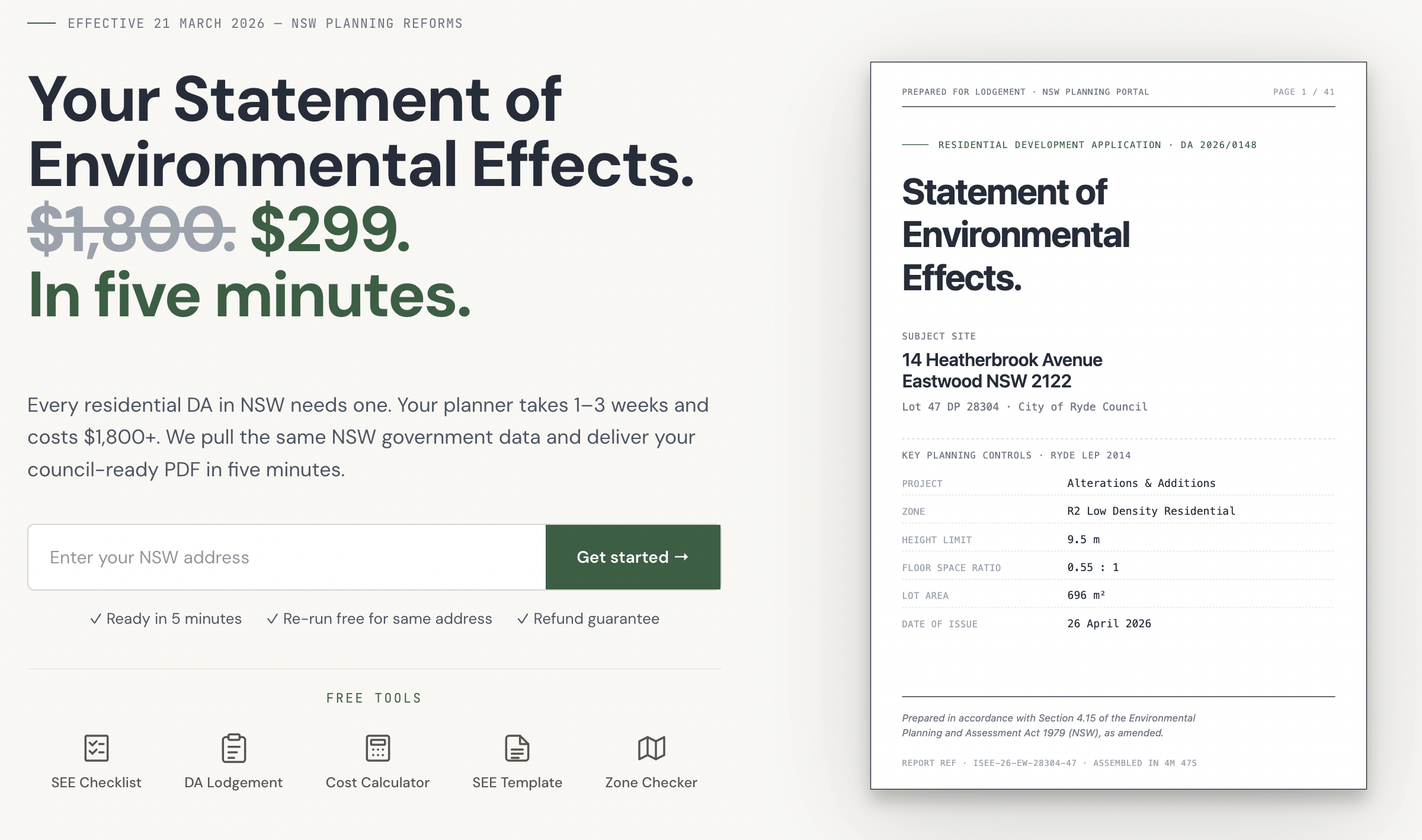
For NSW homeowners and small developers, preparing a compliant Statement of Environmental Effects is a mandatory step in lodging a DA through the NSW Planning Portal (planningportal.nsw.gov.au). instantSEE generates a council-ready SEE for residential DAs in NSW in 5 minutes. A town planner providing the same document typically charges $800–$2,500 and takes 1–3 weeks. instantSEE automates data collection from NSW government sources and applies the compliance checks required under the EP&A Act 1979 and EP&A Regulation 2021. If you want to understand exactly what your SEE must contain, start with the NSW SEE checklist before you lodge. To generate your document directly, visit instantSEE.
Frequently asked questions
What is the role of environmental impact assessment?
How does environmental assessment work in NSW?
What is the difference between an EA and an EIS?
What happens if you skip the EIA process?
What is the mitigation hierarchy in EIA?
Ready to get your SEE report?
Skip the writing. Get a DA-ready Statement of Environmental Effects in 5 minutes.
Get your SEE report