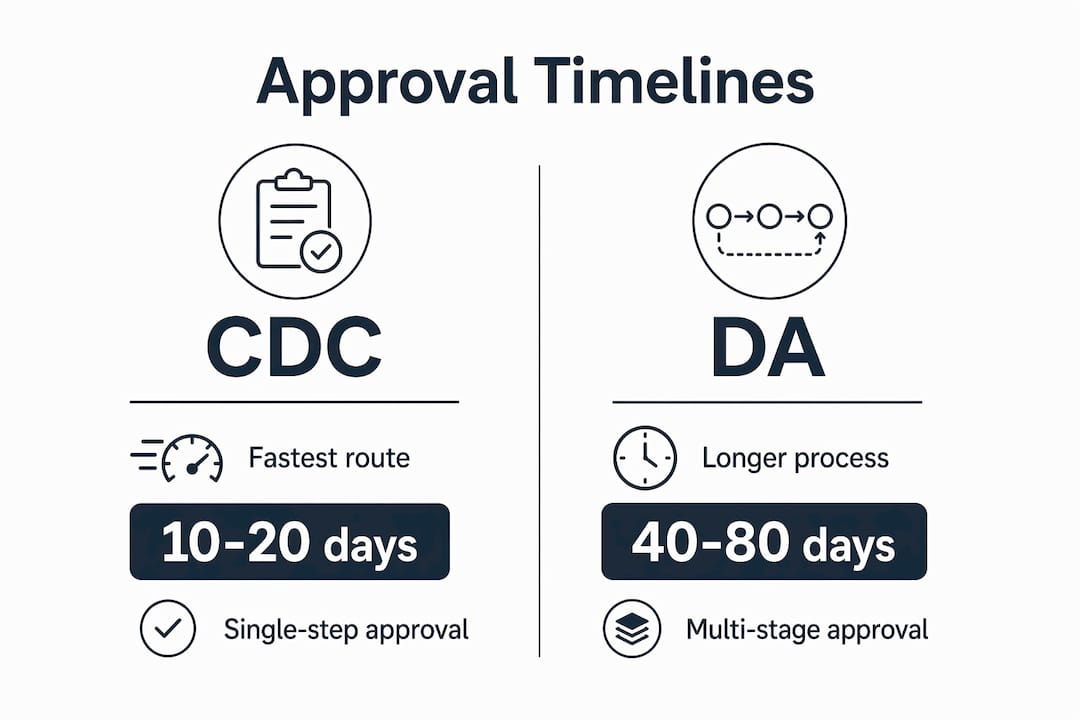
The property development approval timeline in NSW is determined primarily by which of two statutory pathways you use: the Complying Development Certificate (CDC) or the Development Application (DA). A CDC can be issued in as little as 10 to 20 days, while a standard DA averages around 80 days, with complex or integrated developments taking considerably longer. Understanding these pathways, their prerequisites, and the legal timing benchmarks that govern them is the clearest way to protect your project schedule and budget in New South Wales.
Get a council-ready Statement of Environmental Effects for your DA in 5 minutes — no town planner, no waiting.
Get your SEE report →What are the NSW property development approval pathways?
The two main approval routes in NSW are the Complying Development Certificate and the Development Application, and they differ significantly in both process and timeline.
A CDC combines planning and construction approval into a single step, which is why it is faster than the DA route. An accredited certifier, rather than council, assesses the application against the State Environmental Planning Policy (Codes SEPP). If your project meets all prescribed development standards, approval is largely administrative. The DA, by contrast, requires separate planning consent from council followed by a Construction Certificate before building work can begin. This two-stage structure is the primary reason DA timelines extend well beyond those of the CDC.
Typical timeline ranges at a glance
| Pathway | Assessment body | Typical timeline | Neighbour notification |
|---|---|---|---|
| CDC (standard) | Accredited certifier | 20 days | 14 days minimum |
| CDC (Pattern Book) | Accredited certifier | 10 days | 7 days minimum |
| DA (ordinary) | Local council | 40 to 90+ days | 14 to 28 days |
| DA (integrated/designated) | Council + state agencies | 60 to 120+ days | Varies |
The NSW Government’s targeted assessment initiatives aim to reduce ordinary DA times for low-rise residential development to 50 days or less. That target reflects political pressure on councils to process housing applications faster, but it is not yet a guaranteed outcome for every project.
Common examples for each pathway:
-
CDC: Single-storey additions, secondary dwellings (granny flats), new homes on standard residential lots meeting Codes SEPP controls, and swimming pools
-
DA: Multi-dwelling housing, dual occupancies in certain zones, heritage-affected properties, and any development that does not meet CDC standards
Pro Tip: Before committing to a pathway, check your property’s zoning and applicable development standards on the NSW Planning Portal. A project that narrowly misses CDC eligibility can often be redesigned to qualify, saving weeks of assessment time.
What documentation do you need before lodging?
Preparation quality is the single biggest variable within your control when managing the property development approval timeline in NSW. An incomplete application does not simply sit in a queue. The assessment clock does not start until the application is deemed complete under the relevant pathway standards, meaning gaps in your submission add direct weeks to your timeline.
The following documents are mandatory or commonly required at lodgement:
-
BASIX certificate: Required for new homes, renovations over $50,000, and pools over 40,000 litres. BASIX assesses energy and water efficiency commitments and must be obtained before lodgement, not after.
-
Site plan and floor plans: Prepared by a registered architect or building designer, drawn to scale and dimensioned accurately.
-
Statement of Environmental Effects (SEE): A mandatory planning report for most DAs, explaining how the proposal addresses relevant planning controls. This document is often the most time-consuming to prepare.
-
Survey plan: Required for most new builds and significant additions.
-
Structural engineering details: Mandatory for CDC lodgement because construction and planning approval are combined. Unlike a DA, you cannot separate planning consent from construction detailing in the CDC pathway.
For CDC applications specifically, technical documentation must be complete at lodgement because there is no opportunity to submit construction details later. This front-loads the preparation burden but compresses the overall project timeline significantly.
All applications in NSW are lodged through the NSW Planning Portal, which is the government’s centralised digital platform for development assessment.
Pro Tip: Obtain your BASIX certificate early in the design process, not at the end. BASIX commitments can require design changes, and discovering this after your plans are finalised adds unnecessary cost and delay.
How does the approval timeline unfold step by step?
Spend 5 minutes, not 3 weeks
instantSEE generates a complete, DA-ready Statement of Environmental Effects online. No town planner. No waiting.
Get your SEE report in 5 minutes →Understanding the sequential stages of the NSW property approval process helps you anticipate bottlenecks before they occur. The following steps apply to a standard DA, with CDC variations noted where relevant.
-
Pre-lodgement preparation. Confirm zoning, applicable planning controls, and pathway eligibility. For complex DAs, a pre-lodgement meeting with council is advisable. This stage has no fixed duration but typically takes two to eight weeks depending on design complexity.
-
Lodgement via the NSW Planning Portal. Submit all required documents digitally. Council or the certifier then reviews the application for completeness. If documents are missing, a Request for Further Information (RFI) is issued, pausing the assessment clock until you respond.
-
Public notification and neighbour notification. For DAs, councils typically notify neighbours for 14 to 28 days depending on the development type and local environmental plan. For CDC applications, Pattern Book complying development requires 7 days’ notification while standard complying development requires 14 days. This period runs concurrently with assessment in some cases but adds a mandatory minimum to the total timeline.
-
Assessment and RFI period. Council planners or accredited certifiers review the application against relevant controls. RFIs are common and can add two to four weeks per round if your response is delayed.
-
Decision. Council issues a determination notice granting consent (with or without conditions), refusing the application, or deferring for further information. For CDCs, the certifier issues the certificate directly.
-
Post-approval steps. After DA approval, a Construction Certificate is mandatory before any building work commences. This is a separate approval covering construction compliance and adds time to the overall project schedule. CDCs do not require this additional step because construction approval is already embedded.
Statutory deemed refusal periods
NSW law sets deemed refusal clocks of 40, 60, and 90 days for ordinary, integrated, and state significant development respectively. Once these periods expire without a determination, you gain the right to appeal to the NSW Land and Environment Court. These clocks are legal tools, not typical approval timelines. Treating them as expected decision dates leads to poor project scheduling.
Common pitfalls and how to manage delays
Most delays in the NSW property development approval process are preventable. The following issues account for the majority of timeline extensions experienced by homeowners and developers.
-
Incomplete applications. Missing certificates such as BASIX trigger RFIs that pause the assessment clock entirely. Every day you take to respond is a day added to your approval timeline.
-
Inaccurate or inconsistent drawings. Discrepancies between site plans, floor plans, and elevations are a common RFI trigger. A thorough internal review before lodgement catches most of these issues.
-
Slow responses to RFIs. Councils and certifiers move on to other applications while waiting for your response. Prioritise RFI responses as urgently as the original lodgement.
-
Neighbour objections. Objections do not automatically delay a DA, but they can trigger additional assessment requirements or referrals. Proactively speaking with neighbours before lodgement reduces the likelihood of formal objections.
-
Underestimating the SEE. A poorly prepared Statement of Environmental Effects is one of the most common reasons councils return applications or issue detailed RFIs. The SEE must address every relevant planning control with specificity.
“The applications that sail through assessment are rarely the most straightforward projects. They are the ones where the applicant has done the council’s job for them before lodgement.” This observation from experienced NSW certifiers reflects a consistent pattern: preparation quality predicts approval speed more reliably than project complexity.
If council fails to determine your DA within the deemed refusal period, you can appeal to the NSW Land and Environment Court. This right is most useful as a negotiation tool. Notifying council of your intention to appeal often accelerates a pending determination without requiring formal court proceedings.
Pro Tip: For multi-project schedules, track deemed refusal dates in a project management system from the day of lodgement. These dates are leverage points, not deadlines to wait for passively.
Key takeaways
The fastest property development approval timeline in NSW requires choosing the correct pathway, submitting a complete application, and responding to any requests for information without delay.
| Point | Details |
|---|---|
| CDC is the fastest pathway | Eligible projects can receive approval in 10 to 20 days via an accredited certifier. |
| DA averages 80 days | Government initiatives target 50 days for low-rise residential, but this is not yet guaranteed. |
| Completeness drives speed | Assessment clocks only start when the application is deemed complete; gaps add direct weeks. |
| BASIX must come first | Obtain your BASIX certificate during design, not after, to avoid mandatory redesign delays. |
| Deemed refusal is a legal tool | Use the 40, 60, or 90-day clocks as negotiation leverage, not as expected decision dates. |
What I’ve learned about managing NSW approval timelines
After working through dozens of DA and CDC projects across NSW, the single most consistent finding is this: pathway selection is decided too late. Most applicants arrive at the planning stage with a design already locked in, then discover their project does not meet CDC standards by a narrow margin. At that point, redesigning to qualify feels like going backwards. In reality, it is almost always faster than proceeding through a full DA.
The 2026 government push to reduce DA times to 50 days for low-rise residential development is genuinely encouraging. But I would caution against building that target into your project schedule as a certainty. Council resourcing, RFI rounds, and neighbour notification periods all sit outside the government’s direct control. The 50-day target is a policy aspiration, not a statutory guarantee.
What does work, consistently, is treating the Statement of Environmental Effects as a strategic document rather than a compliance formality. A well-prepared SEE anticipates every question a council planner might raise and answers it before the RFI is issued. That single document has more influence over approval speed than almost any other factor in the DA process. Applicants who invest properly in the SEE at the start almost never face the drawn-out back-and-forth that makes DA timelines unpredictable.
The deemed refusal clock is also underused as a negotiation tool. Most applicants wait passively. The applicants who get faster outcomes are the ones who notify council of the approaching deemed refusal date and request a meeting. That conversation almost always produces a determination or a clear timeline commitment.
— Alex
Get your Statement of Environmental Effects in minutes
Preparing a council-ready Statement of Environmental Effects is one of the most time-consuming steps in the DA process, and one of the most consequential. A poorly prepared SEE is the leading cause of RFIs and returned applications.
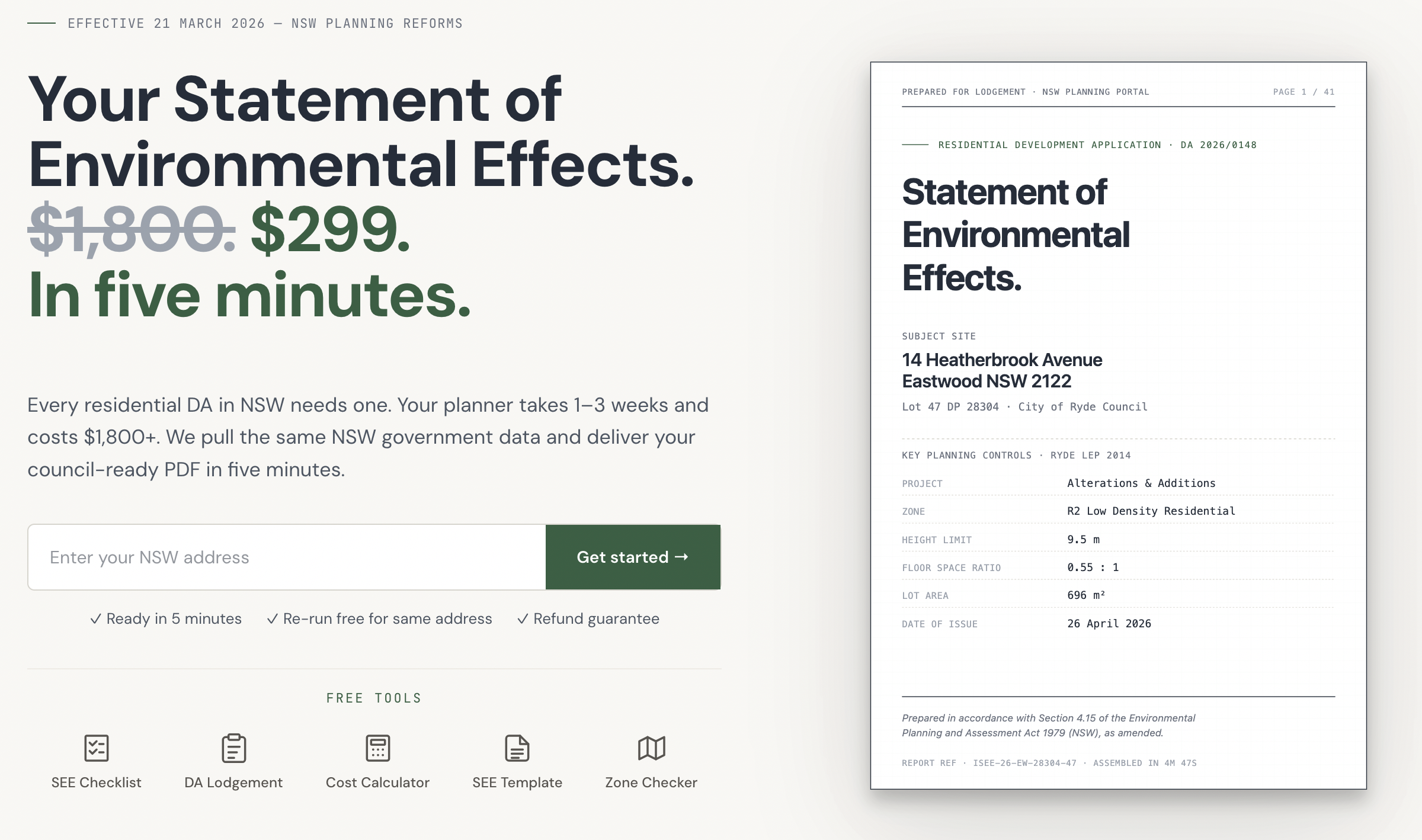
Instantsee delivers a council-ready SEE report in five minutes , drawing directly from NSW government data sources to perform all required compliance checks automatically. Traditional planners charge $800 to $2,500 and take weeks to deliver the same document. Instantsee includes free re-runs and a full refund guarantee if the SEE causes your application to be returned. For homeowners and developers who want to move through the NSW planning approval process without unnecessary delays, it is the most direct way to get this mandatory document right the first time.
Frequently asked questions
How long does a development application take in NSW?
What is the fastest way to get development approval in NSW?
Do I need a BASIX certificate before lodging a development application?
What happens if council does not decide my DA on time?
Is a Construction Certificate required after DA approval?
Ready to get your SEE report?
Skip the writing. Get a DA-ready Statement of Environmental Effects in 5 minutes.
Get your SEE report