A planning proposal in NSW is the formal statutory document used to request an amendment to a Local Environmental Plan (LEP), which is the instrument that controls land zoning and development standards across a council area. Without a planning proposal, the Department of Planning and Environment can only assess an application against what is already permissible under the existing LEP. This makes planning proposals the gatekeeper for what development types can be legally considered at all. If you are a homeowner, developer, or planning professional seeking to change how land may be used in New South Wales, understanding the planning proposal process under the Environmental Planning and Assessment Act 1979 (EP&A Act) is the starting point for any rezoning or development control amendment.
Get a council-ready Statement of Environmental Effects for your DA in 5 minutes — no town planner, no waiting.
Get your SEE report →What is a planning proposal in NSW?
A planning proposal is defined as the document that initiates the preparation or amendment of a Local Environmental Plan under the EP&A Act 1979. LEPs are the primary land-use planning instruments in NSW, setting out permitted land uses, development standards such as height and floor space ratio, and any special provisions that apply to a specific area. A planning proposal sets land zoning and development controls by requesting that the relevant LEP be changed to reflect a new planning outcome. This means that rezoning land from rural to residential, or increasing a height limit in a commercial zone, both require a planning proposal before any development application can be assessed against the new controls.
The legal basis for planning proposals sits within Part 3 of the EP&A Act 1979, supported by the Environmental Planning and Assessment Regulation 2021 (EP&A Regulation 2021). These instruments prescribe who can prepare a planning proposal, what it must contain, and how it must be assessed. A Planning Proposal Authority (PPA) is the body responsible for preparing and progressing a planning proposal. The PPA is typically the relevant local council, but the Minister for Planning or a state agency can also act in that role for proposals of state significance.

Any person or organisation can request that a council prepare a planning proposal. However, the council or PPA retains the authority to decide whether to proceed. Proposals must demonstrate strategic merit, meaning they must align with applicable regional and district plans, state environmental planning policies (SEPPs), and any relevant local strategic planning statements.
Pro Tip: Before lodging a request, review the council's local strategic planning statement and any applicable district plan. Proposals that clearly align with these documents are far more likely to receive council support and progress efficiently through the assessment stages.
How does the planning proposal process work in NSW?
The planning proposal process in NSW follows a structured lifecycle. The City of Wollongong's published lifecycle summary identifies nine distinct steps from initial lodgement to finalisation, which reflects the standard approach applied across most NSW councils. Understanding each stage helps proponents plan their resources, technical studies, and consultation activities accordingly.
The nine stages are as follows:
- Lodgement with council: The proponent submits the planning proposal request to the relevant council or PPA, along with supporting technical studies and a justification report.
- Council assessment and determination: The council assesses the proposal for strategic and site-specific merit, and decides whether to support it proceeding to Gateway.
- Council seeks Gateway determination: If supported, the council forwards the proposal to the Department of Planning and Environment (or the Minister) for a Gateway determination.
- Gateway determination issued: The Department assesses the proposal and either approves it to proceed (with or without conditions), requires amendments, or refuses it.
- Additional studies and stakeholder consultation: The proponent completes any technical studies or agency consultation required by the Gateway determination conditions.
- Public exhibition: The proposal is placed on public exhibition for a mandatory period, during which community members and stakeholders can make submissions.
- Review of submissions and assessment report: The council or PPA reviews all submissions and prepares an assessment report addressing the issues raised.
- Post-exhibition review and ongoing engagement: Further engagement or amendments may be required based on submissions or agency feedback.
- Finalisation and gazettal: The proposal is forwarded to Parliamentary Counsel for drafting, and the LEP amendment is made and published in the NSW Government Gazette.
The NSW Planning Portal (planningportal.nsw.gov.au) provides public tracking of proposals through distinct status stages including Under Assessment, Pre-Exhibition, On Exhibition, Post-Exhibition, Finalisation, and Made. This transparency allows community members and proponents to monitor progress in real time.
| Stage | Description |
|---|---|
| Under Assessment | Council is reviewing the proposal for strategic merit |
| Pre-Exhibition | Gateway conditions are being satisfied before public display |
| On Exhibition | Open for public submissions (minimum 28 days) |
| Post-Exhibition | Submissions reviewed, assessment report prepared |
| Finalisation | LEP amendment drafted and gazetted |
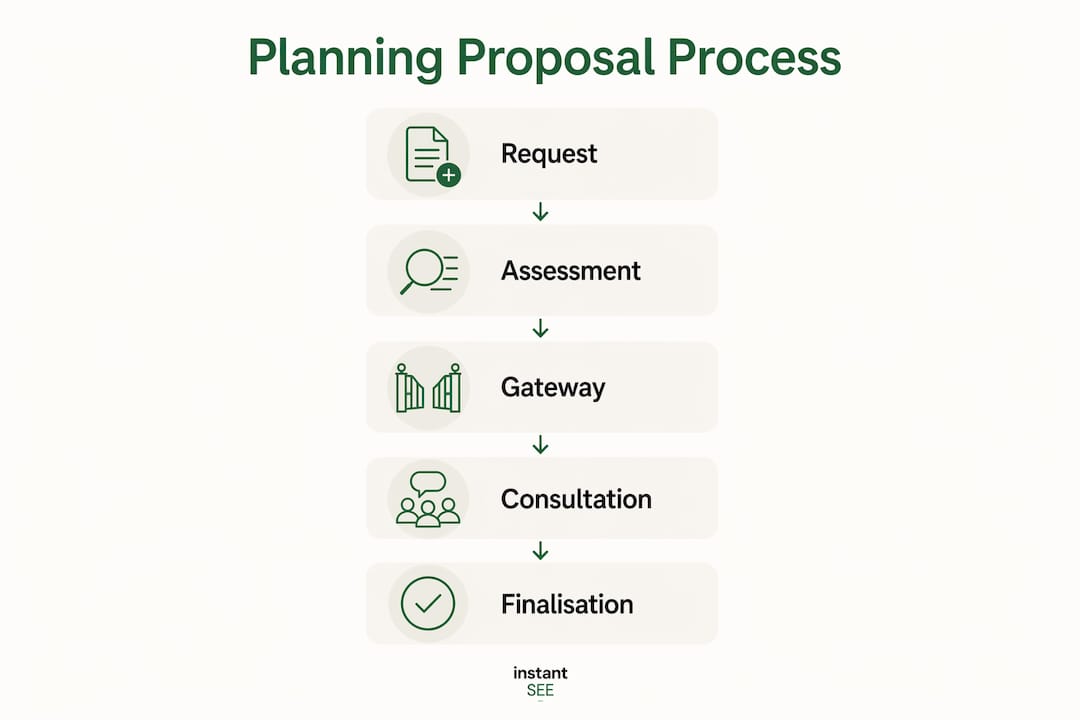
Pro Tip: Use the NSW Planning Portal's status indicators to time your community consultation activities. Engaging affected neighbours and stakeholders during the Pre-Exhibition stage, before the formal exhibition opens, can reduce the volume of adverse submissions and demonstrate proactive community engagement to the council.
What is the Gateway determination and why does it matter?
Spend 5 minutes, not 3 weeks
instantSEE generates a complete, DA-ready Statement of Environmental Effects online. No town planner. No waiting.
Get your SEE report in 5 minutes →The Gateway determination is the formal strategic checkpoint in the NSW planning proposal pathway, issued by the Department of Planning and Environment (or the Minister) after a council has resolved to support a proposal. The Gateway functions as a checkpoint that confirms whether a proposal has sufficient planning merit to proceed to community consultation and plan-making steps. A proposal that fails the Gateway test does not proceed to public exhibition, which means no LEP amendment can be made.
The Gateway determination applies a strategic merit test, which assesses whether the proposal:
- Is consistent with applicable state and regional planning policies and strategies
- Has site-specific merit, meaning the land is suitable for the proposed use or development standard
- Requires any additional technical studies, such as traffic, flooding, or biodiversity assessments
- Should be referred to any state agencies for comment during exhibition
- Can be exhibited for the standard 28-day period or requires a longer consultation window
The strategic merit test is the most critical filter in the entire planning proposal process. A proposal that does not clearly align with the relevant district plan or regional strategy is likely to be refused at Gateway, regardless of its local support. This is why evidence-led preparation is not optional. It is the foundation of a viable proposal.
A Gateway determination sets the conditions and timeline for everything that follows, including which agencies must be consulted, what studies must be completed, and how long the public exhibition must run. Proponents who treat the Gateway conditions as a checklist rather than a minimum standard tend to encounter fewer delays in the post-exhibition phase.
The Department typically issues a Gateway determination within 90 days of receiving the proposal from the council, though complex or contentious proposals may take longer. Conditions attached to the determination are legally binding on the PPA and the proponent.
What are the public exhibition requirements for planning proposals?
Public exhibition is a mandatory stage in the planning proposal process, and the exhibition period is mandated at 28 days under the EP&A Act framework, subject to any conditions set by the Gateway determination. This minimum period applies to all planning proposals, draft development control plans, and contributions plans. The Gateway determination may require a longer exhibition period for proposals with significant community impact.
During exhibition, the following consultation activities are typically required:
- Public notice in a local newspaper and on the council's website
- Display of the proposal documents on the NSW Planning Portal under the "On Exhibition" status
- Written notification to adjoining and nearby landowners where required by the Gateway conditions
- Referral to state agencies nominated in the Gateway determination for formal comment
- Opportunity for any person to make a written submission to the council
The NSW Government's Statewide Community Participation Plan sets out the minimum standards for community engagement across all planning processes, providing consistency in how councils notify and consult the public. Submissions received during exhibition must be formally considered by the council or PPA in the post-exhibition assessment report. Submissions do not carry a veto right, but they can influence whether the proposal is amended, deferred, or refused after exhibition.
The public status listings on the NSW Planning Portal serve as a process map for community members, showing exactly when a proposal is open for comment and when decisions are being made. Proponents should monitor these stages closely, as the transition from Post-Exhibition to Finalisation can move quickly once the assessment report is adopted.
Preparing a planning proposal that progresses efficiently requires treating the document as an evidence-led package aligned with Gateway and agency requirements from the outset. Proposals that arrive at Gateway without adequate technical studies or strategic justification are typically returned for amendment, adding months to the timeline.
The following practices improve proposal outcomes:
- Engage the council early. A pre-lodgement meeting with the council's strategic planning team clarifies what studies are required and whether the proposal aligns with the council's planning priorities.
- Commission technical studies in advance. Studies such as traffic impact assessments, flood risk analyses, and biodiversity assessments take time to prepare. Starting them before lodgement avoids delays at the Gateway conditions stage.
- Align with district and regional plans. The Greater Sydney Commission's district plans and the relevant regional strategy are the primary reference documents for the strategic merit test. Proposals that cannot demonstrate alignment with these documents face a high risk of Gateway refusal.
- Prepare a detailed justification report. The justification report is the core of the planning proposal. It must explain the need for the amendment, the strategic basis, the site context, and the likely planning outcomes.
- Monitor the NSW Planning Portal. Once lodged, track the proposal's status through the public portal stages to anticipate when exhibition and decision windows will open.
Councils often require iteration and additional consultation periods before finalisation. Proponents who build the evidence base early and engage stakeholders proactively are better positioned to address post-exhibition issues without significant rework. When the planning proposal results in a rezoning that permits new residential development, a development application (DA) will follow. That DA will require a Statement of Environmental Effects (SEE) as a mandatory supporting document. Reviewing the DA lodgement requirements at the planning proposal stage helps proponents anticipate what documentation will be needed once the LEP amendment is made.
Pro Tip: If your planning proposal involves biodiversity-sensitive land, include a preliminary biodiversity assessment in your initial submission. The Biodiversity Assessment Method requires knowledge of permitted land uses, and providing this detail upfront reduces the likelihood of additional studies being required as a Gateway condition.
Key takeaways
A planning proposal is the mandatory statutory instrument for amending an LEP in NSW, and its success depends on strategic alignment, evidence-led preparation, and proactive engagement at every stage from lodgement to gazettal.
| Point | Details |
|---|---|
| Planning proposal definition | A formal document requesting an LEP amendment under the EP&A Act 1979, controlling land zoning and development standards. |
| Gateway determination | A mandatory strategic checkpoint that filters proposals for merit before public exhibition and plan-making proceed. |
| Exhibition period | A minimum 28-day public exhibition is required under the EP&A Act, with conditions set by the Gateway determination. |
| Evidence-led preparation | Proposals supported by technical studies and strategic alignment documents progress faster and face fewer Gateway conditions. |
| NSW Planning Portal tracking | Public status stages on planningportal.nsw.gov.au allow proponents and community members to monitor proposal progress in real time. |
The case for treating planning proposals as strategic documents
Planning proposals are frequently approached as administrative hurdles rather than strategic planning instruments. This is a costly misunderstanding. The Gateway determination process exists precisely because poorly prepared proposals consume significant public resources and delay legitimate development outcomes. Proposals that arrive at Gateway without a clear strategic basis, adequate technical studies, or demonstrated alignment with district plans are not just likely to fail. They set back the proponent's timeline by months and sometimes years.
The most effective approach is to treat the planning proposal as the primary strategic document in a development programme, not as a precursor to the "real" work. The evidence assembled for a planning proposal, including traffic studies, flood analyses, and biodiversity assessments, directly informs the development application that follows. Investing in that evidence base early produces compounding returns across the entire approval pathway.
The NSW Planning Portal's public tracking system is an underused resource for proponents. Monitoring competitor proposals in the same precinct or council area can reveal how the council is interpreting its strategic planning statement and what conditions Gateway is attaching to similar rezonings. This intelligence is freely available and directly applicable to proposal preparation.
Legislative reforms in 2026 have reinforced the 28-day exhibition requirement and clarified the relationship between planning proposals, draft development control plans, and contributions plans. Proponents operating across multiple council areas should review the updated EP&A Act provisions to confirm their exhibition and notification obligations are current.
Preparing your DA documents after a successful planning proposal
Once a planning proposal results in a gazetted LEP amendment, the next step is lodging a development application through the NSW Planning Portal (planningportal.nsw.gov.au). Every residential DA in NSW requires a Statement of Environmental Effects as a mandatory supporting document.
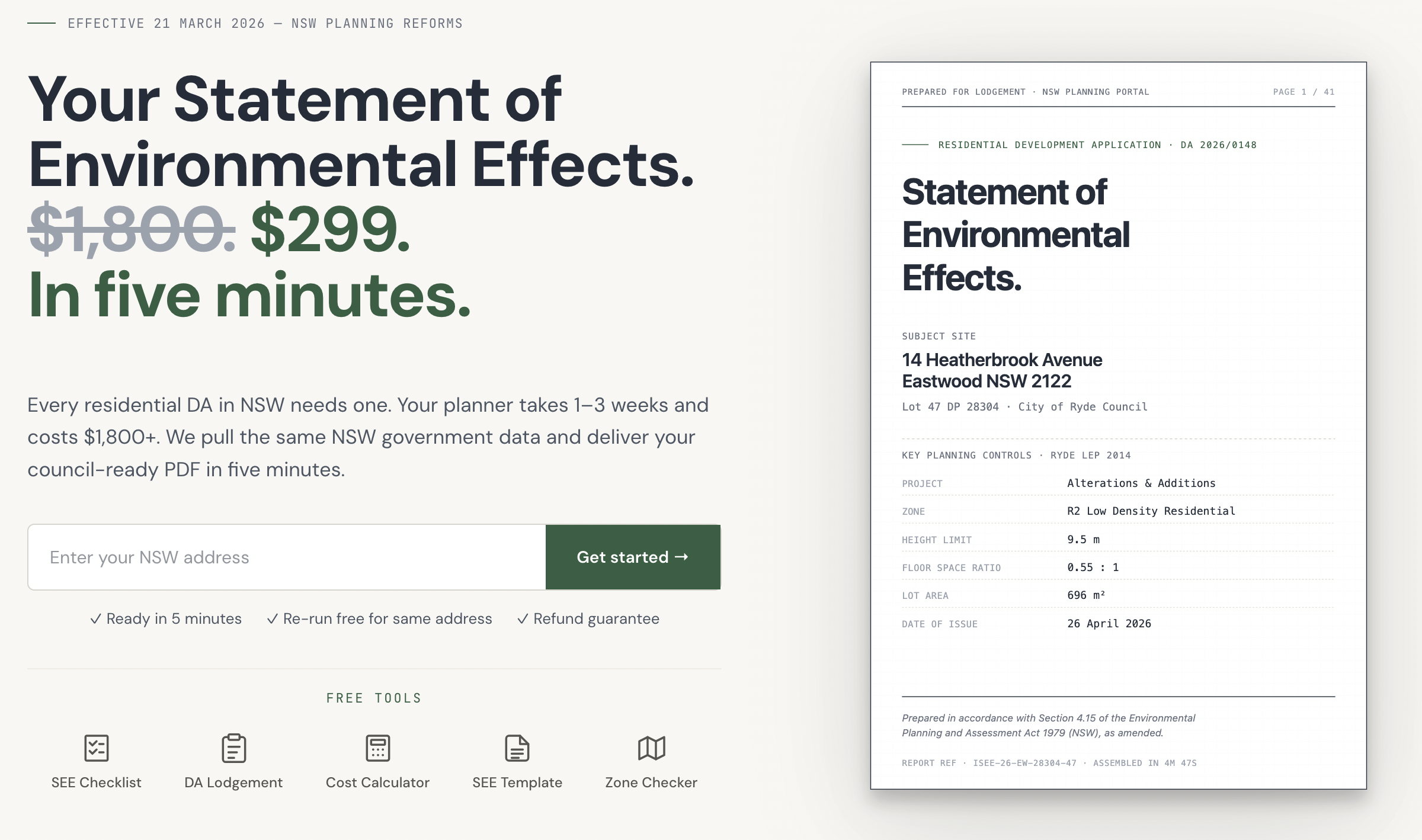
instantSEE generates a council-ready SEE for residential DAs in NSW in 5 minutes. Traditional town planners charge $800–$2,500 and take one to three weeks for the same document. instantSEE automates data collection from NSW government sources, producing a compliant PDF report that addresses the environmental and planning considerations councils require. For homeowners and small developers moving from a successful rezoning into the DA stage, reviewing the SEE requirements checklist is a practical first step before lodgement.
Frequently asked questions
What is a planning proposal in NSW?
How long does a planning proposal take in NSW?
What is the difference between a planning proposal and a development application?
Who can lodge a planning proposal in NSW?
Where can I track a planning proposal's progress in NSW?
Ready to get your SEE report?
Skip the writing. Get a DA-ready Statement of Environmental Effects in 5 minutes.
Get your SEE report