Key takeaways
- Core DA documents are set by Schedule 1 of the EP&A Regulation 2021
- Each of NSW's 128 councils adds its own extras via its DCP
- A BASIX certificate is required for most residential DA work
- Site constraints on your 10.7 certificate trigger specialist reports
- The SEE is the one document no consultant prepares for you
Every Development Application in NSW must include a core set of documents set by state law: a completed application form on the NSW Planning Portal, a Statement of Environmental Effects, architectural plans, a site plan, a BASIX certificate for residential work, an estimate of the cost of the development, and the owner's consent. Each council then adds its own requirements on top through its Development Control Plan. So your DA requirements in NSW are part state-wide baseline, part local.
That split is what trips people up. You can build a perfect document set for one council and find the next council wants a waste management plan, a notification plan, or a different cost report format that the first one never asked for. Lodge without it and your DA bounces at the completeness check before assessment even begins.
Get a council-ready Statement of Environmental Effects for your DA in 5 minutes — no town planner, no waiting.
Get your SEE report →- The core documents every NSW DA must include under state law
- What changes from one of NSW's 128 councils to the next
- Which specialist reports your site's constraints can trigger
- How to find your specific council's DA requirements
- Why the Statement of Environmental Effects is the one document you write yourself
What Every NSW DA Must Include
The state baseline is fixed by Schedule 1 of the EP&A Regulation 2021 and applies wherever you lodge in NSW — it is the floor every DA must clear before assessment can begin.
The baseline is the same wherever you lodge. Under Schedule 1 of the Environmental Planning and Assessment Regulation 2021, a development application must be made in the approved form on the NSW Planning Portal and contain a defined set of information and documents. This is the floor for every DA in the state, from a pool to a new dwelling.
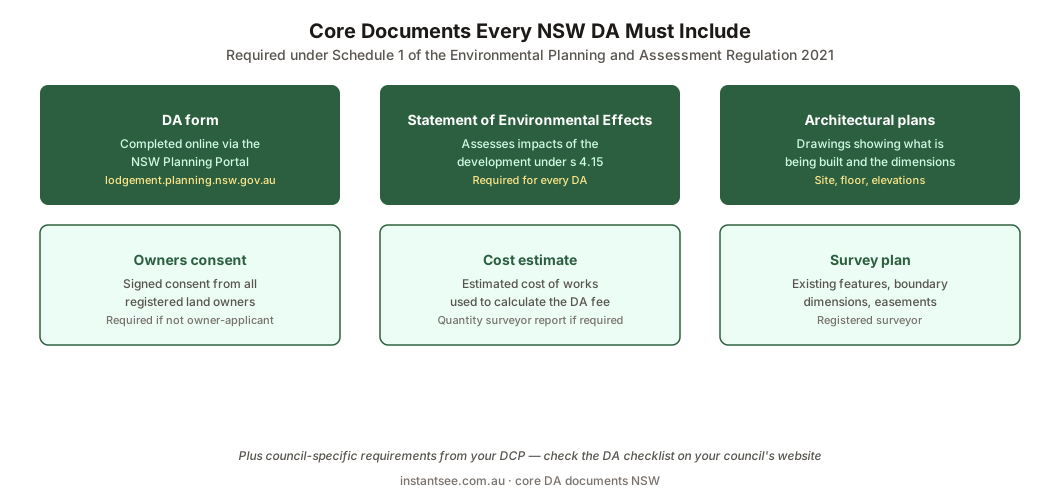
Figure 1: The core documents every NSW DA must include. This baseline is set by state law and applies wherever you lodge.
The required content includes the applicant's name and address, a description of the development, the address and title particulars of the land, the estimated cost of the development, the owner's consent where the applicant is not the owner, a list of the documents accompanying the application, a Statement of Environmental Effects, a site plan, and drawings of the development. A free DA Lodgement Checklist for NSW covers each of these so you can confirm the set is complete before you lodge. The portal will not let you finish lodgement without the mandatory items, which is why a missing document is caught at lodgement rather than weeks later.
- Completed application form on the NSW Planning Portal
- Statement of Environmental Effects
- Architectural plans and drawings with dimensions and setbacks
- Site plan showing the land and proposed development
- BASIX certificate for residential work under the Sustainable Buildings SEPP 2022
- Estimated cost of development for fee calculation
- Owner's consent where the applicant is not the registered owner
The Core Documents Explained
Each mandatory document plays a specific role in the DA, and understanding what each one does shows you which is most likely to hold up a self-lodged application.
Knowing the list is one thing; knowing what each document does tells you which one is likely to hold you up. The application form is generated as you complete the portal workflow. The owner's consent is straightforward unless the land has multiple owners or is held by a company or strata, in which case every owner has to consent.
The architectural plans and site plan come from your designer or draftsperson and must show the proposal accurately, with dimensions, levels, and setbacks. The BASIX certificate, required for most residential work under the Sustainable Buildings SEPP 2022, is produced through the BASIX tool and proves your energy and water targets are met. The estimated cost of the development is not a guess: councils use it to calculate your DA fee, and an under-estimate can be questioned. The one document none of those people hand you is the Statement of Environmental Effects, which has to be written specifically for your proposal. That is the piece most homeowners get stuck on, and the one this whole site is built around.
What Changes Council by Council
Spend 5 minutes, not 3 weeks
instantSEE generates a complete, DA-ready Statement of Environmental Effects online. No town planner. No waiting.
Get your SEE report in 5 minutes →Each of NSW's 128 councils layers its own requirements on top of the state baseline through its DCP and DA checklist — and two identical projects in two council areas can need completely different document sets.
On top of the state baseline, each of the 128 NSW councils sets its own detailed DA requirements through its Development Control Plan and its published DA lodgement guide. This is the layer that varies, and it is why two identical projects in two council areas can need different document sets.
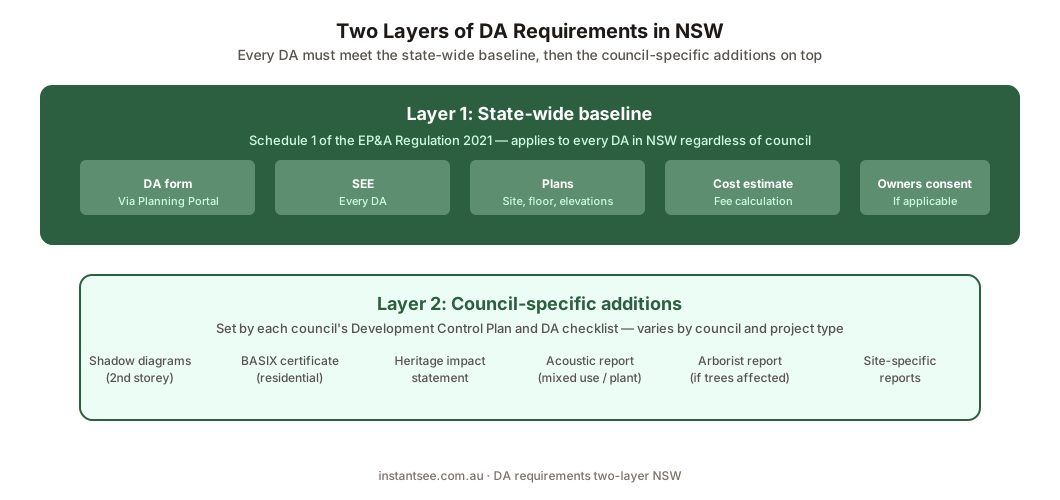
Figure 2: A NSW DA is a state-wide baseline plus a council layer. The core documents never change; the DCP-driven extras do.
A council's DCP can require a waste management plan, a stormwater concept plan, a notification plan showing adjoining properties, shadow diagrams for anything over one storey, a landscape plan, or a specific format for the cost report. The DCP also sets the design controls your SEE has to address, such as setbacks, site coverage, landscaped area, and private open space, and those numbers differ between councils. Under section 4.15 of the EP&A Act, your council must consider its DCP when assessing your DA, so meeting the DCP is not optional. The practical rule is that the state baseline tells you the documents you always need, and your council's DCP and DA checklist tell you the rest.
Documents Triggered by Your Site
Beyond the council's standard checklist, the constraints on your land — flagged on your section 10.7 planning certificate — determine which specialist reports your DA must carry.
Beyond the council's standard list, your own site can trigger extra specialist reports. These are driven by the constraints on your land, which you find on your section 10.7 planning certificate. The more constrained the site, the more reports your DA carries.
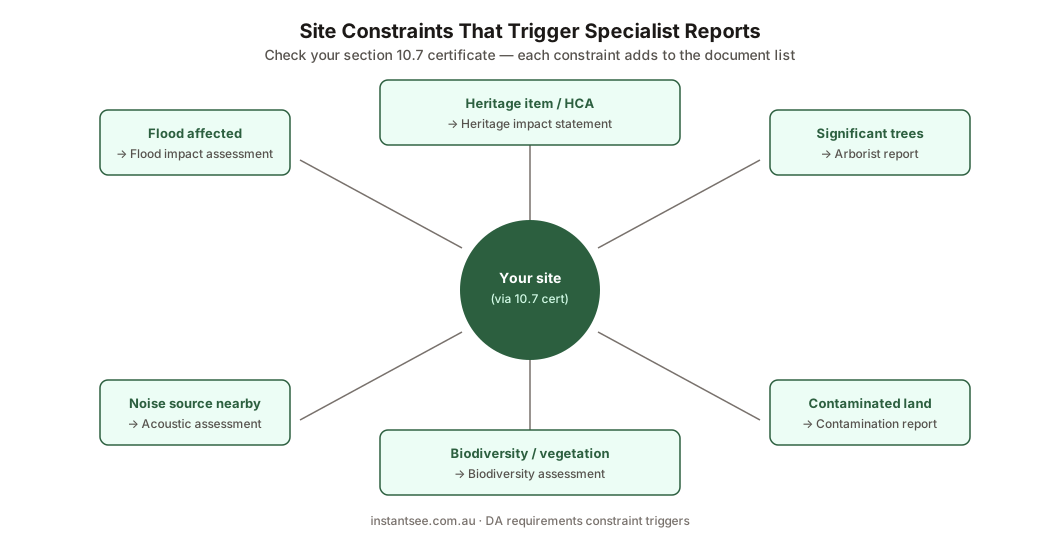
Figure 3: Common site constraints and the report each one triggers. Your section 10.7 certificate flags which apply to your land.
If your land is flood affected, you will likely need a flood study or flood report. Bushfire prone land triggers a bushfire assessment. A heritage item or a heritage conservation area calls for a heritage impact statement. Removing or building near significant trees needs an arborist report. Other common triggers include an acoustic report near a noise source, a geotechnical report on a steep or unstable site, and a traffic impact assessment where the proposal changes vehicle movements. If you are seeking to exceed a development standard such as height or floor space ratio, you also need a clause 4.6 variation request under s 4.15(1) of the EP&A Act 1979. None of these apply to every project, but missing one that your 10.7 certificate flagged is a common reason a DA is sent back.
How to Find Your Council's DA Requirements
Three sources read in the right order give you the complete document set for your specific project and site — and all three are free to access before you lodge.
You do not have to guess which documents your council wants. Three sources, read in order, give you the full picture for your specific project and site.
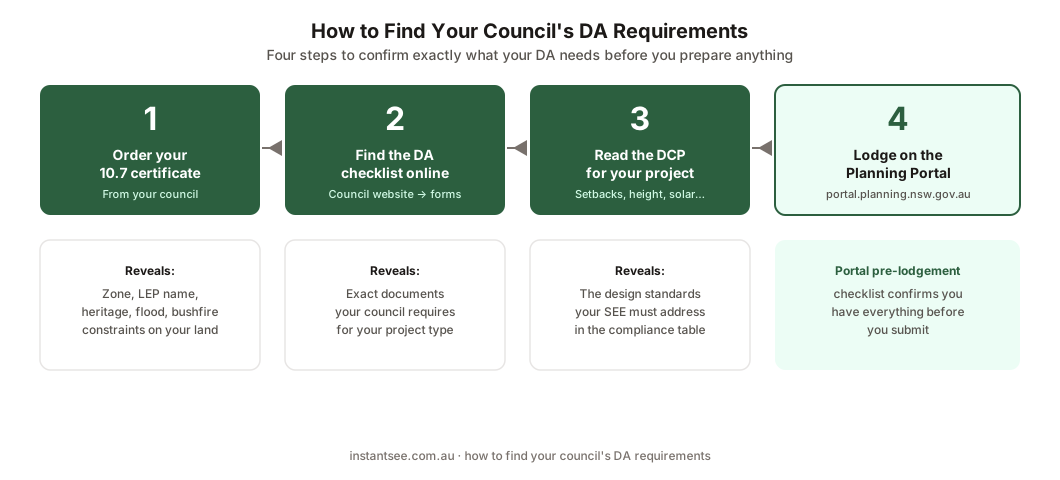
Figure 4: The three places to check for your full DA requirements. Start with your 10.7 certificate, then your council's DA guide, then the Planning Portal.
Start with your section 10.7 planning certificate, which lists the zoning, the planning instruments that apply, and the constraints such as flood, bushfire, and heritage that drive the specialist reports above. Next, read your council's DA lodgement guide or DA checklist, which most councils publish on their website and which sets out their DCP-driven document requirements. Finally, the NSW Planning Portal enforces the state baseline as you complete the application, so anything mandatory under the Regulation is captured there. Work through those three and you have the complete requirements for your DA, both the state floor and the council additions.
The Statement of Environmental Effects: the Part You Write
Of every document on the list, the Statement of Environmental Effects is the only one you cannot order in — it has to be written for your site and proposal specifically, in planning language, and it is the document councils most often send back.
Of every document on the list, the Statement of Environmental Effects is the one you cannot order in. Your plans come from a designer, your BASIX certificate from an assessor, your survey from a surveyor. The SEE has to be written from scratch, in planning language, addressing your site, your proposal, the LEP and DCP controls, and the likely impacts. It is required under Schedule 1, Part 1 of the EP&A Regulation 2021 for every DA that is not complying or designated development, and it is the document councils most often send back when a self-lodged DA is incomplete.
That is the gap instantSEE fills. Rather than write the SEE from a blank page or pay a town planner $800 to $2,500 and wait one to three weeks, you answer a guided set of questions and get a DA-ready SEE in 5 minutes . The rest of your DA document set you assemble from the list above; the SEE is the part we handle.
Frequently asked questions
What documents are required for a DA in NSW?
Are DA requirements the same for every council in NSW?
Do I need a Statement of Environmental Effects for every DA?
How do I know which extra reports my DA needs?
Where do I lodge a development application in NSW?
Ready to get your SEE report?
Skip the writing. Get a DA-ready Statement of Environmental Effects in 5 minutes.
Get your SEE report