Key takeaways
- The Affordable Rental Housing SEPP 2009 was repealed in 2021
- Affordable housing now lives in Housing SEPP 2021, Chapter 3
- The in-fill bonus adds up to 30% extra floor space
- Community providers must manage affordable dwellings for 15 years
- Bonus pathway DAs still need a full Statement of Effects
There is no standalone affordable housing SEPP in NSW. The Affordable Rental Housing SEPP 2009 was repealed on 26 November 2021 and its provisions were consolidated into the Housing SEPP 2021. If your project involves affordable housing, the rules you need are in Chapter 3 of that single, unified policy.
Many applicants still search for the old SEPP by name. They find references to the 2009 instrument on real estate listings, older planning guides, or council websites that have not been updated. That instrument is gone. Understanding what replaced it — and what has changed since — is the first step to lodging a compliant development application.
This guide explains the current framework, what NSW planning law means by affordable housing, how the in-fill affordable housing bonus works, and what your Statement of Environmental Effects must address if you use that bonus.
Get a council-ready Statement of Environmental Effects for your DA in 5 minutes — no town planner, no waiting.
Get your SEE report →- Why there is no longer a standalone affordable housing SEPP in NSW
- What NSW planning law counts as affordable housing
- How the in-fill affordable housing bonus works from December 2023
- What else the Housing SEPP covers alongside affordable housing
- What your SEE must address if you use the in-fill bonus
| Old SEPP repealed | 26 November 2021 |
| Current policy | Housing SEPP 2021, Chapter 3 |
| In-fill bonus commenced | 14 December 2023 |
| Minimum affordable GFA | 10% of gross floor area |
| Maximum bonus | 30% FSR and height uplift |
| Management period | 15 years from first occupation |
The Affordable Housing SEPP is part of the Housing SEPP 2021 and sets out planning incentives for developments that include a minimum share of affordable housing — understanding it helps you decide whether your project qualifies for a height and FSR bonus.
Is There Still an Affordable Housing SEPP in NSW?
No. The Affordable Rental Housing SEPP 2009 was repealed on 26 November 2021 and folded into the Housing SEPP 2021 — affordable housing now sits in Chapter 3 of a single, consolidated policy.
The 2009 SEPP existed to streamline approvals for affordable and social rental housing by removing some of the barriers that local environmental plans created. It covered in-fill affordable housing, social housing, group homes, and seniors housing. Over the decade following its introduction, NSW planning policy moved toward consolidating the many standalone SEPPs into fewer, broader instruments.
The Housing SEPP 2021 completed that consolidation for housing types. It replaced the Affordable Rental Housing SEPP 2009, the State Environmental Planning Policy (Housing for Seniors or People with a Disability) 2004, and several other instruments. The result is one policy document covering most residential housing types that need state-level planning support.
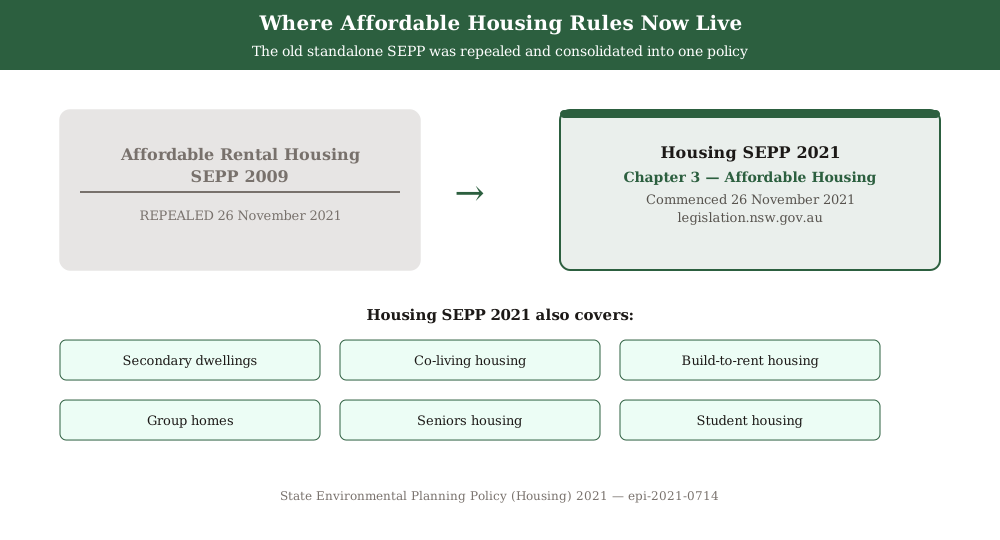
Figure 1: The old standalone policy was repealed and consolidated into the Housing SEPP.
The consolidation did not delete the affordable housing rules. It carried them forward and, in December 2023, significantly strengthened them through the in-fill affordable housing bonus reforms. The full text is available at legislation.nsw.gov.au under the reference epi-2021-0714.
For a broader explanation of how SEPPs work in the NSW planning system, see our guide to SEPP explained.
"When a builder, a real estate listing, or an older blog refers to 'the SEPP affordable housing rules', they are almost always pointing at Chapter 3 of the Housing SEPP — even if they still use the 2009 name."
What Counts as Affordable Housing Under NSW Planning Law?
Affordable housing has a precise legal definition in NSW — under the EP&A Act 1979, it means housing for very low, low or moderate income households, with rent capped under the Affordable Housing Ministerial Guidelines, not just a discount to market rent.
The definition matters because the in-fill bonus and the planning protections that come with it are only available when the dwellings genuinely meet this test. A developer cannot designate apartments as affordable housing by offering a modest rent reduction. The statutory definition requires three things to be satisfied simultaneously:
First, the occupant household must fall within one of the three income bands — very low income (below 50 per cent of area median income), low income (50 to 80 per cent), or moderate income (80 to 120 per cent). The exact thresholds are set by regulation or by the Affordable Housing Ministerial Guidelines.
Second, the rent must be set at a level that is appropriate for households in that income band, as determined under the Ministerial Guidelines. This is a cap, not a target — it links rent to what the household can actually afford, not to a percentage discount off whatever the market happens to be doing.
Third, the dwellings must be managed by a registered community housing provider (CHP) for at least 15 years from the date of first occupation. A registered CHP is an organisation registered under the Community Housing Providers National Law — the register is maintained by the National Regulatory System for Community Housing.
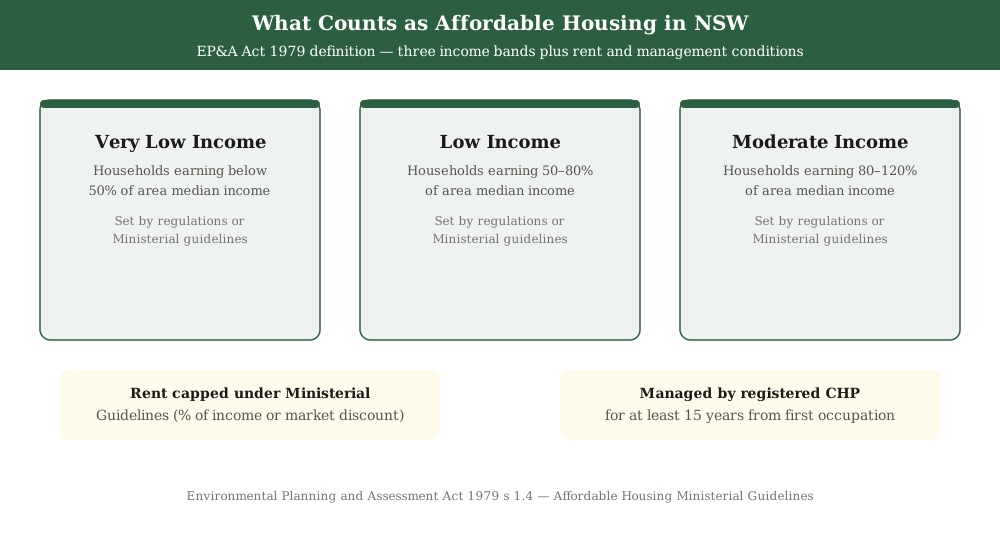
Figure 2: Affordable housing is defined by household income, with rent and management conditions attached.
These conditions are typically secured through conditions of development consent and, where a planning agreement is involved, through a registered deed. They run with the land, not with the owner, so a sale of the property during the 15-year period does not extinguish the obligation.
Checklist before you claim the affordable housing provisions:
- Confirm your project can dedicate at least 10% of GFA to affordable housing
- Identify a registered community housing provider to manage the affordable dwellings
- Confirm the rent cap applies under the Affordable Housing Ministerial Guidelines
- Secure the 15-year affordability period through conditions of consent
- Address the in-fill bonus criteria in your Statement of Environmental Effects
How the In-Fill Affordable Housing Bonus Works
Spend 5 minutes, not 3 weeks
instantSEE generates a complete, DA-ready Statement of Environmental Effects online. No town planner. No waiting.
Get your SEE report in 5 minutes →The in-fill affordable housing bonus lets a residential development exceed its normal floor space ratio and height limits in exchange for affordable housing — the more affordable floor space you provide, the bigger the uplift, up to 30 per cent.
The bonus was introduced as part of the December 2023 reforms to the Housing SEPP. It came into effect on 14 December 2023 and applies to residential flat buildings and shop top housing in certain zones. The mechanism is straightforward in principle: the bonus scales proportionally with the share of gross floor area dedicated to affordable housing, within defined bands.
At the entry point, if at least 10 per cent of the total gross floor area is dedicated to affordable housing, the development can exceed its base FSR and height limit by 20 to 25 per cent. If the affordable housing share reaches 15 per cent of GFA, the development qualifies for the maximum bonus of 30 per cent above the base FSR and height limit. Between those thresholds the bonus is proportional.
The gross floor area calculation includes the affordable housing floor space itself. The bonus applies to both the FSR limit and the height limit simultaneously — it is not a choice between one or the other.
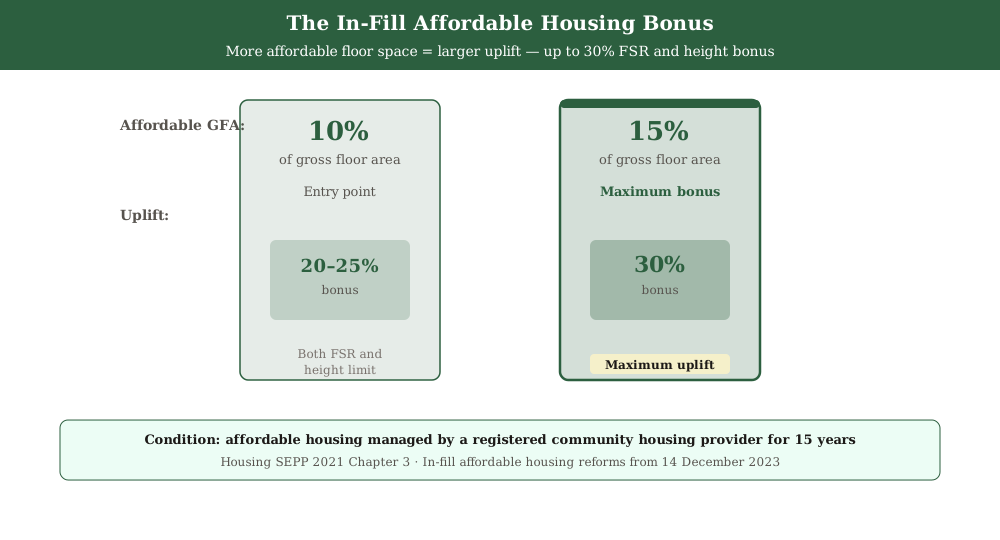
Figure 3: The bonus is proportional. More affordable floor space buys a larger uplift, up to 30 per cent.
The bonus does not override every development standard. Other requirements — setbacks, landscaping minimums, car parking rates, design quality provisions — continue to apply unless separately addressed. A council cannot refuse consent solely on the grounds that the development exceeds the base FSR or height limit if the affordable housing criteria are met, but it retains the ability to assess all other impacts in the ordinary way.
For projects that also engage the medium density housing rules, see our guide to medium density housing rules.
"The in-fill bonus is not free density. In return, the affordable dwellings must stay affordable, managed by a registered community housing provider, for at least 15 years."
What Else the Housing SEPP Covers
The Housing SEPP is broader than affordable housing — it also covers secondary dwellings, co-living housing, build-to-rent, group homes, social housing, seniors housing and student housing, all under one policy rather than scattered across separate SEPPs.
Understanding the full scope of the Housing SEPP matters for two reasons. First, a project may engage more than one chapter — a development that includes both affordable housing and co-living accommodation, for example, needs to satisfy the relevant criteria for each. Second, a project that does not meet the affordable housing definition may still be able to use a different chapter of the SEPP to obtain planning support.
The chapters of the Housing SEPP relevant to residential development are:
- Chapter 2: Secondary dwellings (granny flats)
- Chapter 3: Affordable housing and the in-fill bonus
- Chapter 4: Co-living housing
- Chapter 5: Build-to-rent housing
- Chapter 6: Group homes
- Chapter 7: Social housing by social housing providers
- Chapter 8: Seniors housing
- Chapter 9: Student housing
Each chapter has its own eligibility criteria, zone permissibility rules, and development standards. A development application under more than one chapter needs to address all applicable criteria in the SEE.
What Your SEE Must Address for an Affordable Housing DA
A DA using the in-fill affordable housing bonus still needs a Statement of Environmental Effects that proves the Housing SEPP criteria are met — affordable share, management arrangement, and all the usual impacts that come with extra height and floor space.
The SEE is the primary document through which a council assesses a development application under section 4.15(1) of the EP&A Act 1979. For an affordable housing DA that claims the in-fill bonus, the SEE must do more than address the standard planning impacts. It must also establish that the preconditions for the bonus are satisfied.
A well-structured SEE for an affordable housing DA in NSW will address the following:
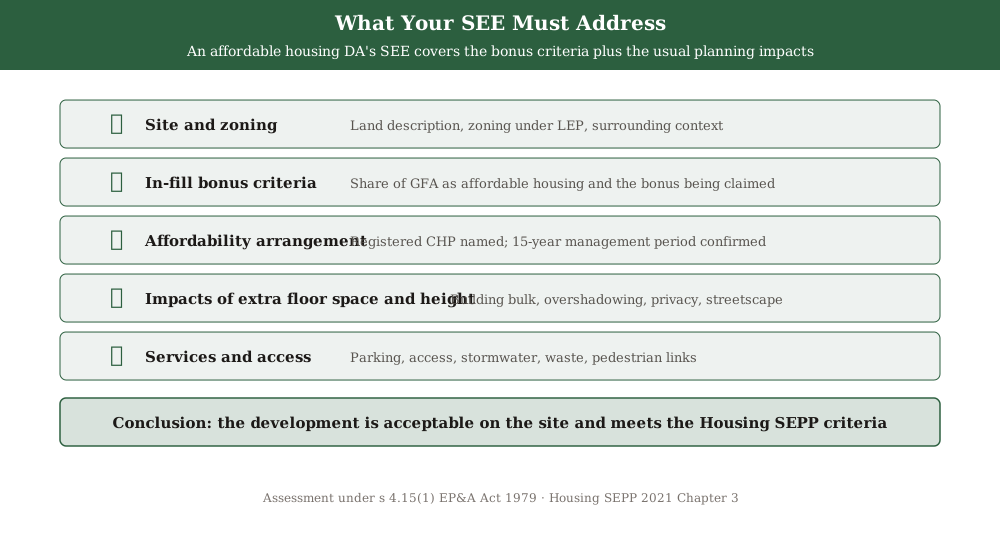
Figure 4: An affordable housing SEE has to cover the bonus criteria as well as the usual impacts.
1. Site and zoning — A description of the land, its zone under the applicable local environmental plan, and the surrounding context. This establishes that the zone permits residential flat buildings or shop top housing and that the Housing SEPP applies.
2. In-fill bonus criteria — A calculation showing the total gross floor area of the development and the floor area dedicated to affordable housing, expressed as a percentage. The SEE must demonstrate that the percentage meets or exceeds the threshold for the bonus being claimed and state the bonus percentage applied to FSR and height.
3. Affordability arrangement — Identification of the registered community housing provider that will manage the affordable dwellings. The SEE should confirm that the arrangement will run for at least 15 years from first occupation and that the rent will be set under the Affordable Housing Ministerial Guidelines.
4. Impacts of extra floor space and height — An assessment of the additional bulk and scale that flows from the bonus. This covers overshadowing of neighbouring properties and public spaces, loss of privacy, visual impact on the streetscape, and wind effects if relevant.
5. Services and access — Car parking provision (applying the correct rate for affordable housing if different), vehicle access and turning, pedestrian links, stormwater management, and waste storage and collection.
The SEE closes with a conclusion that the development is acceptable on the site, that the Housing SEPP criteria are satisfied, and that consent is warranted under section 4.15 of the EP&A Act.
For a complete list of documents to include with your DA, see the DA Lodgement Checklist.
Frequently asked questions
Is the Affordable Rental Housing SEPP 2009 still in force?
What is the minimum share of floor area required to claim the in-fill bonus?
Does the bonus override all development standards?
Who qualifies as a registered community housing provider?
Does the 15-year management period run from DA approval or from first occupation?
Ready to get your SEE report?
Skip the writing. Get a DA-ready Statement of Environmental Effects in 5 minutes.
Get your SEE report