Key takeaways
- SOEE and SEE mean exactly the same document
- Both stand for Statement of Environmental Effects
- Different councils use different abbreviations
- The legal requirement is the same regardless of the term
- A planning statement is another name for the same report
A SOEE is a Statement of Environmental Effects — the report that accompanies a Development Application in NSW and explains your proposal's impact on its surroundings. SOEE and SEE are two abbreviations for exactly the same document. If a council, planner, or template uses the term SOEE, it means the same report a SEE refers to, and it is required for most DAs in NSW under Schedule 1, Part 1 of the Environmental Planning and Assessment Regulation 2021.
The acronym trips people up constantly. You start researching what your council needs, find a SEE on one page and a SOEE on the next, and reasonably wonder whether you now have two documents to prepare. You do not. The confusion is purely in the abbreviation, not in the requirement.
Get a council-ready Statement of Environmental Effects for your DA in 5 minutes — no town planner, no waiting.
Get your SEE report →- What SOEE stands for and why two abbreviations exist for one document
- When you actually need a SOEE in NSW and when you do not
- What goes inside a SOEE, section by section
- Who can prepare a SOEE and how much it costs
- How to get yours done in 5 minutes instead of weeks
What Does SOEE Stand For?
SOEE stands for Statement of Environmental Effects — the same document most people call a SEE.
SOEE stands for Statement of Environmental Effects. It is the written report that describes what you want to build, assesses how it affects the environment and the surrounding area, and explains how any impacts will be managed. The same document is the Statement of Environmental Effects that sits at the centre of almost every residential DA in the state.
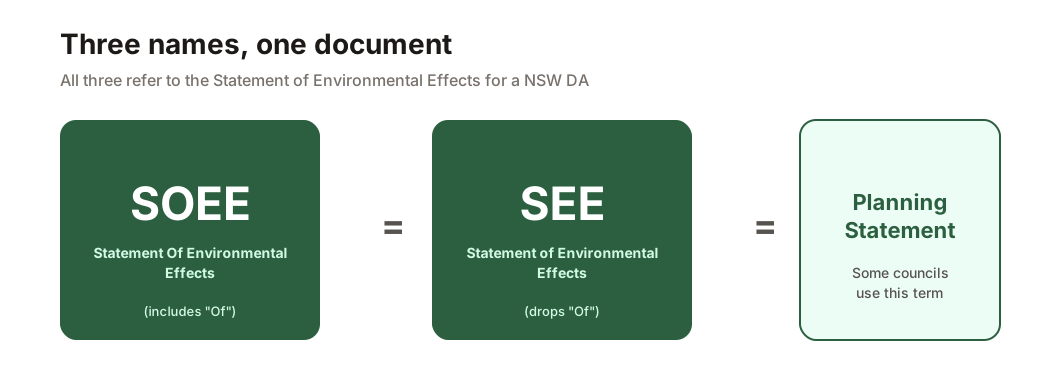
Figure 1: SOEE, SEE, and planning statement all refer to the same document. The name changes; the requirement does not.
The reason two acronyms exist is simply how people shorten the full title. "Statement Of Environmental Effects" gives you SOEE if you include the "Of", and SEE if you drop it. Some councils and planners write SOEE; others write SEE; and a few call it a planning statement. All three terms point to the identical report. There is no version of the document that is a SOEE but not a SEE, and no council requires both. When you see either abbreviation in your council's DA requirements, treat them as one and the same.
When Do You Need a SOEE in NSW?
You need a SOEE whenever your project goes through the Development Application pathway.
You need a SOEE in NSW whenever you lodge a Development Application that requires development consent from your council. Under Schedule 1, Part 1 of the Environmental Planning and Assessment Regulation 2021, a DA (other than for complying development) must be accompanied by a Statement of Environmental Effects. So if your project goes through the DA pathway, a SOEE is part of the package.
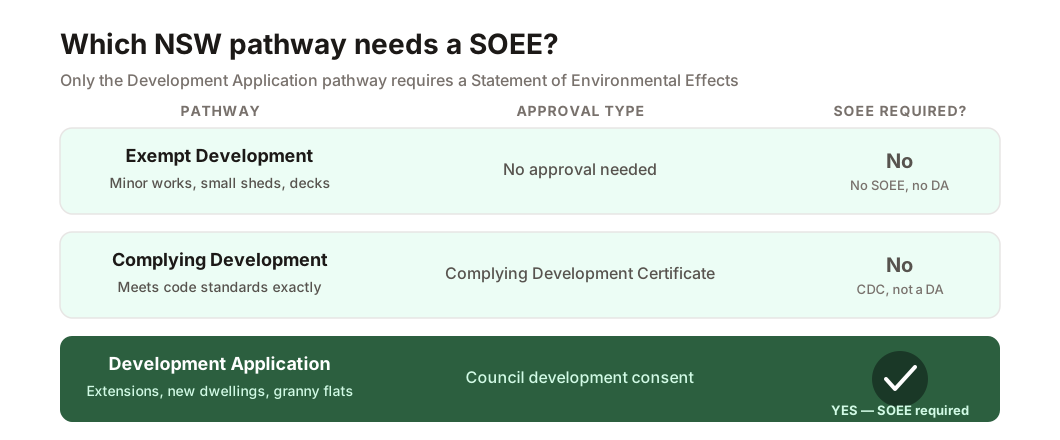
Figure 2: Only the DA pathway requires a SOEE. Exempt and complying development do not.
NSW has three approval pathways, and only one of them needs a SOEE. Exempt development — such as a small shed or a minor deck that meets the State Policy — needs no approval and no SOEE. Complying development is approved against a fixed code through a Complying Development Certificate (CDC) and does not need a SOEE either. The Development Application is the third pathway, and it is the one that requires the document. A knock-down rebuild, a two-storey addition, or a granny flat that does not meet the complying code will all go through a DA, which means a SOEE is required.
What Goes in a SOEE?
Spend 5 minutes, not 3 weeks
instantSEE generates a complete, DA-ready Statement of Environmental Effects online. No town planner. No waiting.
Get your SEE report in 5 minutes →A SOEE must address three things under the Regulation: impacts, locality effects, and management steps.
A SOEE contains a description of your site and proposal, an assessment against the planning controls, and an honest account of the impacts and how you will manage them. The legal core, from Schedule 1, Part 1 of the EP&A Regulation 2021, is that the document must indicate the environmental impacts of the development, its impact on the natural and built environment along with the social and economic effects in the locality, and the steps you will take to protect the environment or lessen harm.
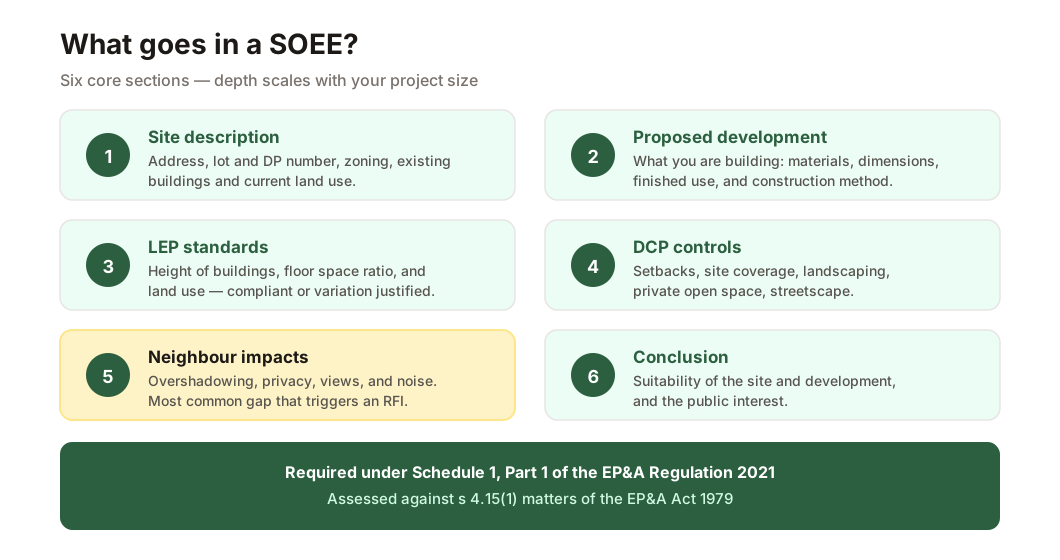
Figure 3: The core sections of a SOEE. The full content list scales with the size of your project.
In practice, that statutory requirement expands into a standard set of sections:
- Site and proposal description — address, lot and DP, existing buildings and use
- LEP zoning and development standards — height of buildings and floor space ratio
- DCP compliance — setbacks, site coverage, landscaping, private open space
- Impact assessment — overshadowing, privacy, views, noise for neighbours
- Site suitability — flood, bushfire, heritage constraints and how you manage them
- Conclusion on suitability and the public interest
The depth of each section should scale with your project. A single-storey alteration at the rear might cover each item in a paragraph. A two-storey addition with new upper-floor windows facing a neighbour needs far more on privacy and overshadowing. For the full picture of every item your council expects, see our guide to what must be included in a SEE, which sets out the content section by section.
How to Prepare a SOEE for Your DA
Preparing a SOEE follows the same path whether you call it a SOEE or a SEE.
Finalise your architectural plans first, obtain your BASIX certificate, and confirm your zoning and any constraints from your property's planning certificate (10.7 certificate). With the design locked in, the document can describe a fixed proposal rather than a moving one — the single biggest time-saver when writing any SOEE.
From there, work to a checklist so you address every matter your council requires the first time. Our free SEE Checklist for NSW lists each item your SOEE should cover before you lodge on the NSW Planning Portal. A town planner will write the document for you for $800 to $2,500 over one to three weeks. If you would rather not write it at all, instantSEE produces a complete, DA-ready SOEE in about 5 minutes online, from a guided questionnaire that handles the planning language for you.
Frequently asked questions
What does SOEE stand for?
Is a SOEE the same as a SEE?
Do I need a SOEE for my development application in NSW?
Who can prepare a SOEE in NSW?
How much does a SOEE cost?
Ready to get your SEE report?
Skip the writing. Get a DA-ready Statement of Environmental Effects in 5 minutes.
Get your SEE report