Key takeaways
- Every Nambucca Valley DA requiring consent needs a Statement of Environmental Effects
- Your SEE must address the Nambucca LEP 2010 and DCP 2010
- Estuary flooding and coastal hazard shape coastal-town DAs
- Acid sulfate soils and koala habitat affect many sites
- Most Nambucca Valley DAs are decided by a council officer
A Statement of Environmental Effects for a Nambucca Valley Council Development Application must show how your proposal sits with the Nambucca Local Environmental Plan 2010 and Nambucca Development Control Plan 2010 and the applicable State policies, and how it manages its impacts on neighbours and the surrounding area. Every DA lodged with Nambucca Valley Council that needs consent must include one, and it is the document the council reads to understand your project.
Nambucca Valley is a Mid North Coast shire on the Nambucca River, taking in Macksville, Nambucca Heads, Bowraville, Scotts Head and Valla. The estuary, the coastline and the forested hinterland put coastal, flood and biodiversity constraints close together, so the mix on any given block matters. Get the wrong controls and your SEE argues the wrong planning case.
Get a council-ready Statement of Environmental Effects for your DA in 5 minutes — no town planner, no waiting.
Get your SEE report →- What a Nambucca Valley SEE must address under section 4.15 of the EP&A Act
- The council's common zones and the overlays that commonly bite here
- The common DA types locally and what each SEE focuses on
- How to lodge your DA through the NSW Planning Portal step by step
- Who determines your application — officer, panel, or State body
What Nambucca Valley Council Requires in a SEE
Your SEE must address five matters that map directly onto the section 4.15 assessment the council runs — LEP compliance, control-plan compliance, site constraints, neighbour impacts, and the public interest.
Your Statement of Environmental Effects for a Nambucca Valley DA must address five things: how your proposal complies with the Nambucca Local Environmental Plan 2010, how it meets the Nambucca Development Control Plan 2010, the constraints on your specific site, the impacts on your neighbours, and the public interest. These map directly onto the matters a council must weigh under section 4.15 of the Environmental Planning and Assessment Act 1979.
The council's principal planning instrument is the Nambucca Local Environmental Plan 2010, supported by the Nambucca Development Control Plan 2010. The LEP sets your land's zone and the development standards that come with it, such as height and minimum lot size. The DCP then sets the design detail: setbacks, landscaping, private open space, parking and privacy, along with hazard controls where they apply. Your SEE needs to walk through each control that applies and either show you comply or justify the variation.
Common Zones and Overlays in Nambucca Valley
Your zone sets what you can build, but the constraint that shapes a Nambucca Valley SEE is usually one of the mapped overlays over the top of it.
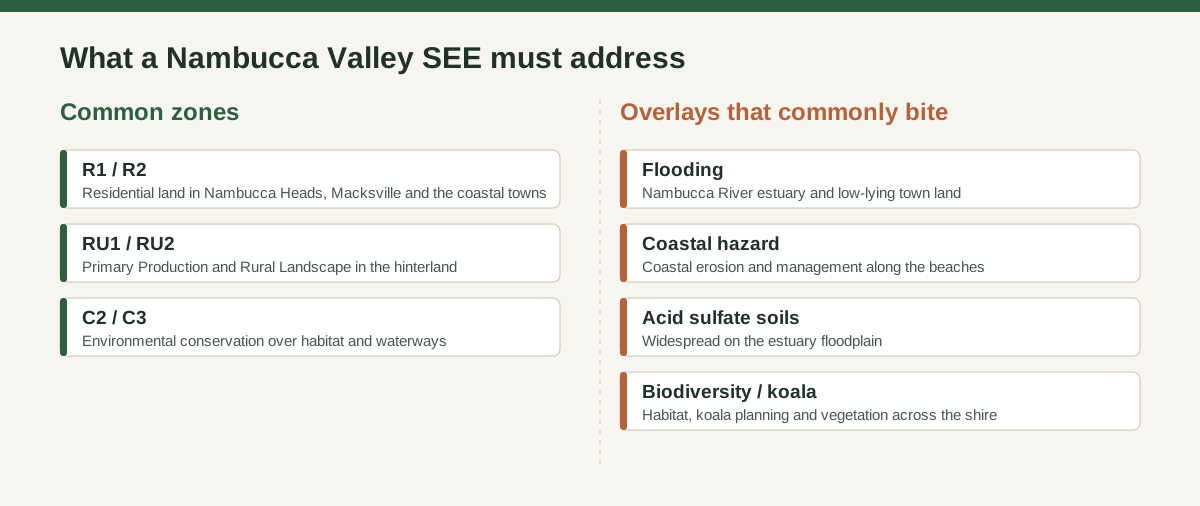
Figure 1: The zones and mapped constraints a Nambucca Valley SEE most often has to address.
Under the Nambucca LEP 2010 most housing sits in R1 General Residential and R2 Low Density Residential in Nambucca Heads, Macksville and the coastal towns, with RU1 Primary Production and RU2 Rural Landscape in the hinterland and C2/C3 conservation land over habitat and waterways. The constraints mapped over the top are where a Nambucca Valley SEE really lives. Flooding on the Nambucca River estuary affects low-lying town land, coastal hazard and erosion shape work near the beaches, acid sulfate soils are widespread on the estuary floodplain and call for a management plan where disturbed, and biodiversity and koala habitat run through the forested parts of the shire. A SEE that names the specific constraint on your lot is far stronger than one that speaks in generalities.
Common DA Types in Nambucca Valley and What Your SEE Must Address
Spend 5 minutes, not 3 weeks
instantSEE generates a complete, DA-ready Statement of Environmental Effects online. No town planner. No waiting.
Get your SEE report in 5 minutes →The focus of your SEE shifts with the project type, so the same five section 4.15 matters get different weight depending on what you are building.
For alterations and additions in the coastal towns, the SEE concentrates on height, setbacks, privacy, flooding and coastal hazard. For a new dwelling or shed on rural land, it focuses on siting, biodiversity, bushfire, effluent and access. For a secondary dwelling, the focus is floor area, private open space and servicing. For work on the estuary floodplain, acid sulfate soils and flood levels lead. A DA lodgement checklist for NSW helps you gather the right supporting documents for each.
How to Lodge a DA with Nambucca Valley Council
You lodge every Nambucca Valley DA through the NSW Planning Portal — upload your plans, SEE, owner's consent, and pay the fee; the council registers it and notifies neighbours before assessment begins.
You lodge a Nambucca Valley DA through the NSW Planning Portal at planningportal.nsw.gov.au, the system every NSW council uses. You upload your plans, owner's consent, supporting documents and your SEE, then pay the fee. Our step-by-step guide to lodging a DA in NSW covers the portal mechanics.
Once lodged, the council registers your DA, notifies adjoining owners where required, and assesses it against section 4.15. Nambucca Valley Council is the consent authority for most local development. It does not run a standing local planning panel, so most DAs are decided by a council officer under delegated authority or by the elected council, while regionally significant development is determined by the Northern Regional Planning Panel. For a typical extension, granny flat or shed, expect a council officer to determine it. The biggest cause of delay is an incomplete application or a SEE that does not address the controls, which triggers a request for more information. The general DA requirements across NSW councils follow the same legislative base, so a complete Nambucca Valley lodgement looks much like any other.
Do You Need a Town Planner for a Nambucca Valley DA?
For a straightforward residential DA you can prepare the SEE yourself or use a service; a planner earns its keep on the harder, constrained sites.
Not always. For a straightforward residential DA in Nambucca Valley — a single-storey addition, a granny flat, a shed — you can prepare the SEE yourself or use a service rather than engaging a town planner. You are more likely to want a planner where the project is complex: a flood-affected or otherwise constrained lot, a heritage-listed property, or one that seeks to vary a development standard. For the common residential cases, a well-structured SEE that addresses the Nambucca LEP 2010 and the council's controls is what you need.
Frequently asked questions
Do I need a Statement of Environmental Effects for a Nambucca Valley DA?
Which LEP applies to a Nambucca Valley development application?
Do I need to address acid sulfate soils for a Nambucca Valley DA?
Who decides my Nambucca Valley DA?
Ready to get your SEE report?
Skip the writing. Get a DA-ready Statement of Environmental Effects in 5 minutes.
Get your SEE report