Key takeaways
- Mosman LEP 2012 governs all DAs across the LGA
- Scenic Protection Area guards foreshore slopes and views
- Castlecrag-style heritage areas require heritage impact assessment
- Steep foreshore sites need geotechnical stability assessment
- Sydney North Planning Panel determines larger Mosman DAs
Mosman is one of Sydney's most constrained planning environments. Wedged between Sydney Harbour, Middle Harbour, and the national park, virtually every development application in the LGA must negotiate foreshore setbacks, scenic amenity, heritage, or steep-slope geotechnical risk — and often all four at once. A Statement of Environmental Effects (SEE) that overlooks any of these dimensions will not survive council's assessment gateway. This guide explains exactly what your SEE must address.
Get a council-ready Statement of Environmental Effects for your DA in 5 minutes — no town planner, no waiting.
Get your SEE report →What Planning Instruments Govern Mosman DAs?
Before you write a single word of your SEE, you need to know which instruments council will measure it against. In Mosman, that framework is compact but demanding.
The Mosman Local Environmental Plan 2012 is the operative LEP across the entire LGA. It is a standard instrument plan made under the Environmental Planning and Assessment Act 1979 (EP&A Act 1979) and sets the permissibility, zone objectives, height limits, and floor space ratio controls for all land in Mosman. Beneath the LEP sits the Mosman Residential Development Control Plan, which provides detailed design standards covering setbacks, landscaping, scenic protection, and heritage.
The legal content requirements for a SEE are set by Schedule 1, Part 1 of the EP&A Regulation 2021. Every SEE lodged with Mosman Council — regardless of the scale of the proposal — must address the prescribed matters in that schedule. These include the environmental impacts of the development, how the proposal is consistent with the relevant planning instruments, and why the development is in the public interest.
Council assesses the application against s 4.15(1) of the EP&A Act 1979, which requires it to consider the provisions of the LEP and DCP, the likely impacts on the built and natural environment, the suitability of the site, any submissions received, and the public interest. Your SEE must be written with each of those five limbs in mind.
State Environmental Planning Policies may also overlay Mosman sites — verify on the NSW Planning Portal for your specific lot before finalising your SEE.
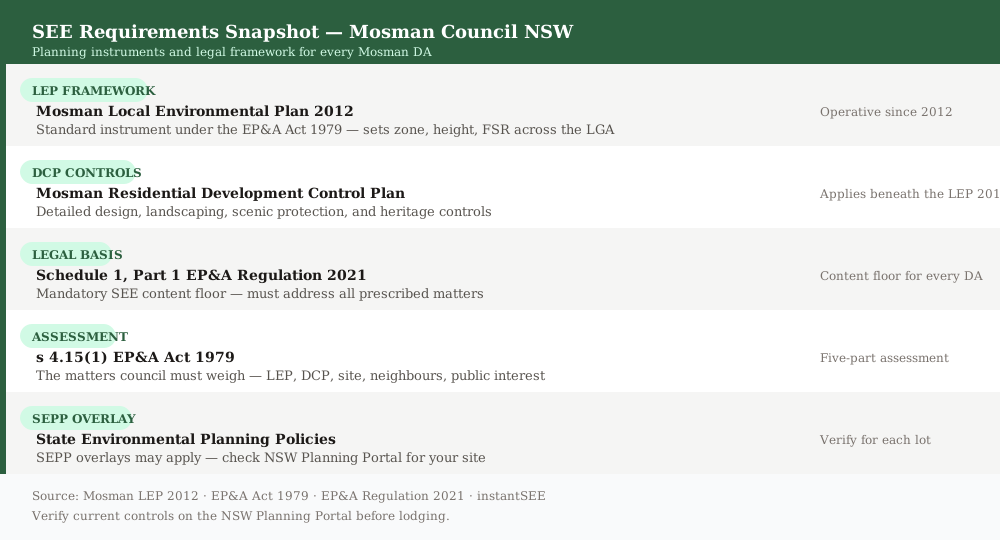 Figure 1: The planning instruments and legal framework that govern every Mosman DA.
Sydney and Middle Harbour Foreshore — Scenic Protection Area
The Mosman Scenic Protection Area is not a vague aspiration — it is a specific control in the Mosman LEP 2012 with real legal teeth. Ignore it and your SEE will fail.
The Mosman Scenic Protection Area was created under the Mosman LEP 2012 to protect the visual significance and landscape quality of the Sydney Harbour and Middle Harbour foreshore slopes. It covers the sloping terrain visible from the water — the ridgelines, escarpments, and vegetated margins that give Mosman its distinctive harbourside character.
Any DA for land within the Scenic Protection Area must address, in the SEE:
- Views and scenic amenity — how the proposal will be perceived from the water, from public vantage points, and from neighbouring properties
- Landscape quality — how the design responds to the natural character of the foreshore slopes, including material choices, colour, and planting
- Bulk and scale — whether the massing of the building or structure is subservient to the landscape and avoids dominating the ridgeline or foreshore
- Foreshore building lines — the minimum setback from the mean high water mark established in the DCP
Public access to the foreshore is also a consideration under the LEP 2012. Where a proposal involves works near the water's edge, the SEE should demonstrate that lawful public access to the foreshore is not unreasonably restricted.
Foreshore sites on Balmoral, Beauty Point, Clifton Gardens, and the Middle Harbour foreshores are particularly likely to trigger Scenic Protection Area controls. If your site is visible from the water, budget for a view corridor analysis as part of your DA package.
Heritage — Conservation Areas and Items
Spend 5 minutes, not 3 weeks
instantSEE generates a complete, DA-ready Statement of Environmental Effects online. No town planner. No waiting.
Get your SEE report in 5 minutes →Mosman's heritage overlay is extensive. The LEP 2012 maps both individual heritage items and heritage conservation areas across multiple precincts, and the SEE requirements are specific.
Heritage items and heritage conservation areas (HCAs) are listed and mapped in Schedule 5 of the Mosman LEP 2012. A development application affecting a heritage item, or located within or adjacent to a heritage conservation area, requires a heritage impact statement as part of the DA package — and the SEE must incorporate its findings.
- Heritage impact statement checklist · Identify the heritage item or HCA and its statement of significance · Describe all proposed works in detail · Assess the impact of the works on the fabric, setting, and significance of the item or area · Propose mitigation measures — materials, finishes, reversibility · Include photographic evidence of existing conditions
Heritage conservation areas in Mosman are concentrated in the older residential precincts. The Mosman LEP 2012 controls for HCAs aim to preserve the streetscape character, setbacks, materials, and scale of development that contribute to the area's historic significance.
Where a proposal involves demolition of a building within an HCA, or substantial external alteration of a heritage item, council may require a conservation management plan (CMP) in addition to the heritage impact statement. Check council's heritage officer requirements early in the design process.
Bushland and Biodiversity — Sydney Harbour National Park
Mosman shares its southern and eastern boundaries with Sydney Harbour National Park — and DAs near those boundaries must contend with biodiversity and tree protection requirements that sit squarely within the SEE.
The national park land at Georges Head, Chowder Bay, and Middle Head forms an ecological buffer along Mosman's southern fringe. Properties adjoining the park or its associated bushland corridors may trigger biodiversity assessment requirements under the Mosman Residential DCP's tree and vegetation controls.
The Mosman Residential DCP sets controls for the retention of significant trees — including size thresholds, species protections, and canopy cover requirements. Any DA involving tree removal, root zone encroachment, or significant vegetation clearing should address tree impacts in the SEE, supported by an arborist report.
Where clearing exceeds the relevant threshold under the Biodiversity Conservation Act 2016, a Biodiversity Development Assessment Report (BDAR) may be required. This should be identified early — ideally at the pre-DA stage — because a BDAR significantly affects the scope of the SEE's environmental impact assessment.
Council's development assessment officers will check whether the site is mapped on the NSW Biodiversity Values Map. If it is, early engagement with the Biodiversity Conservation Trust may be warranted before lodgement.
Common DA Types in Mosman
Most DAs in Mosman fall into four broad categories. Each has a characteristic set of SEE issues — and knowing them in advance saves time at lodgement and during assessment.
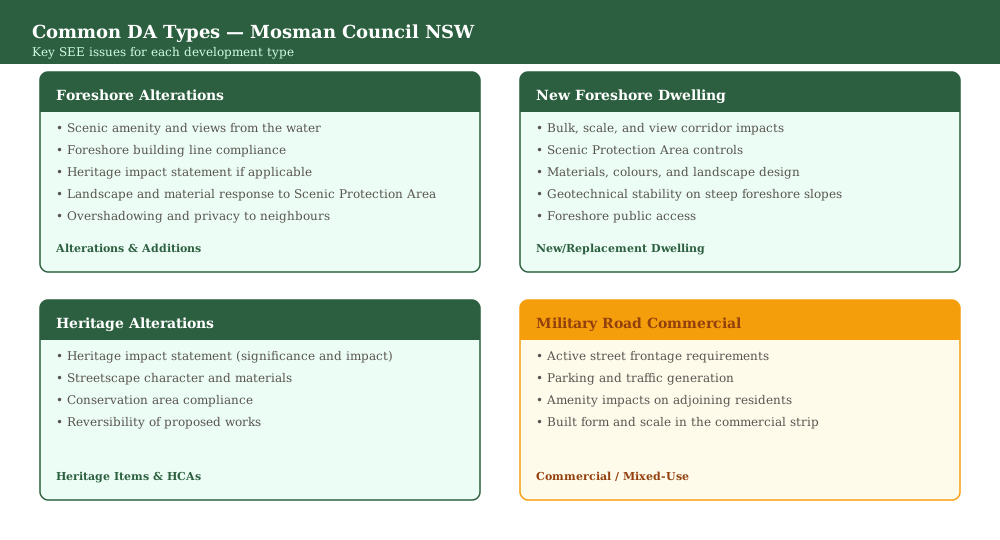 Figure 3: The four most common DA types in Mosman and the key SEE issues for each.
1. Alterations and additions to existing dwellings The majority of Mosman DAs fall into this category. The SEE must address height, setbacks, solar access and overshadowing, visual and acoustic privacy, and — where the site is in a heritage conservation area or near the foreshore — scenic amenity and heritage character. Overlooking impacts on neighbouring properties are a consistent concern given Mosman's dense harbourside topography.
2. New or replacement dwelling on a foreshore lot These DAs attract the highest level of SEE scrutiny. Bulk, scale, and view impacts are central, together with Scenic Protection Area controls, foreshore building line compliance, materials, landscape, and geotechnical considerations on steep slopes.
3. Pools, decks, outbuildings, and foreshore works Even small-scale structures on foreshore lots must address siting, excavation and drainage management, tree retention, and foreshore setback compliance in the SEE. Works below the mean high water mark may also require separate Crown Lands approvals.
4. Commercial and mixed-use development on Military Road Mosman Village and Spit Junction are the primary commercial strips. DAs here must address built form and active street frontage requirements, parking and traffic generation, and amenity impacts on surrounding residential areas.
Use the DA lodgement checklist to confirm what supporting documents — beyond the SEE — your Mosman DA requires.
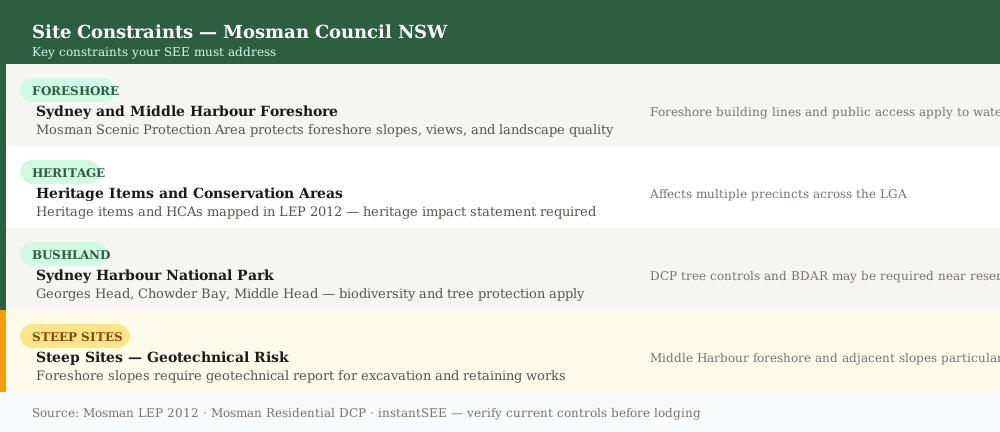 Figure 2: Key site constraints your SEE must address — including the amber-flagged steep-slope geotechnical risk.
When Does the Sydney North Planning Panel Decide?
Most Mosman DAs are determined by council officers under delegated authority. But larger or more complex proposals go to a planning panel — and the SEE standard rises accordingly.
The Mosman Local Planning Panel (established 1 March 2018, replacing the Mosman Development Assessment Panel) determines DAs that exceed council's delegation thresholds — typically applications with a capital investment value (CIV) above the relevant threshold set by the Minister's directions, or applications that raise issues of a contentious or sensitive nature.
For regionally significant development — generally DAs with a CIV above $30 million, or DAs in the State significant development category — the Sydney North Planning Panel (SNPP) is the consent authority. Where the SNPP is the determining body, the SEE must meet an evidential standard commensurate with the scale of the proposal: expert witness reports, detailed impact assessments, and comprehensive responses to the s 4.15(1) matters are expected.
If your proposal is near the SNPP threshold, obtain pre-DA advice from council to confirm the determining authority before investing in the SEE.
Frequently asked questions
When did the Mosman LEP 2012 come into force?
What is the Mosman Scenic Protection Area?
When is a heritage impact statement required for a Mosman DA?
Can instantSEE prepare a SEE for a Mosman DA?
Ready to get your SEE report?
Skip the writing. Get a DA-ready Statement of Environmental Effects in 5 minutes.
Get your SEE report