Key takeaways
- Liverpool LEP 2008 governs most of the large south-west LGA
- Georges River flooding applies under clause 7.8 to flood-prone land
- Liverpool city centre allows greater height near transport hubs
- Growth release areas at Austral and Edmondson Park have specific controls
- Sydney Western City Planning Panel determines larger Liverpool DAs
A Statement of Environmental Effects (SEE) is the mandatory planning document for every standard development application (DA) lodged with Liverpool City Council. The SEE must meet the content requirements of Schedule 1, Part 1 of the EP&A Regulation 2021, and it must demonstrate how your proposal responds to the Liverpool Local Environmental Plan 2008 and the Liverpool Development Control Plan. Liverpool is one of Sydney's largest and most diverse LGAs — spanning established residential suburbs, a growing city centre, major growth-release precincts, and rural land on the urban fringe. Georges River flooding, the city centre height and density framework, and growth-area staging controls are the three most common SEE challenges. Bush fire risk and proximity to Western Sydney International (Nancy-Bird Walton) Airport add further considerations for affected sites.
Get a council-ready Statement of Environmental Effects for your DA in 5 minutes — no town planner, no waiting.
Get your SEE report →What Planning Instruments Govern Liverpool DAs?
Liverpool City Council operates under a layered set of planning instruments. Your SEE must engage all of them — and the right ones in the right order — to avoid requisitions and delays.
Liverpool City Council covers a large south-west Sydney LGA that includes established suburbs (Liverpool, Casula, Moorebank, Green Valley, Prestons), fast-growing release areas (Austral, Leppington, Edmondson Park, Middleton Grange), and rural and large-lot land further out. The Georges River runs through the LGA, and Western Sydney International (Nancy-Bird Walton) Airport is nearby. The planning framework operates at three levels.
Liverpool Local Environmental Plan 2008. The Liverpool LEP 2008 is a standard instrument plan made under the Environmental Planning and Assessment Act 1979. It was gazetted on 29 August 2008 and applies across most of the Liverpool local government area. Its stated aims include strengthening the Liverpool city centre as the principal service and employment centre for Sydney's south west, and minimising risk in areas subject to flooding and bush fire. The LEP 2008 controls permissibility, height, floor space ratio, heritage, flood-prone land (including clause 7.8), and bush fire risk.
Liverpool Development Control Plan. The DCP provides detailed controls beneath the LEP 2008 covering residential design, city centre built form, growth-area precincts, and environmental management. Your SEE must demonstrate compliance with relevant DCP chapters for the type of development proposed.
Schedule 1, Part 1 of the EP&A Regulation 2021. This is the minimum mandatory content floor for every SEE in New South Wales. Your SEE must describe the proposal, address environmental impacts, and demonstrate how the proposal responds to the applicable planning instruments. Compliance with this Schedule is required for a DA to be lodged as valid.
s 4.15(1) of the EP&A Act 1979. Liverpool City Council assesses your DA against the five-part framework in s 4.15(1): the applicable environmental planning instrument, the DCP, likely impacts on the natural and built environments, site suitability, and the public interest.
State Environmental Planning Policies. Biodiversity, housing, and infrastructure SEPPs may apply across the Liverpool LGA depending on site location and the nature of the proposal. Verify which SEPPs are relevant for each lot before lodging.
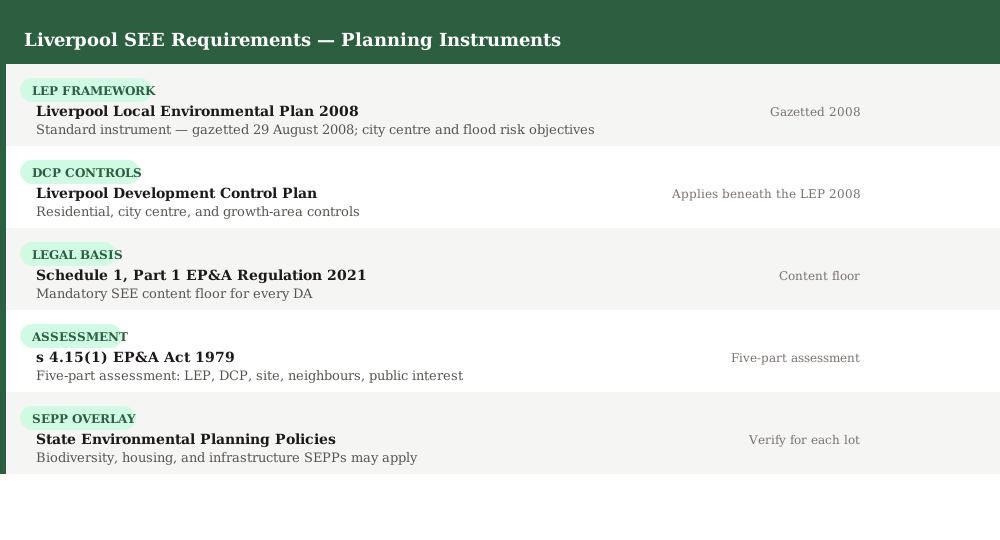 Figure 1: The five planning instruments and frameworks that govern an SEE for a Liverpool City Council DA.
Georges River Flooding — Clause 7.8 and Flood-Prone Land
The Georges River and its tributaries create significant flooding risk across a large portion of the Liverpool LGA. Clause 7.8 of the Liverpool LEP 2008 imposes specific controls on development in flood-prone areas — and your SEE must address them directly.
Flooding is the most critical environmental constraint for a large proportion of DA sites across the Liverpool LGA. The Georges River runs through the LGA and its tributaries affect many of the established suburbs, including parts of Liverpool, Casula, Moorebank, and Prestons.
Clause 7.8 of the Liverpool LEP 2008. This clause applies to development on land identified as flood-prone in the LEP 2008. Where clause 7.8 applies, the development consent authority must be satisfied that the proposal is compatible with the flood hazard, will not result in unreasonable risk to life or property, and will not significantly impede flood flows. Your SEE must address each of these matters.
Flood planning controls. For flood-affected sites, the LEP 2008 and DCP impose requirements including: minimum finished floor levels determined by the flood planning level for the site; assessment against the 1% Annual Exceedance Probability (1% AEP) flood event; consideration of the Probable Maximum Flood (PMF); and safe evacuation route analysis.
Engineer's assessment. Where flood data is unknown or the site is at the fringe of a mapped flood area, the council may require a qualified hydraulic engineer to assess flood risk before the DA proceeds. Your SEE should proactively address flooding to avoid a requisition that stalls assessment.
What your SEE must include. For flood-affected Liverpool sites: the applicable flood planning level; how proposed finished floor levels respond to that level; an overland flow path analysis; evacuation considerations; and a hydraulic engineer's assessment where required.
Amber hazard — Flooding. Clause 7.8 of the Liverpool LEP 2008 applies to flood-prone land across the LGA. The Georges River and its tributaries affect a large proportion of established residential suburbs. If your site is flood-prone, your SEE must address finished floor levels, the 1% AEP event, and evacuation. Where flood information is unknown, an engineer's assessment may be required before the DA can proceed.
Liverpool City Centre — Height, Density, and Urban Activation
Spend 5 minutes, not 3 weeks
instantSEE generates a complete, DA-ready Statement of Environmental Effects online. No town planner. No waiting.
Get your SEE report in 5 minutes →Liverpool's city centre is one of the NSW Government's identified strategic centres. The LEP 2008 allows greater height and density near transport infrastructure — but built form, amenity, and active frontage requirements must be addressed in the SEE.
The Liverpool city centre is identified in the Liverpool LEP 2008 as the principal service and employment hub for Sydney's south west. The LEP permits greater building height and floor space ratio in the city centre compared to surrounding residential areas, particularly in proximity to Liverpool railway station and key transport corridors.
Height and density. Height limits and FSR maximums are set in the LEP 2008 Height of Buildings Map and Floor Space Ratio Map. Your SEE must demonstrate that the proposed height and floor space are consistent with the LEP controls, or provide justification for any variation.
Built form and active frontage. The DCP requires active street-level frontages in the city centre, limiting blank walls and requiring ground-floor uses that contribute to pedestrian activation. Your SEE must address how the proposed built form meets these requirements.
Overshadowing and amenity. Higher-density city centre proposals must include shadow diagrams demonstrating that overshadowing of neighbouring properties and public spaces is within DCP-permitted limits. Amenity impacts — including privacy, wind, and noise — must also be assessed.
Parking and traffic. City centre DAs may require a traffic impact assessment or parking demand analysis, depending on the scale and use of the development. These should be referenced in and cross-linked to your SEE.
- City centre SEE items · Height and FSR compliance · Active street-level frontage · Overshadowing and shadow diagrams · Amenity impacts: privacy, wind, noise · Parking and traffic assessment reference
Growth-Release Areas — Austral, Leppington, and Edmondson Park
Liverpool's growth-release precincts are among the fastest-growing parts of south-west Sydney. Each precinct has its own staging and infrastructure controls, and your SEE must engage with them specifically for the lot in question.
The Liverpool LGA contains several major growth-release precincts, including Austral, Leppington, Edmondson Park, and Middleton Grange. These areas are subject to precinct-specific controls that go beyond the standard LEP 2008 and DCP provisions.
Precinct plans and staging. Each growth precinct operates under a precinct plan or similar instrument that sets out staging, infrastructure delivery, lot layout, and development sequencing. Your SEE must identify which precinct applies to the site and demonstrate compliance with the relevant precinct controls.
Infrastructure contributions. Development in growth areas typically attracts significant infrastructure contributions under an applicable contributions plan. While contributions are assessed separately from the SEE, the SEE should acknowledge the contributions framework and demonstrate that the proposal is consistent with the precinct's intended development pattern.
Lot context and site suitability. In growth precincts, the SEE must address the lot's context — its relationship to approved infrastructure, surrounding development, drainage, and road connections — and demonstrate that the site is suitable for the proposed use.
Bush fire risk. Austral, Leppington, and other rural-fringe precincts can be subject to bush fire risk. Where the site is within or adjacent to a Bush Fire Prone Land area, your SEE must address the bush fire risk and compliance with Planning for Bush Fire Protection 2019 (PBP). An Asset Protection Zone (APZ) may be required.
- Growth area SEE items · Applicable precinct plan identification · Staging and infrastructure compliance · Lot context and drainage · Bush fire prone land check · APZ requirements if applicable
Common DA Types in Liverpool
Most Liverpool DAs fall into one of four categories. Each type carries a distinct set of SEE obligations.
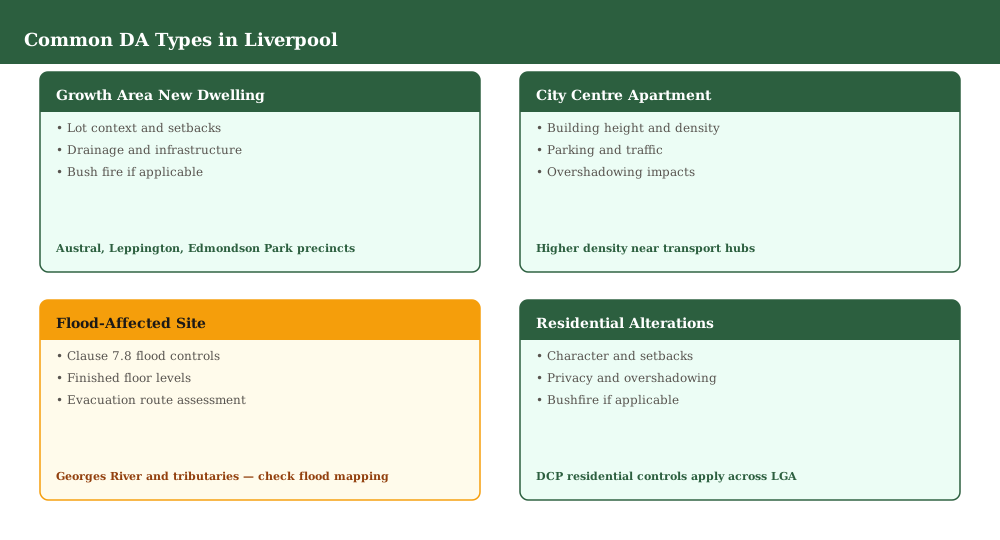 Figure 3: The four common DA types in Liverpool and the key SEE topics each one requires.
Growth area new dwelling. In Austral, Leppington, Edmondson Park, and Middleton Grange, new dwellings must address lot context, setbacks, drainage, infrastructure contributions, and bush fire risk where applicable. The relevant precinct plan must be identified and addressed in the SEE.
City centre apartment. Higher-density residential or mixed-use proposals in the Liverpool city centre require SEE treatment of building height, FSR, active frontage, overshadowing, amenity, and parking. Shadow diagrams and traffic assessment are typically required.
Flood-affected site. Where the Georges River or a tributary creates flood risk, the SEE must address clause 7.8 of the LEP 2008, finished floor levels, overland flow paths, and evacuation, supported by a hydraulic engineer's assessment where required.
Residential alterations. Alterations and additions across established suburbs must address DCP character controls, setbacks, privacy, solar access, and overshadowing. Where the site is near a bush fire prone land boundary, bush fire risk must also be addressed.
For a full DA lodgement checklist applicable across NSW, see the DA lodgement checklist.
When Does the Sydney Western City Planning Panel Decide?
Liverpool City Council is within the Sydney Western City Planning Panel's jurisdiction. Above prescribed capital investment value thresholds, the Panel — not the council — becomes the consent authority for your DA.
The City of Liverpool falls within the jurisdiction of the Sydney Western City Planning Panel (SWCPP). The SWCPP determines DAs where the capital investment value (CIV) exceeds the threshold set by the Minister for Planning (generally $30 million or above), or where the DA is of a prescribed class. Regionally significant development is also referred to the SWCPP.
Below those thresholds, DAs are determined by council officers for routine applications, or referred to the Liverpool Local Planning Panel for proposals involving contentious issues, heritage items, significant neighbour objections, or planning agreements.
The SEE content obligations under Schedule 1, Part 1 of the EP&A Regulation 2021 apply equally regardless of which body determines the DA. However, Panel-referred DAs attract greater scrutiny, and SEEs for those applications should address environmental impacts with particular care and completeness.
Frequently asked questions
When did the Liverpool LEP 2008 come into force?
Is my Liverpool property flood affected?
What controls apply to growth-release areas such as Austral and Edmondson Park?
Can instantSEE prepare a SEE for a Liverpool DA?
Ready to get your SEE report?
Skip the writing. Get a DA-ready Statement of Environmental Effects in 5 minutes.
Get your SEE report