Key takeaways
- Every Lismore City DA needing consent requires a Statement of Environmental Effects
- Your SEE must address the Lismore LEP 2012 and the DCP
- Flood planning after the 2022 Wilsons River disaster dominates local DAs
- Higher flood planning levels and buyback land reshape what can be built
- Most routine residential DAs are decided by a council officer
A Statement of Environmental Effects for a Lismore City Development Application must show how your proposal sits with the Lismore Local Environmental Plan 2012 and the Lismore Development Control Plan, and how it manages its impacts on neighbours, the floodplain, and the surrounding area. Every DA lodged with Lismore City Council that needs consent must include one, and it is the document the council reads to understand your project.
No NSW council carries the shadow of flooding the way Lismore does. The February 2022 Wilsons River flood set record levels through the CBD and low-lying suburbs, and the planning response — higher flood planning levels, a Flood Prone Lands DCP, and hundreds of buyback lots — now shapes almost every residential DA on affected land. Your SEE has to meet Lismore's flood controls head-on where they apply, and address the ordinary planning matters everywhere else.
Get a council-ready Statement of Environmental Effects for your DA in 5 minutes — no town planner, no waiting.
Get your SEE report →- What a Lismore City SEE must address under section 4.15 of the EP&A Act
- How the 2022 flood reshaped flood planning for Lismore DAs
- The common zones and overlays that shape a Lismore DA
- How to lodge your DA through the NSW Planning Portal
- Who determines your application — officer, panel, or regional panel
What Lismore City Council Requires in a SEE
Your SEE must address five matters that map directly onto the section 4.15 assessment the council runs — LEP compliance, DCP compliance, site constraints, neighbour impacts, and the public interest.
Your Statement of Environmental Effects for a Lismore DA must address five things: how your proposal complies with the Lismore Local Environmental Plan 2012, how it meets the Lismore Development Control Plan, the constraints on your specific site, the impacts on your neighbours, and the public interest. These map directly onto the matters a council must weigh under section 4.15 of the Environmental Planning and Assessment Act 1979.
The Lismore LEP 2012 sets your land's zone and the standards that ride with it, such as height and floor space ratio; a small amount of land is still covered by the older Lismore LEP 2000. The Lismore DCP then sets the design detail across two parts — Part A of whole-of-LGA controls and Part B of area-specific controls — covering setbacks, parking, landscaping, steep land, and the flood interface. Your SEE walks through each applicable control and either shows you comply or justifies the variation.
Flooding After 2022 and What It Means for Your SEE
On flood-affected land, your SEE must meet Lismore's revised flood planning level and reflect the council's post-2022 flood controls, not just the ordinary DCP.
Flood is the defining constraint in Lismore. The city sits in the Richmond River catchment, and local flooding is dominated by the Wilsons River and tributaries such as Leycester Creek and Browns Creek. After the 2022 disaster, the council moved to a higher flood planning level — set at the 1% AEP 2090 climate-change level plus 500 mm freeboard — and is delivering a dedicated Flood Prone Lands DCP to control development in risk precincts.
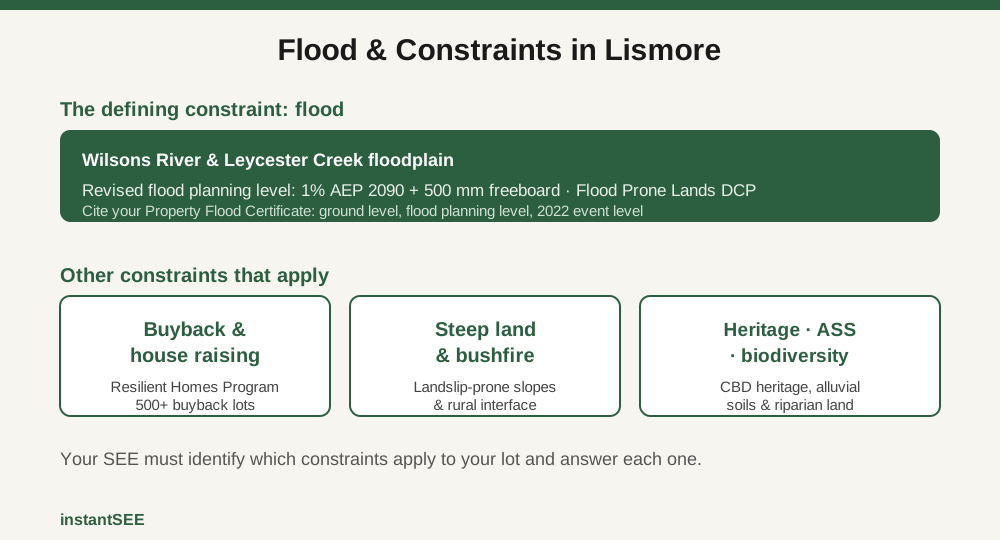
Figure 1: Flood dominates Lismore planning, but steep land, heritage and biodiversity also apply. Your SEE must identify which constraints touch your lot and answer each.
For any site that may be affected, the council issues a Property Flood Certificate setting out natural ground level, building flood level, the flood planning level, and the 2022 event level — the numbers your SEE and your design must respond to. The NSW Reconstruction Authority's Resilient Homes Program adds another layer on the ground: voluntary buybacks of the highest-risk lots, house raising to lift habitable floors, and retrofits to improve resilience. With more than 500 buyback blocks across the city and precinct planning underway for their future use, some flood-affected land now carries development expectations very different from a decade ago. Where your lot is flood-affected, cite the flood certificate figures and show how floor levels, materials, and evacuation are handled.
Common Zones, Overlays and DA Types in Lismore
Spend 5 minutes, not 3 weeks
instantSEE generates a complete, DA-ready Statement of Environmental Effects online. No town planner. No waiting.
Get your SEE report in 5 minutes →Beyond flood, Lismore DAs commonly touch steep-land, bushfire, acid sulfate soils, heritage and biodiversity controls — and the SEE's weight shifts with the project type.
Common zones under the Lismore LEP 2012 include R1 General Residential and R2 Low Density Residential in the urban areas, RU1 Primary Production and RU2 Rural Landscape across the farmland and villages, and business zones through the Lismore CBD and centres such as Goonellabah. Beyond flood, the constraints that most often shape a Lismore SEE are steep and landslip-prone land on the hilly urban fringes, bushfire prone land on rural and interface lots, acid sulfate soils on the low alluvial country, heritage items and conservation areas, and biodiversity and vegetation controls on riparian corridors and mapped habitat.
The weight of your SEE then shifts with the project type. For alterations and additions, it concentrates on height, setbacks, overshadowing, privacy, and flood levels where they apply. For a secondary dwelling, the focus is floor area, private open space, parking, flood planning, and — on the slopes — earthworks and slope stability. For a change of use in the CBD or a centre, it addresses hours, noise, parking, heritage, and flood resilience. A DA lodgement checklist for NSW helps you gather the right supporting documents for each.
How to Lodge a DA with Lismore City Council
You lodge every Lismore DA through the NSW Planning Portal — upload your plans, SEE, owner's consent and supporting reports, and pay the fee; the council registers it and notifies neighbours before assessment begins.
You lodge a Lismore City DA through the NSW Planning Portal at planningportal.nsw.gov.au, the system every NSW council uses. You upload your plans, owner's consent, supporting documents, and your SEE, then pay the fee. Our step-by-step guide to lodging a DA in NSW covers the portal mechanics.
Once lodged, the council registers your DA, notifies adjoining owners where required, and assesses it against section 4.15. Most straightforward residential DAs are decided by a council officer under delegated authority. More contentious or significant local applications go to the Lismore Local Planning Panel, and regionally significant development is determined by the Northern Regional Planning Panel. For a typical extension, granny flat or pool, expect a council officer to determine it.
Do You Need a Town Planner for a Lismore DA?
For a straightforward residential DA you can prepare the SEE yourself or use a service; you are more likely to want a planner where flooding, steep land, or a variation is in play.
Not always. For a straightforward residential DA in Lismore on land clear of flood and steep-slope constraints, such as a single-storey addition, a granny flat, or a pool, you can prepare the SEE yourself or use a service rather than engaging a town planner. You are more likely to want a planner where the project is genuinely complex: a flood-affected lot near the Wilsons River, a landslip-prone hillside site, a heritage-listed property, or one that seeks to vary a development standard. For the common residential cases, a well-structured SEE that addresses the Lismore LEP 2012 and DCP is what you need.
Frequently asked questions
Do I need a Statement of Environmental Effects for a Lismore DA?
How does flooding affect a Lismore development application?
Which LEP and DCP apply to a Lismore DA?
Who decides my Lismore DA?
Ready to get your SEE report?
Skip the writing. Get a DA-ready Statement of Environmental Effects in 5 minutes.
Get your SEE report