Key takeaways
- A dual occupancy DA needs a Statement of Environmental Effects in almost every case
- The SEE must address density, private open space and parking for both dwellings, and the streetscape
- If you plan to subdivide, the SEE addresses the subdivision and how each dwelling works as a separate lot
- Attached and detached dual occupancies raise different built-form and privacy issues
- Section 4.15 of the EP&A Act 1979 sets the matters every SEE must address
A dual occupancy — two dwellings on one lot, attached or detached — almost always needs a Statement of Environmental Effects, because it is almost always lodged as a Development Application. A duplex is a bigger intervention on a site than a single house or a granny flat, so the council looks harder at density, the amenity of both dwellings, parking, and how the building reads in the street. Your SEE is where you show all of that works.
Whether a dual occupancy is even permissible, and on what minimum lot size, depends on your zone and your council's Local Environmental Plan and Development Control Plan. Recent NSW housing reforms have made dual occupancies permissible in more low-density (R2) areas than before, but the specific controls — minimum lot width and area, floor space ratio, height, and setbacks — are set locally. Confirm them for your site before you design, because the SEE has to argue compliance against those exact figures.
Get a council-ready Statement of Environmental Effects for your DA in 5 minutes — no town planner, no waiting.
Get your SEE report →- Whether your dual occupancy needs a SEE
- What a dual occupancy SEE must cover
- How attached and detached duplexes differ
- What changes when you want to subdivide
Does a Dual Occupancy Need a SEE?
In almost every case a dual occupancy is a Development Application, and a DA requires a Statement of Environmental Effects by law.
Some dual occupancies can be approved as complying development where they meet every standard under the Housing SEPP and Codes SEPP, but many cannot — because of lot size, a corner or battle-axe configuration, a heritage or flood overlay, or a design that exceeds a standard. When the complying development pathway is not available, you lodge a DA, and the Environmental Planning and Assessment Regulation 2021 requires a SEE with it.
What a Dual Occupancy SEE Must Cover
The duplex SEE has to show two dwellings fit the site at the permitted density, each with adequate light, private open space and parking, without overwhelming the streetscape or the neighbours.
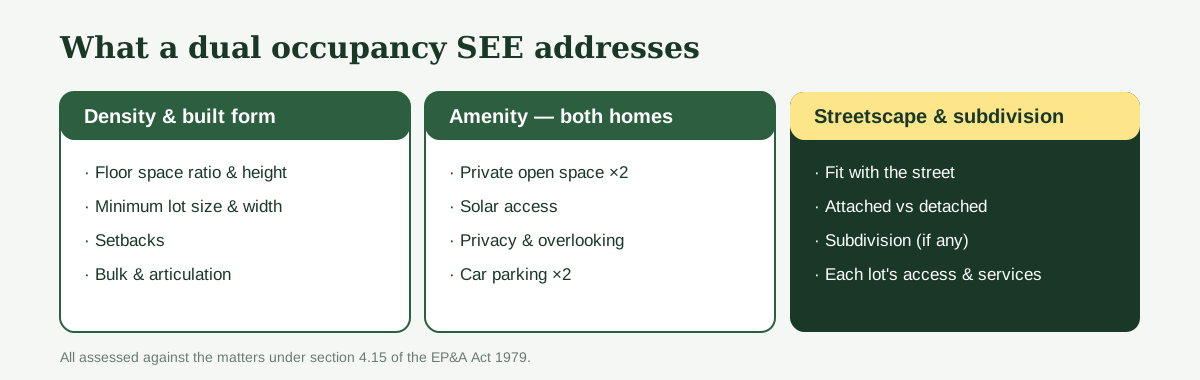
Your SEE assesses the proposal against the matters under section 4.15 of the EP&A Act 1979. For a dual occupancy the load-bearing controls are floor space ratio and height (the density), minimum lot size and width, setbacks, private open space for each dwelling, solar access, and car parking for both dwellings. The amenity assessment covers overshadowing and privacy between the two dwellings and to the neighbours, and the built-form assessment covers how the duplex sits in the streetscape — its bulk, articulation, and whether it reads as one over-scaled building or two homes.
Attached vs Detached, and the Subdivision Question
Spend 5 minutes, not 3 weeks
instantSEE generates a complete, DA-ready Statement of Environmental Effects online. No town planner. No waiting.
Get your SEE report in 5 minutes →Attached and detached duplexes raise different privacy and built-form issues, and if you intend to sell the two dwellings separately the SEE must also address subdivision.
An attached dual occupancy shares a wall and reads as one building, so the streetscape and party-wall acoustic and fire issues come forward; a detached dual occupancy puts two buildings on the lot, so site coverage, separation, and the amenity of the rear dwelling matter more. If you plan to subdivide — to sell each dwelling on its own title, whether Torrens or strata — the SEE addresses the subdivision as part of the proposal: how each lot meets the minimum size, has its own access, services, and private open space. Whether subdivision is permitted, and at what minimum lot size, is set by your LEP. Check your site on the NSW Planning Portal spatial viewer.
Who Should Prepare It
For a compliant dual occupancy on a straightforward lot you can prepare the SEE yourself. Because a duplex is a denser proposal with more controls in play, a non-compliance — say an FSR or height breach needing a Clause 4.6 variation — or a constrained site is where a town planner's judgment earns the fee.
The Bottom Line
A dual occupancy almost always needs a Statement of Environmental Effects, and that SEE has to do more work than a single-dwelling one: it argues the density is permissible, both dwellings have proper light, open space and parking, the building respects the street, and — if you are subdividing — that each future lot stands on its own. Confirm your zone's controls first, because the whole SEE is built around hitting those figures.
This guide is general information about the NSW planning system, not legal or planning advice for your specific site. Review every section of any SEE before submitting it to council.
Frequently asked questions
Do I need a SEE for a dual occupancy in NSW?
What does a duplex SEE need to address?
Can I subdivide a dual occupancy?
Is a dual occupancy allowed on my block?
Ready to get your SEE report?
Skip the writing. Get a DA-ready Statement of Environmental Effects in 5 minutes.
Get your SEE report