Key takeaways
- Three entry tests decide if the Biodiversity Offsets Scheme applies
- Clearing over 0.25 hectares of native vegetation triggers the scheme
- The Biodiversity Values Map can trigger the scheme independently
- A BDAR must be prepared by an accredited assessor
- Biodiversity findings must be addressed in your SEE
A biodiversity assessment is required for your NSW DA when your project triggers the Biodiversity Offsets Scheme under the Biodiversity Conservation Act 2016. Three entry tests determine whether the scheme applies, and meeting any one of them makes a Biodiversity Development Assessment Report mandatory. If none of the tests are met, your council can still require an ecological assessment — biodiversity rarely disappears from the DA entirely.
Many applicants discover the biodiversity requirement late, after the design is locked and the budget is set. A clearing area that looks modest on a plan can cross a threshold that pulls the whole project into the Offsets Scheme, adding months and real cost to the approval pathway. Understanding which test applies — and when — is the most useful thing you can do before the first shovel goes in the ground.
This guide sets out the three Offsets Scheme entry tests, the clearing area thresholds that trigger them, what a Biodiversity Development Assessment Report involves, what happens when you stay under the threshold, and how all of it connects to your Statement of Environmental Effects.
Get a council-ready Statement of Environmental Effects for your DA in 5 minutes — no town planner, no waiting.
Get your SEE report →- When the three Biodiversity Offsets Scheme entry tests apply to your DA
- The native vegetation clearing thresholds that trigger the scheme
- What a Biodiversity Development Assessment Report involves
- What happens when your DA stays under the threshold
- How biodiversity assessment fits into your DA and SEE
When Does a NSW DA Need a Biodiversity Assessment?
A biodiversity assessment becomes mandatory when your DA meets one of three entry tests for the Biodiversity Offsets Scheme — clear native vegetation above a threshold, land on the Biodiversity Values Map, or likely significant effect on a threatened species.
The Biodiversity Offsets Scheme is the regulatory mechanism that applies when a development proposal is likely to have a significant impact on biodiversity. It operates under the Biodiversity Conservation Act 2016 and is linked to the development assessment process through the Environmental Planning and Assessment Act 1979. When the scheme applies, a standard ecological assessment is not enough — the DA must be accompanied by a Biodiversity Development Assessment Report prepared by an accredited assessor using the Biodiversity Assessment Method.
Three separate entry tests determine whether the scheme is triggered. They are not a hierarchy — you do not need to fail the first to reach the second. Any single test, if met, pulls your DA into the scheme.
The first test is area-based. If your development proposes to clear native vegetation above the threshold area for your lot's minimum lot size, the scheme is triggered. The thresholds are set in Schedule 2 of the Biodiversity Conservation Regulation 2017 and vary by the minimum lot size applicable to the land under the relevant local environmental plan.
The second test is map-based. If any part of the land subject to your development falls on the Biodiversity Values Map — a statewide spatial dataset maintained by the NSW Department of Planning and Environment — then any clearing of native vegetation triggers the scheme. There is no minimum area. Even a small amount of clearing on mapped land brings the development into the Offsets Scheme.
The third test is significance-based. Even if the clearing area is under the threshold and the land is not on the Biodiversity Values Map, the scheme is triggered if the development is likely to significantly affect a threatened species, population or ecological community, or their habitats. This is assessed using the test of significance under section 7.3 of the Biodiversity Conservation Act 2016.
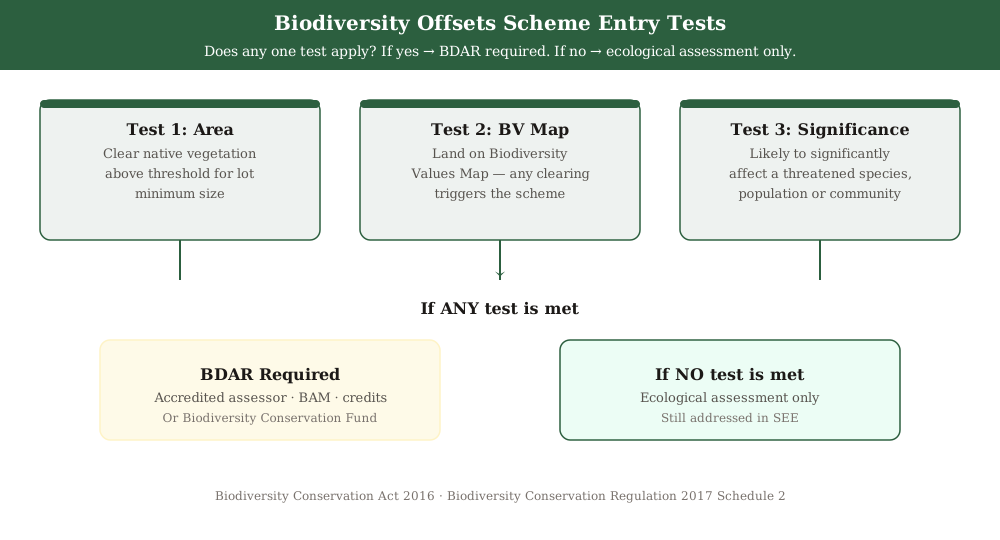
Figure 1: The three entry tests. Meeting any one sends your DA into the Offsets Scheme.
The practical implication is that you need to check all three tests independently. A development on a large rural lot might clear only a small area and sit below the area threshold, but still trigger the scheme if that area contains habitat for a listed threatened species. Similarly, a suburban block might not appear on the Biodiversity Values Map, but the proposed clearing could push past the 0.25-hectare threshold for a small lot.
The Native Vegetation Clearing Thresholds That Trigger the Scheme
The clearing thresholds are tied to your lot's minimum lot size, set in Schedule 2 of the Biodiversity Conservation Regulation 2017 — for most suburban houses, clearing just 0.25 hectares of native vegetation triggers the scheme.
The area thresholds in Schedule 2 are tied to the minimum lot size applicable to the land under the local environmental plan — not the actual size of the lot being developed. This distinction matters. A lot that is currently 2,000 square metres but has a minimum lot size of 600 square metres in the LEP will fall into the "less than 1 hectare" row of the schedule, meaning the clearing threshold is 0.25 hectares.
The four thresholds under Schedule 2 of the Biodiversity Conservation Regulation 2017 are:
- Lots with a minimum lot size of less than 1 hectare: 0.25 ha (2,500 sqm)
- Lots with a minimum lot size of 1 ha to less than 40 ha: 0.5 ha
- Lots with a minimum lot size of 40 ha to less than 1,000 ha: 1 ha
- Lots with a minimum lot size of 1,000 ha or more: 2 ha
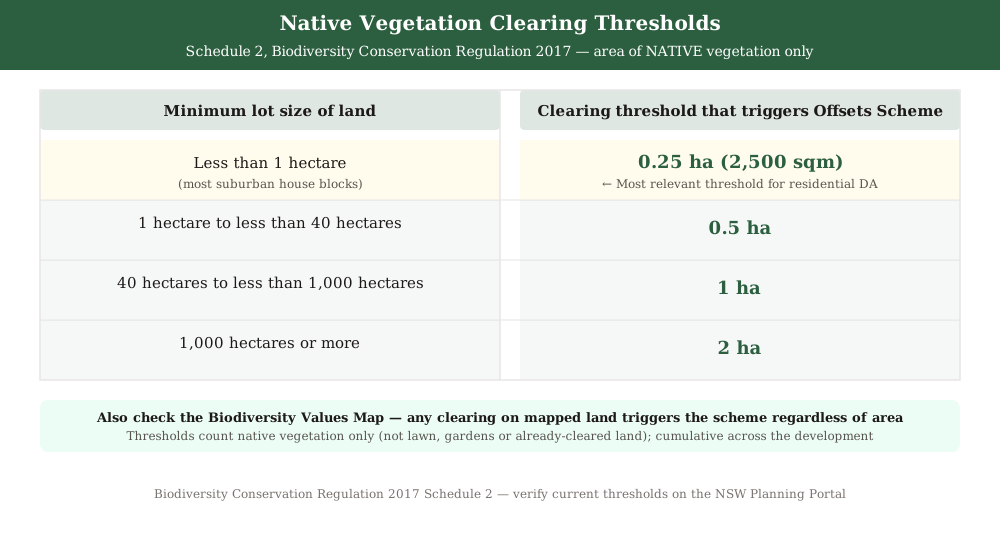
Figure 2: The four clearing thresholds. Most suburban blocks fall in the first row.
For most residential DAs in Sydney, Newcastle or Wollongong, the relevant threshold is 0.25 hectares. That is 2,500 square metres — about a quarter of a typical suburban block. If the proposed works require clearing more than that area of native vegetation, the Biodiversity Offsets Scheme is triggered regardless of whether a threatened species is present.
- Check the Biodiversity Values Map for your land on the NSW Planning Portal
- Find your lot's minimum lot size from your council's LEP
- Calculate the area of native vegetation you propose to clear
- Compare against the Schedule 2 threshold for your lot size
- Engage an accredited assessor early if the scheme may be triggered
The area counted is native vegetation only. Established lawn, ornamental garden beds, pavement and already-cleared areas do not count toward the threshold. The area is also cumulative across the development — you cannot split a project into stages to stay under the limit.
What a Biodiversity Development Assessment Report Involves
Spend 5 minutes, not 3 weeks
instantSEE generates a complete, DA-ready Statement of Environmental Effects online. No town planner. No waiting.
Get your SEE report in 5 minutes →A BDAR must be prepared by an accredited assessor using the Biodiversity Assessment Method set under the BC Act 2016 — you cannot write one yourself, and this is specialist work that adds real cost and time to a DA.
A Biodiversity Development Assessment Report is a technical document that quantifies the biodiversity impact of a development and identifies the offset required to compensate for it. It cannot be prepared by the applicant, the architect or the town planner. It must be prepared by an assessor accredited under the Biodiversity Conservation Act 2016, and the assessment must follow the Biodiversity Assessment Method — a standardised methodology set by the NSW Biodiversity Conservation Trust.
The process follows a hierarchy of avoid, minimise, then offset. The assessor will first consider whether the design can be modified to avoid impacts on native vegetation entirely, or to reduce the area cleared. The residual impact — what cannot be avoided or minimised — is then quantified in biodiversity credits specific to the species and vegetation communities affected.
Those credits must be retired. There are two ways to do it. The applicant can purchase biodiversity credits on the market from a landholder who has generated them under a biodiversity stewardship agreement, or they can make a payment into the Biodiversity Conservation Fund, from which the NSW Biodiversity Conservation Trust acquires credits on their behalf. Both pathways must be secured as a condition of development consent — you cannot lodge the BDAR and deal with the offset later.
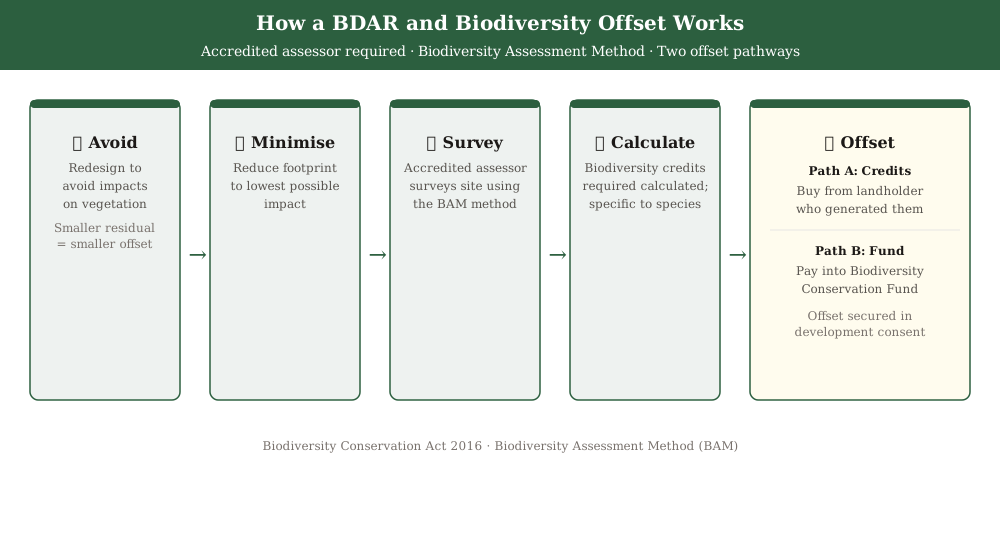
Figure 3: A BDAR follows avoid, minimise, then offset. The residual impact is offset with credits or a fund payment.
The time and cost implications are real. Accredited assessors are in demand. Field surveys must be conducted at appropriate times of year to detect species that may be seasonally active or cryptic. The Biodiversity Assessment Method requires specific survey effort standards, which means assessors cannot simply inspect a site and write a report — the surveys themselves take time. For a project where the Offsets Scheme is triggered, you should expect the biodiversity assessment to add several months to the DA programme, and potentially tens of thousands of dollars to the project cost depending on the type and extent of vegetation involved.
What If Your DA Does Not Trigger the Offsets Scheme?
Staying under the Offsets Scheme threshold does not mean biodiversity disappears from your DA — your council must still consider the impact on plants and animals, and will usually ask for an ecological assessment prepared by a qualified ecologist.
If none of the three entry tests are met, your development does not enter the Biodiversity Offsets Scheme. You do not need a BDAR. But that does not mean ecology is off the table.
Under section 4.15 of the Environmental Planning and Assessment Act 1979, a consent authority must consider the likely impacts of a development on the natural environment, including its flora and fauna. In practice, councils will ask for an ecological assessment — sometimes called a flora and fauna assessment or a preliminary ecological assessment — even for smaller developments that appear to sit comfortably under the Offsets Scheme thresholds.
That ecological assessment is prepared by a qualified ecologist (not necessarily an accredited assessor under the BC Act). It will typically identify the native vegetation and any threatened species or habitat present on the site, assess the likely impact of the proposed works, and apply the test of significance under section 7.3 of the Biodiversity Conservation Act 2016 to confirm whether the Offsets Scheme is triggered.
The five-part test of significance considers:
- Whether the development is likely to affect the life cycle of a threatened species, population or ecological community
- Whether the development is likely to affect an area of outstanding biodiversity value
- The extent of the habitat removed, modified or fragmented
- Whether the development is likely to disrupt the reproduction or other life cycle processes of a threatened species or population
- Whether the development is likely to cause invasive species to spread into new areas or cause fragmentation that isolates populations
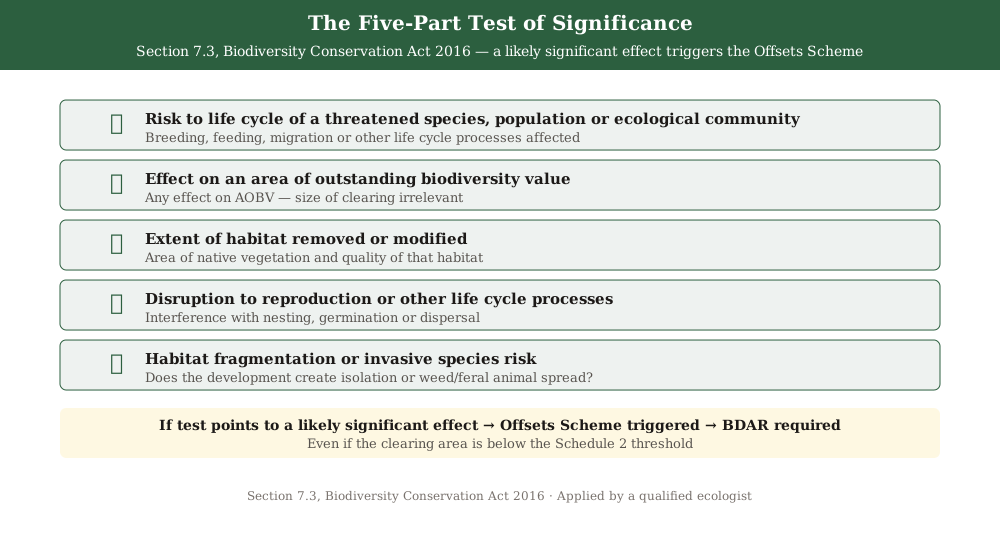
Figure 4: The five-part test. A likely significant effect pulls the DA back into the Offsets Scheme.
If the test of significance concludes that the development is likely to have a significant effect, the Offsets Scheme is triggered — even if the clearing area was below the Schedule 2 threshold. This is the pathway by which a development that looked like it would avoid the Offsets Scheme can end up back inside it. The test is applied by the ecologist, but the consent authority makes the final determination.
How a Biodiversity Assessment Fits Your DA and SEE
Whether your project needs a full BDAR or just a short ecological assessment, the findings have to be drawn together in your Statement of Environmental Effects — the document that explains why your development is acceptable.
The Statement of Environmental Effects is the core explanatory document for a DA. It addresses every aspect of potential environmental impact — including biodiversity. If your development requires a BDAR, the BDAR is lodged as a separate supporting document, and the SEE summarises its findings, confirms that the Offsets Scheme has been triggered, and explains how the offset obligation will be met. If your development requires only an ecological assessment, the SEE incorporates or annexes that assessment and addresses the test of significance findings.
Consent authorities assess biodiversity impact as part of their broader evaluation of the DA under section 4.15 of the EP&A Act. A SEE that does not adequately address biodiversity — or that mischaracterises whether the Offsets Scheme is triggered — creates a gap that can lead to an information request, a deferral or a refusal.
For a well-prepared DA, the sequence is: engage an ecologist early, check the Biodiversity Values Map and the LEP minimum lot size, calculate the clearing area, determine which pathway applies, commission the appropriate report, and make sure the SEE reflects the findings accurately. The DA lodgement checklist and the DA supporting documents guides set out what else needs to be lodged alongside the biodiversity material. The SEE requirements guide explains how to structure the SEE and what it must address.
How you lodge a DA in NSW also affects the biodiversity component — the NSW Planning Portal requires specific document types to be uploaded in the correct categories, and a BDAR or ecological assessment must be attached in the supporting documents section.
Frequently asked questions
Do I always need a biodiversity assessment for a NSW DA?
Can I prepare a BDAR myself?
What is the Biodiversity Values Map and where do I find it?
What is the difference between a BDAR and an ecological assessment?
How long does a biodiversity assessment take?
Ready to get your SEE report?
Skip the writing. Get a DA-ready Statement of Environmental Effects in 5 minutes.
Get your SEE report