Key takeaways
- A granny flat (secondary dwelling) needs a SEE only when it goes through a Development Application, not complying development
- The Housing SEPP 2021 caps a secondary dwelling at 60 m² of floor area in most cases
- A granny flat SEE focuses on floor area, setbacks, private open space, parking and neighbour amenity
- If your proposal does not meet the complying development standards, the DA route and a SEE are how you proceed
- Section 4.15 of the EP&A Act 1979 sets the matters every SEE must address
You need a Statement of Environmental Effects for a granny flat in NSW when you lodge it as a Development Application — not when it is approved as complying development. That single fork decides everything: a granny flat (in planning terms, a secondary dwelling) can be approved two ways, and only one of them involves a SEE. Knowing which path your proposal takes is the first thing to settle.
A granny flat is a self-contained second home on the same lot as the main dwelling. Under the State Environmental Planning Policy (Housing) 2021, a secondary dwelling is generally capped at 60 m² of floor area (excluding some ancillary areas, unless your council's LEP allows more). If your proposal meets all the complying development standards, it can be approved by a certifier as a Complying Development Certificate with no DA and no SEE. If it does not — because of the site, a heritage or flood overlay, or a design choice that breaks a standard — you lodge a DA, and that DA needs a SEE.
Get a council-ready Statement of Environmental Effects for your DA in 5 minutes — no town planner, no waiting.
Get your SEE report →- When a granny flat needs a SEE and when it does not
- What a granny flat SEE must cover
- The site constraints that push a granny flat onto the DA route
- How to lodge a granny flat DA in NSW
When a Granny Flat Needs a SEE
A secondary dwelling that meets every complying development standard can be approved without a DA or a SEE; the moment it fails one of those standards, or sits on constrained land, the DA route applies and a SEE is required.
The complying development pathway under the Codes SEPP and the Housing SEPP is fast, but it is all-or-nothing: miss a single standard and you cannot use it. Common reasons a granny flat falls to the DA route include a lot that is below the minimum size, insufficient setbacks, a battle-axe or irregular block, or land affected by heritage, flood, or bushfire mapping. When that happens, you lodge a Development Application, and the law requires a SEE with it.
What a Granny Flat SEE Must Cover
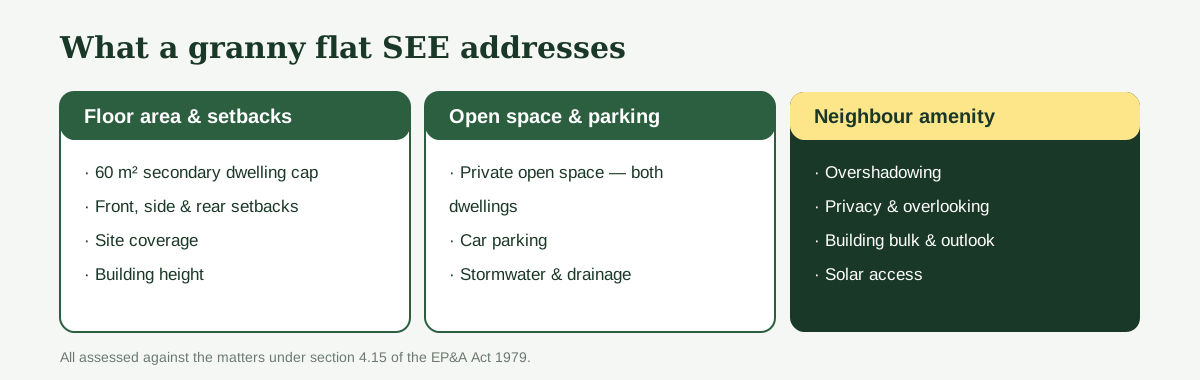
A granny flat SEE shows the secondary dwelling complies with the floor-area, setback, parking and private-open-space controls, and that it does not unreasonably affect the neighbours' light, privacy, or amenity.
Your SEE assesses the proposal against the matters a council must weigh under section 4.15 of the Environmental Planning and Assessment Act 1979. For a granny flat, the controls that do the work are the secondary-dwelling floor area, the setbacks from each boundary, private open space for both dwellings, car parking, and stormwater. The amenity questions — overshadowing of a neighbour's yard or windows, overlooking and privacy, and the bulk of the structure as seen from adjoining properties — are usually where a council focuses.
Site Constraints That Push You to a DA
Spend 5 minutes, not 3 weeks
instantSEE generates a complete, DA-ready Statement of Environmental Effects online. No town planner. No waiting.
Get your SEE report in 5 minutes →The features that disqualify the complying development pathway are the same ones your SEE then has to address head-on.
If your site is heritage-listed or in a conservation area, flood-affected, bushfire-prone, or below the minimum lot size for a secondary dwelling, the complying development route is usually closed and the DA route applies. In each case the SEE has extra work to do: a heritage item needs a heritage impact assessment, a flood-affected lot is assessed against the council's flood controls, and bushfire-prone land is assessed against Planning for Bush Fire Protection. Check your site on the NSW Planning Portal spatial viewer before you decide which path to take.
How to Lodge a Granny Flat DA
Granny flat DAs are lodged online through the NSW Planning Portal with your plans, owner's consent, supporting documents, and your SEE.
You lodge through the NSW Planning Portal: upload your site and floor plans, elevations, owner's consent, any specialist reports, and your Statement of Environmental Effects, then pay the lodgement fee. The council registers the application, notifies adjoining owners where required, and assesses it under section 4.15. For a standard, compliant secondary dwelling on unconstrained land, you can prepare the SEE yourself; for a heritage, flood, or bushfire-affected site, consider a town planner.
The Bottom Line
A granny flat needs a Statement of Environmental Effects only on the DA route, which is the path you take when complying development is not available. If that is you, the SEE's job is to show the secondary dwelling meets the floor-area, setback, parking and open-space controls and treats the neighbours fairly on light and privacy. Confirm your site's overlays first, because they decide both which path you are on and what your SEE has to address.
This guide is general information about the NSW planning system, not legal or planning advice for your specific site. Review every section of any SEE before submitting it to council.
Frequently asked questions
Do I need a SEE for a granny flat in NSW?
How big can a granny flat be in NSW?
What does a granny flat SEE focus on?
Can I avoid a DA for my granny flat?
Ready to get your SEE report?
Skip the writing. Get a DA-ready Statement of Environmental Effects in 5 minutes.
Get your SEE report